

Key Takeaways
- A home plumbing system has two distinct sides: supply (water in) and drain-waste-vent (water out).
- The main shutoff valve is the single most important control every homeowner should be able to locate quickly.
- Vent pipes prevent dangerous sewer gases from entering the home and keep drains flowing freely.
- Most visible plumbing problems - slow drains, low pressure, gurgling - trace back to specific, diagnosable causes.
- Knowing your system's layout helps you communicate clearly with a licensed plumber and catch problems early.
Start here
How Water Enters Your Home
Next
The Supply System: Hot and Cold Distribution
Then
The Drain-Waste-Vent System
Key controls
Fixtures, Shutoffs, and Valves
Apply it
Common Problem Signs and What They Indicate
How Water Enters Your Home
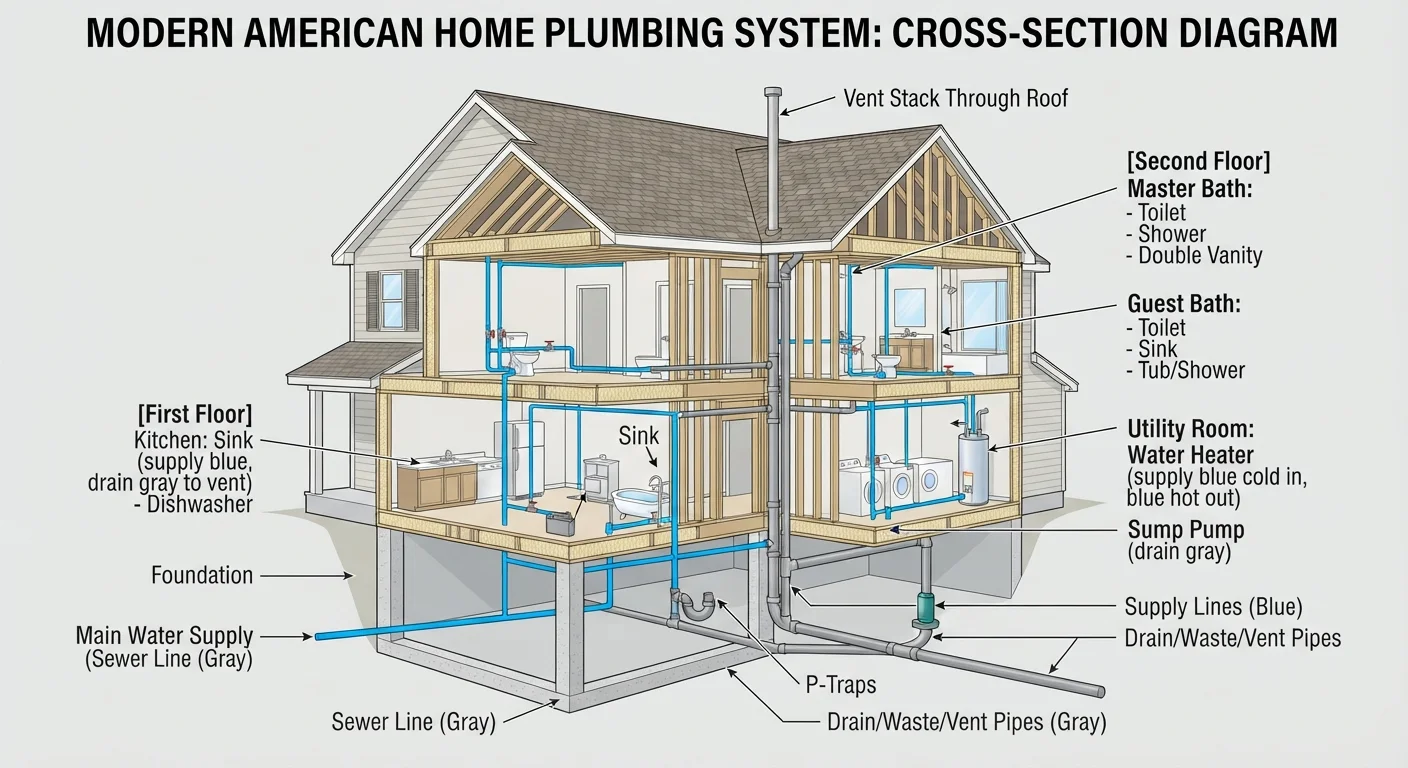
Water arrives at your home through a service line - a pressurized pipe that runs underground from the municipal main (or, in rural areas, a private well) to your foundation. That line connects to your home's internal plumbing at the main shutoff valve, typically located where the pipe crosses the foundation wall.
Just before or after that connection sits your water meter, which records total consumption. Learning to read your water meter is one of the most practical skills a homeowner can develop - it can reveal hidden leaks before they cause serious damage.
Water pressure in most municipal systems ranges from 40 to 80 psi (pounds per square inch). If pressure at your home exceeds 80 psi, a pressure-reducing valve (PRV) is typically installed on the service line to protect your fixtures and appliances from strain.
Service line
The underground pipe that carries pressurized water from the municipal main (or private well) into your home.
Main shutoff valve
A single valve that stops all water flow into the home when closed - the first thing to find in any plumbing emergency.
Drain-Waste-Vent (DWV)
The gravity-fed side of your plumbing that carries wastewater away and vents sewer gases safely out through the roof.
P-trap
A curved pipe section beneath a drain that holds a small water seal, preventing sewer gases from entering the home.
Pressure-reducing valve (PRV)
A device installed on the service line that limits incoming water pressure to a safe range for household fixtures and appliances.
Fixture shutoff valve
A small valve located near an individual fixture (sink, toilet) that lets you cut water to that fixture without affecting the rest of the house.
The Supply System: Hot and Cold Distribution
From the main shutoff, cold water branches out through your home via a network of supply pipes - historically copper or galvanized steel, and increasingly cross-linked polyethylene (PEX) in newer and remodeled homes. One branch feeds cold water directly to every fixture; another routes to the water heater, where it's heated before being distributed through a parallel hot-water line.
Supply pipes run under pressure, which is why a failure in this side of the system - a burst pipe or failed fitting - can release water rapidly. Individual fixture shutoff valves (also called stop valves or angle stops) sit beneath sinks and behind toilets, letting you isolate one fixture without shutting off the entire house.
Label Your Shutoff Valves Now
Take 15 minutes to locate and label every shutoff valve in your home - main, fixture-level, water heater, and hose bibbs. A small adhesive label or tag saves critical time during a leak. Include the location in any home documentation you keep for future owners or contractors.
The Drain-Waste-Vent System
Unlike the pressurized supply side, the drain-waste-vent (DWV) system moves water by gravity. Every drain in your home slopes downward toward larger collection pipes that ultimately connect to the main sewer line - which exits through the foundation toward either a municipal sewer or a private septic system. Understanding the difference between your interior drain lines and the exterior sewer line matters because responsibility and repair costs differ significantly between the two.
Equally important are the vent pipes - often overlooked because they're hidden inside walls and exit through the roof. Vents serve two functions: they allow air into the drain system so water flows freely (without air, suction would slow or stop drainage), and they route sewer gases safely out of the home rather than letting them accumulate indoors. Each fixture also has a P-trap, the curved pipe section that holds a water seal to block those gases at the point of use.
Fixtures, Shutoffs, and Valves
Fixtures - sinks, toilets, showers, tubs, dishwashers, and washing machines - are the endpoints where supply and drain systems meet. Each fixture draws pressurized water from the supply side and releases wastewater into the DWV side.
Beyond the main shutoff and individual fixture stops, most homes include additional isolation valves at the water heater and at any outdoor hose bibbs (spigots). Knowing the location of all these valves is essential for responding quickly to a leak or burst pipe. Small plumbing decisions made during construction or renovation - like skipping a shutoff valve in a hard-to-reach location - can create significant problems later, a pattern explored in detail in common overlooked plumbing decisions.
Many homeowners benefit from creating a simple sketch of their home's shutoff locations and pipe routing, especially after any renovation work that moves or adds plumbing.
Electrical Work Near Plumbing Requires Extra Caution
Water and electricity in close proximity - under sinks, near water heaters, in utility rooms - create serious shock and fire hazards. Never attempt electrical work in wet or damp areas without shutting off the appropriate circuit breaker and, ideally, consulting a licensed electrician. Similarly, any plumbing work near gas lines should be handled only by a licensed professional.
Common Problem Signs and What They Indicate
Understanding your plumbing's anatomy makes it much easier to interpret warning signs:
- Low water pressure at one fixture - usually a clogged aerator, a partially closed stop valve, or a failing fixture-specific cartridge.
- Low pressure throughout the house - may signal a failing PRV, a partially closed main valve, or a corroded supply pipe.
- Slow drains - most often a partial clog in the trap or drain line; if multiple fixtures slow simultaneously, the blockage is likely deeper in the main drain.
- Gurgling drains - typically a blocked or inadequate vent pipe disrupting air pressure balance.
- Water hammer (banging pipes) - caused by pressure surges when fast-closing valves abruptly stop flow; water hammer arrestors can absorb the shock.
Pairing this knowledge with a seasonal checkup routine - covering your plumbing alongside HVAC and electrical systems - helps catch deterioration before it becomes an emergency. A seasonal home systems walkthrough provides a practical framework for doing exactly that.
This article provides general educational information about residential plumbing systems. It is not a substitute for advice from a licensed plumber. Always consult a qualified professional for diagnosis, repair, or any work requiring permits in your jurisdiction.