

Key Takeaways
- Drain lines carry wastewater inside your home; the sewer line carries it from your home to the municipal system.
- Homeowners are typically responsible for the sewer lateral - the underground pipe from the house to the street.
- A slow single drain usually signals a localized clog; multiple slow drains or sewage odors point to a sewer line issue.
- Sewer line repairs can cost several thousand dollars, making early detection critical.
- Tree roots, age, and ground shifting are leading causes of sewer lateral failure.
- Reviewing your homeowner's insurance and local utility policies can clarify what repair costs may be covered.
Sewer Line vs. Drain Line
A drain line is any pipe inside your home that carries wastewater away from a sink, toilet, shower, or appliance. A sewer line is the single underground pipe that collects all of that wastewater and transports it from your home to the municipal sewer system or a septic tank. Though they work together, they are separate systems with different owners, different failure modes, and very different repair costs.
Drain lines are part of the drain-waste-vent (DWV) system and are typically made of PVC, ABS, or cast iron. The main sewer lateral - the pipe running from your house to the street - is generally the homeowner's financial responsibility up to the municipal connection point.
Two Systems, One Purpose - But Very Different Implications
Most homeowners think of their plumbing as one unified system - water comes in, waste goes out. In reality, the wastewater side of your home is divided into two distinct layers, and confusing them can lead to misdiagnosed problems, unnecessary repairs, or an unexpected bill for work that should have been caught sooner.
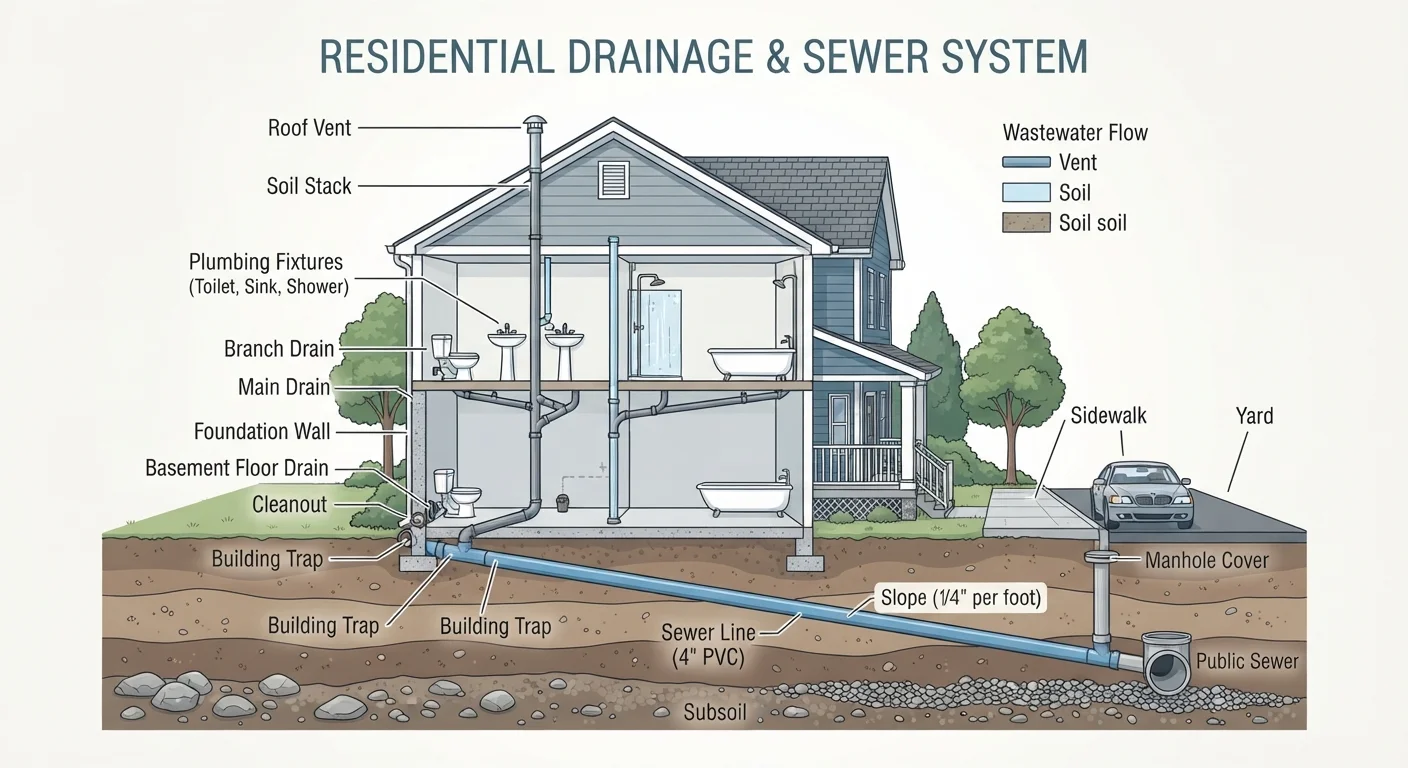
To understand how these systems relate, it helps to trace the full path wastewater takes from a fixture to the street. Every sink, toilet, bathtub, and appliance connects to an interior drain line. Those individual lines converge into larger branch pipes, then into a single main stack - and that stack exits the foundation and becomes the sewer lateral running underground to the municipal connection. The dividing line between drain system and sewer system is roughly where the pipe leaves your home's footprint.
$3,000-$6,000+
Typical sewer lateral replacement cost
According to plumbing industry cost data, full sewer lateral replacement commonly falls in this range, varying by pipe length, depth, and local labor rates.
~50%
Sewer laterals in need of repair or replacement
The Water Research Foundation has estimated that roughly half of the residential sewer laterals in older U.S. cities show significant deterioration requiring attention.
Pre-1980
Homes most at risk for lateral failure
Homes built before 1980 are more likely to have clay tile or Orangeburg sewer laterals, both of which are known to degrade significantly over time.
What Drain Lines Cover - and What Can Go Wrong
Interior drain lines are entirely within your home and are your responsibility to maintain. They are designed to move wastewater by gravity through a network of sloped pipes, supplemented by a vent system that allows air in to prevent siphoning and keeps sewer gases from entering living spaces.
Common drain line problems include:
- Localized clogs - grease buildup in kitchen lines, hair and soap scum in bathroom drains, or foreign objects flushed accidentally.
- Leaking joints - especially in older homes with deteriorating gaskets or corroded cast iron pipe sections.
- Improper slope - a pipe installed at the wrong angle allows solids to settle and accumulate over time.
The upside: most drain line repairs are confined to accessible areas - under sinks, inside walls, or in the basement - and tend to be less costly than sewer lateral work. Small plumbing decisions, like mismatched pipe materials, can compound these issues significantly over time.
Know Where Your Cleanout Is
Most homes have a sewer cleanout - a capped pipe at ground level that provides direct access to the main drain line. Locating it before a problem occurs saves time and money when a plumber needs to snake or inspect the line. It is typically found near the foundation, in the basement, or in the yard along the lateral's path.
The Sewer Lateral: Your Underground Responsibility
The sewer lateral is the underground pipe that runs from your home's main stack to the public sewer main, usually located beneath the street. In the vast majority of U.S. jurisdictions, the homeowner owns and is responsible for this pipe in its entirety - right up to the point it joins the municipal main.
Sewer lateral failures are often invisible until they become serious. Warning signs include:
- Multiple fixtures draining slowly or backing up simultaneously
- Sewage odors inside or outside the home
- Unusually lush or sunken patches of lawn above the pipe's path
- Gurgling sounds from toilets when other fixtures are used
The most common causes of sewer lateral damage are tree root intrusion, pipe age (clay and Orangeburg pipes from pre-1980 construction are particularly prone to failure), and soil movement. A professional camera inspection is the only reliable way to assess the condition of a buried lateral.
Repair costs vary widely based on pipe depth, length, and local labor rates, but full lateral replacement often runs several thousand dollars - making early detection worthwhile. If you suspect a hidden issue, monitoring your water meter can help surface abnormalities before they escalate.
Ownership, Coverage, and When to Call a Professional
Understanding who owns what matters enormously when a problem arises. Interior drain lines are unambiguously the homeowner's responsibility. The sewer lateral is almost always the homeowner's responsibility too, though some municipalities have begun offering maintenance programs or cost-sharing arrangements - worth checking with your local utility.
Standard homeowner's insurance policies typically exclude gradual sewer lateral deterioration, though service line endorsements are sometimes available as add-ons. Reviewing coverage before a failure occurs is far better than discovering a gap after the fact. This is similar to the logic behind understanding what a home inspection covers versus what an appraisal evaluates - both matter, and confusing them costs money.
For any symptom involving multiple slow drains, sewage odors, or unexplained wet patches in the yard, contact a licensed plumber promptly. Attempting to snake or pressure-flush a compromised lateral without professional assessment can worsen a partial failure into a complete collapse. When in doubt, a camera inspection provides a clear picture and a defensible starting point for any repair decision.
“The sewer lateral is often the most neglected pipe in residential plumbing - homeowners don't see it, so they don't think about it until it fails completely. A proactive camera inspection every decade or so in an older home is one of the highest-value diagnostic steps a homeowner can take.”
— Licensed Master Plumber, Plumbing industry educator and trade publication contributor