

Key Takeaways
- Forced air systems distribute heat by moving warm air through ducts; radiant systems heat surfaces and objects directly.
- Forced air warms rooms faster but can circulate dust, allergens, and uneven temperature pockets.
- Radiant heat delivers consistent, quiet warmth but typically costs more to install, especially as a retrofit.
- Forced air systems can share ductwork with central air conditioning; radiant heat cannot.
- Both system types vary widely in efficiency depending on fuel source, installation quality, and home insulation.
- Radiant systems require a separate cooling solution, while forced air handles both heating and cooling.
Option A
Forced Air Heating
The widespread, versatile standard for American homes.
Best for: Homeowners who want integrated heating and cooling from a single duct system and faster temperature response.
Option B
Radiant Heat
The quiet, even-warmth alternative without ductwork.
Best for: Homeowners prioritizing consistent comfort, allergy-friendliness, or building new construction with heated floors.
If you want one system to handle both heating and cooling
Forced Air Heating
Forced air uses the same ductwork for heating and central air conditioning, making it the only practical dual-function choice.
If you or family members have respiratory allergies or asthma
Radiant Heat
Radiant systems don't move air, so they don't circulate dust, pet dander, or airborne allergens the way forced air systems can.
If you're building new construction and want long-term comfort
Radiant Heat
Installing radiant tubing or cables during construction is far less disruptive and costly than retrofitting an existing home, making new builds the ideal opportunity.
If you need to replace an existing heating system on a budget
Forced Air Heating
In homes with existing ductwork, upgrading a forced-air furnace is typically less expensive than installing a radiant system from scratch.
If consistent room-to-room temperatures and quiet operation are priorities
Radiant Heat
Radiant systems heat objects and occupants evenly without the cycling noise of a blower fan or the temperature swings common in ducted systems.
How Each System Actually Works
Understanding the fundamental difference between these two heating approaches helps explain nearly every trade-off that follows. The distinction comes down to the medium each system uses to deliver warmth.
Forced air systems - the most common type in American homes - use a furnace to heat air, then push that warmed air through a network of ducts and into rooms via vents or registers. The furnace cycles on and off in response to a thermostat, and a blower fan moves air throughout the system. Because forced air shares infrastructure with central air conditioning, the same ducts that deliver warm air in winter can circulate cooled air in summer. For more on how that cooling side operates, see our explainer on central air conditioning.
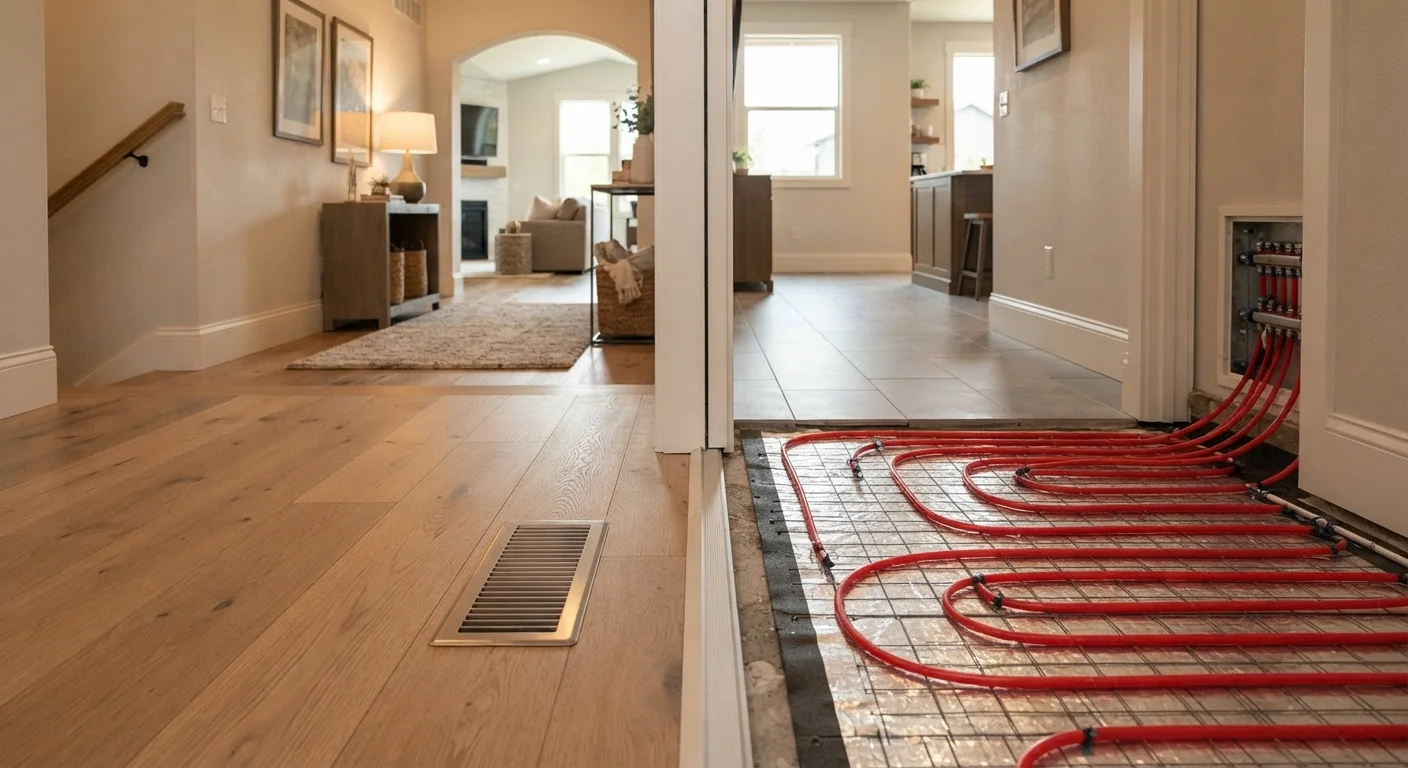
Radiant heating systems work on an entirely different principle. Rather than heating air, they heat surfaces - floors, walls, or ceiling panels - which then radiate warmth outward to objects and people in the room. The two main types are hydronic (hot water circulated through tubing beneath flooring) and electric (resistance cables or mats embedded under flooring or in walls). There is no ductwork and no blower fan involved.
| Criterion | Forced Air | Radiant Heat |
|---|---|---|
| Heat delivery method | Warms air via furnace, distributes through ducts | Heats surfaces; warmth radiates outward |
| Speed of warmth | Fast - rooms heat quickly | Slower - best for consistent use |
| Temperature evenness | Can create hot/cold zones | Consistent floor-to-ceiling warmth |
| Air quality impact | Can circulate dust and allergens | No air movement; better for allergies |
| Noise level | Blower fan produces noticeable cycling sound | Silent operation |
| Cooling compatibility | Shares ductwork with central A/C | Requires a separate cooling system |
| Retrofit difficulty | Easy if ducts exist; invasive without | Disruptive and costly in existing homes |
| Best installation scenario | Homes with existing ductwork | New construction |
Comfort, Air Quality, and Noise
Day-to-day living experience differs noticeably between the two systems. Forced air heats a room relatively quickly - useful when temperatures drop fast - but the delivery method introduces a few trade-offs. Warm air rises, creating temperature gradients where ceilings are warmer than floor level. Ductwork can harbor dust and mold if not maintained, and the blower fan produces audible cycling noise. Homeowners with allergies should pay particular attention here: forced air can redistribute allergens unless high-quality air filters and regular duct maintenance are part of the routine. Our article on whole-house ventilation explores how tightly built homes manage indoor air quality alongside heating systems.
Radiant heat, by contrast, produces a notably even warmth. Because heat rises from the floor upward, rooms tend to feel comfortable from the ground up - particularly pleasant underfoot in cold climates. There's no fan noise, no air movement, and no duct system to maintain. Allergy sufferers often find radiant heat more comfortable for precisely this reason. The main limitation: radiant systems respond more slowly to thermostat changes, meaning they suit steady, consistent use better than rapid temperature adjustment.
~90%
U.S. homes using forced air heating
The U.S. Energy Information Administration estimates that forced-air furnaces are the dominant heating system type in American residences.
2-3°F
Typical floor-to-ceiling temp difference with radiant heat
Compared to larger gradients common in forced air systems, radiant heat typically produces a much smaller temperature difference between floor and ceiling level.
Installation, Cost, and Practical Considerations
Cost and installation complexity are where the two systems diverge most sharply for homeowners weighing a switch or upgrade.
Forced air systems are relatively straightforward to replace in homes that already have ductwork - a significant advantage given how prevalent ducted homes are across the U.S. Installing new ductwork in a home that lacks it, however, is an invasive and expensive project. The quality and condition of existing ducts also matter: leaky ducts reduce system efficiency considerably, regardless of how efficient the furnace itself is. Good insulation throughout the home supports either system - see our overview of common insulation misconceptions for context on why this matters.
Radiant systems are most cost-effective when installed during new construction, when tubing or cables can be embedded before flooring goes down. Retrofitting radiant heat into an existing home typically means removing and replacing flooring, adding ceiling height, or accepting higher-profile panel solutions - all of which increase cost and disruption. Hydronic systems also require a boiler or water heater to function; if you're already evaluating water heating options, our comparison of tank vs. tankless water heaters may be useful context.
Neither system inherently outperforms the other on energy efficiency - outcomes depend heavily on fuel type, local utility rates, home insulation levels, and system maintenance. A well-sealed, well-insulated home benefits both systems significantly.