
Tank vs. Tankless Water Heaters: What the Difference Actually Means for Your Home

Key Takeaways
- Tank heaters store and continuously reheat a fixed supply of hot water; tankless units heat water only when needed.
- Tankless heaters typically cost significantly more upfront but can reduce energy use over time.
- Tank heaters may run out of hot water during high demand; tankless heaters can struggle with simultaneous high-flow demands.
- Tankless units last longer on average but require more specialized maintenance and installation work.
- Both types are available in gas and electric models, each with different efficiency and venting considerations.
- Replacing a tank with a tankless unit often involves additional installation costs for gas lines, venting, or electrical upgrades.
Option A
Tank Water Heater
The familiar, time-tested storage approach.
Best for: Households wanting lower upfront costs and straightforward installation with predictable hot water delivery.
Option B
Tankless Water Heater
The on-demand, space-saving modern alternative.
Best for: Households prioritizing long-term energy efficiency, unlimited hot water flow, and smaller physical footprint.
If you want lower upfront costs and simple installation
Tank Water Heater
Tank heaters cost less to purchase and install, and replacement parts are widely available, making them a budget-friendly starting point for most homes.
If your household runs multiple hot-water appliances simultaneously
Tankless Water Heater
Tankless units supply hot water continuously without depleting a stored reservoir, though you may need a higher-capacity model or multiple units for very large households.
If you're in a smaller home or want to reclaim floor space
Tankless Water Heater
Wall-mounted tankless heaters are compact and free up the utility closet or basement space occupied by a bulky storage tank.
If you plan to stay in your home long-term and want lower operating costs
Tankless Water Heater
Tankless units generally consume less energy because they avoid standby heat loss, which can translate to lower utility bills over many years of use.
If you want a simple, low-maintenance replacement in an existing setup
Tank Water Heater
Swapping one tank unit for another is typically straightforward and avoids the additional plumbing, gas line, or electrical work that tankless conversion often requires.
How Each System Actually Works
Understanding the core operating difference between these two systems makes every other comparison easier to follow.
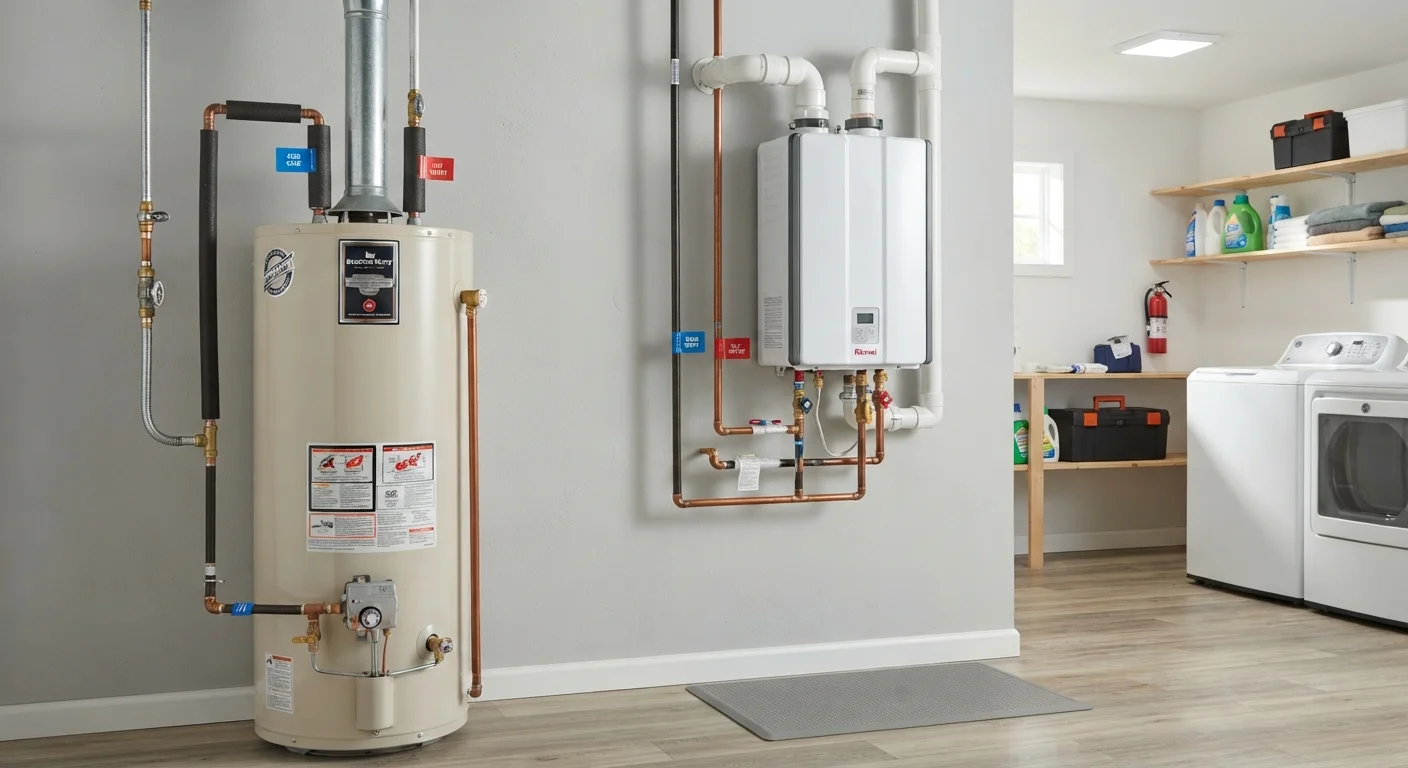
A tank water heater maintains a reservoir of preheated water - commonly 40 to 80 gallons - inside an insulated tank. A thermostat monitors the water temperature and triggers a burner or electric heating element whenever the temperature drops below a set point. This ongoing process is called standby heating, and it happens whether or not anyone in the home is using hot water. When you turn on a faucet, heated water is drawn from the top of the tank while cold water enters at the bottom to be reheated.
A tankless water heater (also called an on-demand or instantaneous water heater) stores no water at all. When a hot-water tap opens, a flow sensor activates a burner or electric heating element that heats water as it passes through a heat exchanger. The moment demand stops, the unit shuts off. Because there's no tank to keep warm around the clock, tankless systems eliminate standby heat loss - the energy spent maintaining stored water temperature.
If you've noticed unusual noises from your current unit, our guide to water heater sounds can help you interpret what the system is telling you before you decide to replace it.
| Criterion | Tank Water Heater | Tankless Water Heater |
|---|---|---|
| Upfront cost | Lower (unit + standard install) | Higher (unit + possible upgrades) |
| Energy use | Higher (standby heat loss) | Lower (heats on demand only) |
| Hot water supply | Limited by tank capacity | Continuous while demand is met |
| Typical lifespan | 8-12 years | Up to 20+ years |
| Physical footprint | Large (floor-standing tank) | Compact (wall-mounted unit) |
| Installation complexity | Generally straightforward | Often requires upgrades |
| Maintenance | Annual flush; anode rod check | Periodic descaling; filter cleaning |
Cost, Efficiency, and Lifespan Trade-Offs
The financial picture for each system spans upfront costs, operating expenses, and how long you'll realistically own the unit before replacement.
Upfront costs: Tank heaters generally cost several hundred dollars for the unit itself, with installation that's relatively straightforward for a licensed plumber. Tankless units carry a higher purchase price, and installation often involves upgrading gas lines, adding proper venting, or boosting electrical capacity - all of which add to the total project cost.
Energy efficiency: The U.S. Department of Energy notes that tankless water heaters can be more energy-efficient than tank models for many households, largely by eliminating standby heat loss. However, the actual savings depend on how much hot water your household uses, the fuel type, and local utility rates. Homes with very high hot-water demand may see narrower efficiency gains.
8-34%
Potential energy savings with tankless units
The U.S. Department of Energy estimates tankless heaters can be 8-34% more energy efficient than tank models, depending on household usage volume.
20+ years
Typical tankless heater lifespan
Tankless water heaters are generally rated for over 20 years of service life, roughly double the average lifespan of a conventional storage tank unit.
40-80 gal
Common tank heater storage capacity
Most residential tank water heaters hold between 40 and 80 gallons, with household size and peak demand determining the appropriate capacity.
Lifespan: Tank heaters typically last 8 to 12 years with regular maintenance, including annual flushing to remove sediment buildup. Tankless units are generally rated for 20 years or more, though they require periodic descaling - especially in areas with hard water - and their components can be more complex and costly to repair. See our article on reading your water meter to monitor for signs of leaks that can shorten any water heater's life.
Performance, Installation, and Practical Fit
Each system has real-world strengths and limitations that show up in daily household use.
Hot water availability: A tank heater delivers hot water quickly because it's already heated, but a household can exhaust the supply during back-to-back showers or simultaneous appliance use. Once the tank is depleted, recovery time - how long it takes to reheat a full tank - can range from 30 minutes to over an hour depending on the unit. Tankless heaters supply hot water continuously, but a single unit may struggle to meet simultaneous high-flow demand across multiple fixtures at once. Sizing the unit correctly, or installing multiple units, addresses this limitation.
Space and installation: Tank heaters require dedicated floor space - typically in a basement, utility closet, or garage. Tankless heaters mount on a wall and take up a fraction of that footprint, which can matter in smaller homes. However, tankless conversion is rarely a straight swap; it frequently involves rerouting gas lines, installing new venting systems, or upgrading electrical panels for electric models. These changes should always be performed by licensed professionals, and permits may be required depending on your local building codes.
Fuel compatibility: Both system types are available in natural gas, propane, and electric configurations. Gas tankless models generally deliver higher flow rates than electric ones, making them better suited to larger households. The right fuel type for your home depends on what's already available and the cost of upgrades.
If you're evaluating broader home system upgrades at the same time, our comparison of forced air vs. radiant heat covers similar trade-offs for heating systems. And if you're weighing this as part of a larger housing decision, the renting vs. buying trade-offs article provides useful financial context.
Permits and Professional Installation Matter
Water heater installation - particularly tankless conversions - often requires a permit and inspection under local building codes. Always verify requirements with your local building department before work begins. Hiring a licensed plumber and, where applicable, a licensed electrician or gas fitter helps ensure the installation meets safety and code standards and protects your home's insurance coverage.