

Key Takeaways
- Air conditioners remove heat from indoor air rather than generating cold air.
- Refrigerant cycles through four key components: evaporator, compressor, condenser, and expansion valve.
- The refrigerant changes between liquid and gas states to absorb and release heat at different points.
- The outdoor condenser unit expels the heat collected from inside your home.
- Understanding the cycle helps homeowners recognize signs of inefficiency or refrigerant issues.
Refrigeration Cycle
The refrigeration cycle is the process your central air conditioner uses to transfer heat from inside your home to the outside air. It works by circulating a special fluid called refrigerant through a closed loop of components, repeatedly changing the refrigerant between liquid and gas states to absorb and release heat. Contrary to common belief, your AC doesn't manufacture cold air - it removes unwanted heat and dumps it outdoors.
The cycle follows thermodynamic principles established by the second law of thermodynamics, specifically exploiting the relationship between pressure, temperature, and phase changes in refrigerant compounds such as R-410A or R-32.
Heat Moves, It Doesn't Disappear
Most homeowners think of air conditioning as a system that produces cold air. In reality, it does something more precise: it moves heat from one place to another. Your central AC pulls heat energy out of your indoor air and deposits it outside, leaving cooler air behind. This is the same fundamental principle used in your refrigerator - which is why the back of a fridge feels warm while the interior stays cold.
Understanding this distinction helps explain why your system needs refrigerant, why the outdoor unit gets hot, and why a low refrigerant charge makes cooling impossible. It all comes back to the physics of heat transfer.
“An air conditioner is essentially a heat pump in cooling mode - it doesn't cool your home so much as it uncools it by continuously extracting thermal energy and moving it elsewhere.”
— U.S. Department of Energy, Office of Energy Efficiency and Renewable Energy - educational guidance on home cooling systems
The Four Key Components
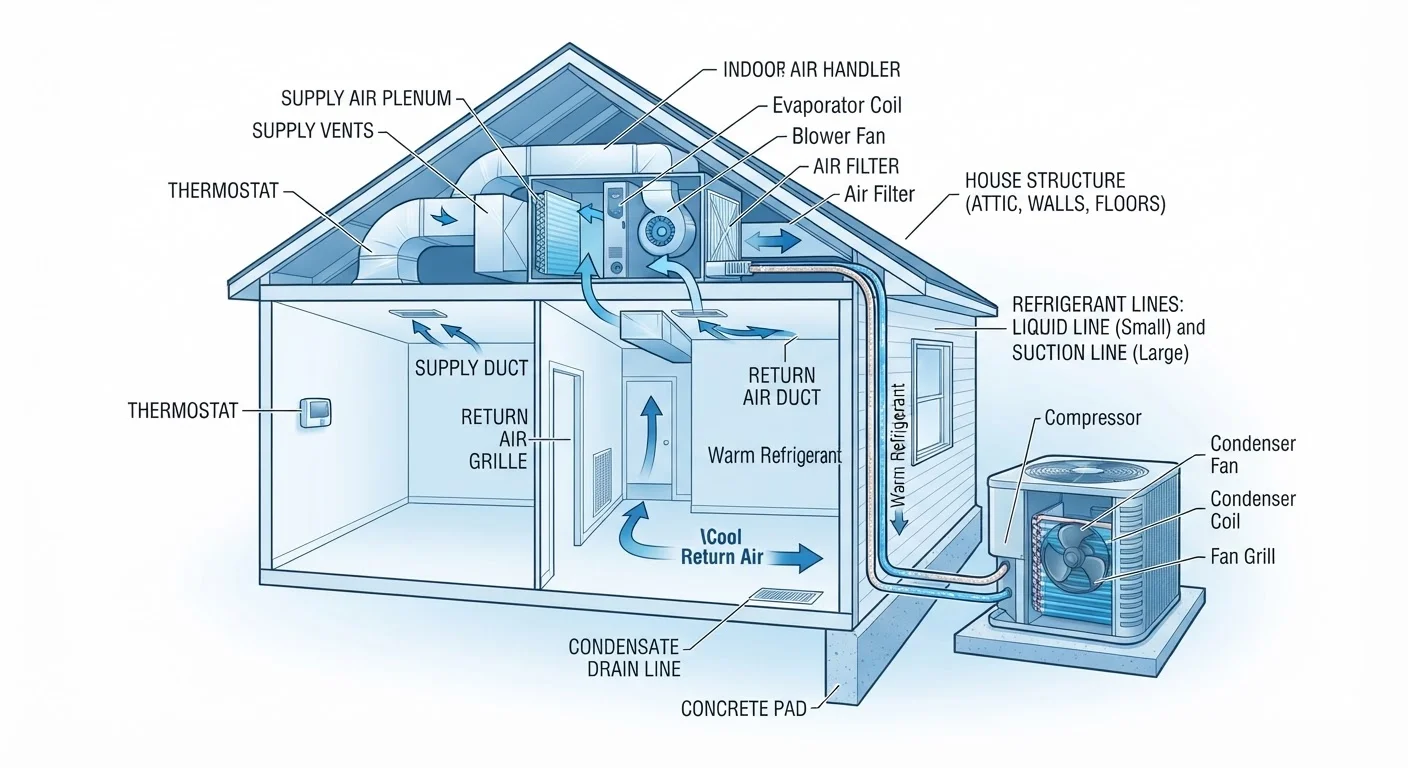
The refrigeration cycle flows through four main components, each playing a specific role:
- Evaporator coil - Located inside your home in the air handler, this coil carries cold, low-pressure refrigerant. As warm indoor air passes over it, the refrigerant absorbs heat and evaporates into a gas.
- Compressor - Housed in the outdoor unit, the compressor pressurizes the refrigerant gas, which dramatically raises its temperature. This is the heart of the system and the most energy-intensive component.
- Condenser coil - Also in the outdoor unit, the hot pressurized gas flows through this coil. A fan blows outdoor air across it, allowing the heat to dissipate outside. The refrigerant cools and condenses back into a liquid.
- Expansion valve - This small device rapidly lowers the pressure of the liquid refrigerant, causing its temperature to drop sharply before it re-enters the evaporator coil and the cycle begins again.
Keep the Outdoor Unit Clear
The condenser coil needs free airflow to release heat effectively. Maintain at least 2 feet of clearance around the outdoor unit by trimming back shrubs and removing debris. Hosing off the coil fins gently at the start of cooling season can also help. Always turn the system off at the breaker before doing any cleaning around the unit.
Tracing the Cycle Step by Step
Here is how the cycle works in continuous motion:
- Your thermostat signals that indoor air is too warm, starting the system.
- The blower fan pulls warm room air across the evaporator coil. The cold refrigerant inside absorbs that heat and vaporizes.
- The now-gaseous refrigerant travels to the compressor, which squeezes it tightly. Compressed gas gets very hot - often above 100°F.
- That hot gas moves to the condenser coil outdoors. The fan blows ambient air across it, carrying the heat away. The refrigerant releases its heat load and condenses into a warm liquid.
- The liquid passes through the expansion valve, which drops its pressure and temperature rapidly, readying it to absorb heat again.
- The cold refrigerant re-enters the evaporator coil, and the cycle repeats.
For a comparison with how heating systems circulate energy through your home, see our guide to forced air vs. radiant heat.
~6%
U.S. electricity used by air conditioning
The U.S. Department of Energy estimates that air conditioners account for roughly 6% of all electricity produced in the United States annually.
90°F+
Typical condenser coil operating temperature
Under normal summer conditions, refrigerant entering the outdoor condenser can exceed 90-100°F as it releases collected indoor heat.
1-3 months
Recommended air filter replacement interval
Most HVAC manufacturers and energy agencies recommend replacing standard 1-inch air filters every 1-3 months to maintain efficient airflow through the system.
What This Means for Homeowners
Knowing how the refrigeration cycle works makes you a better-informed homeowner. When the outdoor condenser coil is buried in overgrown shrubs, it can't release heat efficiently - the whole cycle backs up. When air filters are clogged, insufficient airflow across the evaporator coil reduces how much heat is absorbed. And when refrigerant leaks, there simply isn't enough working fluid to carry heat through the loop.
None of these issues create cold - they disrupt a finely balanced heat-transfer process. If you notice your system running longer than usual, ice forming on the indoor unit, or rooms that won't cool down, these are signs the cycle is struggling. Always contact a licensed HVAC technician for refrigerant-related work, as handling refrigerants requires EPA Section 608 certification in the United States.
Refrigerant Is a Regulated Substance
In the United States, purchasing and handling refrigerants for HVAC systems requires EPA Section 608 certification. Homeowners should never attempt to add or recover refrigerant themselves. If you suspect a refrigerant leak - indicated by hissing sounds, ice on the coil, or reduced cooling - contact a licensed HVAC technician. Refrigerant released into the atmosphere is harmful to the environment and subject to federal regulations.