
Renting vs. Buying a Home: A Practical Look at the Financial and Lifestyle Trade-Offs

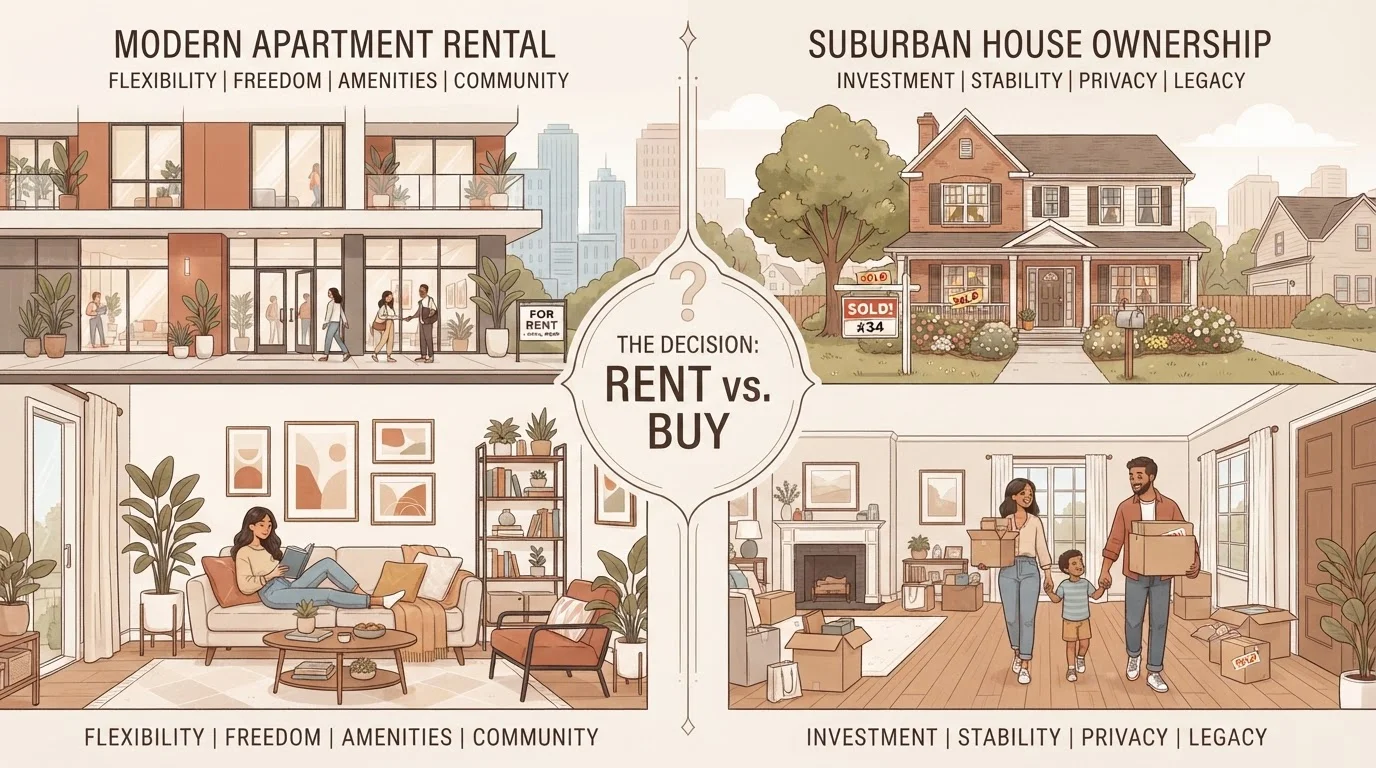
Key Takeaways
- Neither renting nor buying is universally better - it depends on your finances, timeline, and priorities.
- Buying builds equity over time but requires significant upfront capital and ongoing maintenance costs.
- Renting offers flexibility and lower short-term costs but provides no ownership stake in the property.
- Your local housing market conditions can heavily influence which option makes more financial sense.
- Life circumstances - job stability, family plans, and credit health - matter as much as the numbers.
Builds equity and long-term wealth potential
Each mortgage payment gradually increases your ownership stake, and home appreciation over time can produce meaningful gains - though this varies by market and is not guaranteed.
Stable, predictable housing costs with a fixed mortgage
A fixed-rate mortgage locks in your principal and interest payment, protecting you from rent increases that often outpace inflation in competitive markets.
Freedom to customize and renovate your space
Homeowners can repaint, remodel, or landscape without landlord approval, allowing the property to reflect personal preferences and potentially increase its value.
Potential tax benefits in some situations
Mortgage interest and property taxes may be deductible for some homeowners, though the benefit depends on individual tax circumstances and current law - consult a tax professional.
Greater sense of community and long-term roots
Owning a home in one location can support deeper neighborhood ties, school stability for children, and a more settled lifestyle that suits many households.
Large upfront capital requirement
Down payments, closing costs, inspections, and moving expenses can easily total tens of thousands of dollars before you make a single mortgage payment.
Full responsibility for maintenance and repairs
Unlike renting, where a landlord typically handles repairs, homeowners absorb all maintenance costs - from a leaking roof to an aging HVAC system - which can be unpredictable and expensive.
Reduced geographic flexibility
Selling a home takes time and carries transaction costs on both sides, making it costly to relocate quickly - a real constraint in today's mobile job market.
Exposure to market value fluctuations
Home values can decline, leaving owners with less equity than expected or even underwater on their mortgage - a situation that limits options and can cause financial stress.
Ongoing costs beyond the mortgage payment
Property taxes, homeowner's insurance, HOA fees, and routine upkeep can add hundreds of dollars per month beyond what mortgage calculators typically show.
Our Verdict
Buying a home can be a sound long-term financial strategy for those with stable income, a strong credit profile, and plans to stay in one place for several years. Renting, however, is a rational and often practical choice for people who value flexibility, are in a high-cost market, or aren't yet financially prepared for homeownership. Neither path is inherently superior - the right choice depends on your individual circumstances, goals, and the conditions of your local market.
Buying is best suited to those with multi-year stability plans and the financial readiness to cover upfront and ongoing costs; renting suits those prioritizing flexibility or building toward ownership.
The Core Question: What Are You Really Comparing?
The rent-vs.-buy debate often gets reduced to a simple monthly payment comparison - but that framing misses the bigger picture. When you rent, you're paying for a place to live and for flexibility. When you buy, you're paying for a place to live and building an ownership stake, while also taking on responsibility for maintenance, taxes, and market risk.
A more honest comparison weighs the total cost of each path over your expected time horizon - not just the monthly check you write. For a deeper look at the financial variables that often get overlooked on both sides, see the financial trade-offs most people overlook. And for a broader exploration of market and lifestyle factors shaping each path, this overview of the real trade-offs offers helpful context.
The Financial Case for Each Option
Buying a home has historically helped many Americans accumulate wealth through home equity - the portion of the property's value you own outright as you pay down the mortgage and the home appreciates. However, this outcome is never guaranteed. Home values fluctuate with market conditions, and the early years of a mortgage are heavily weighted toward interest rather than principal.
Renting, on the other hand, keeps your capital more liquid. A renter can invest the money that would have gone toward a down payment elsewhere, though this requires discipline and carries its own risks. The math varies considerably depending on local market prices, prevailing mortgage rates, and how long you stay.
5+ years
Typical break-even horizon for buying
Most housing economists and financial planners suggest homeowners need to stay at least five years to recoup transaction costs through equity gains.
1-2%
Annual home maintenance cost estimate
A commonly cited rule of thumb is that homeowners should budget 1-2% of their home's value each year for maintenance and repairs.
2-5%
Typical buyer closing costs as share of purchase price
The Consumer Financial Protection Bureau notes that closing costs typically range from 2-5% of the loan amount, varying by location and lender.
Don't overlook what hidden costs of renting - like application fees, utility deposits, and renters insurance - can add to your monthly budget. Buyers face parallel hidden costs: property taxes, homeowner's insurance, HOA fees, and maintenance, which commonly run 1-2% of a home's value annually.
Flexibility vs. Stability: The Lifestyle Dimension
Renting typically offers far greater flexibility. Most leases run 12 months, and month-to-month arrangements can offer even shorter commitments. If your job, relationship, or priorities shift, relocating as a renter is considerably simpler than selling a home.
Buying, by contrast, anchors you to a location. Selling within just a few years of purchase often means losing money once you factor in closing costs (typically 2-5% of the purchase price on each end of the transaction). Most financial guidance suggests you need to stay in a purchased home for at least five years to break even on those transaction costs.
How Long You Stay Changes Everything
The rent-vs.-buy calculation shifts dramatically based on your time horizon. In many markets, renting is cheaper in the short term once you account for closing costs and the interest-heavy early years of a mortgage. If there's a reasonable chance you'll relocate within three to four years, the financial case for buying weakens considerably. Always model your specific scenario using current local data before committing.
If you share finances with a partner, major housing decisions intersect directly with how you manage money together - see budgeting as a couple for practical guidance on aligning priorities before committing.
When Buying Makes Sense - and When It Doesn't
Buying tends to work in your favor when you have a stable income, a credit score that qualifies you for a competitive mortgage rate, enough savings to cover the down payment and closing costs without depleting your emergency fund, and a clear intention to remain in the area for five or more years.
Builds equity and long-term wealth potential
Each mortgage payment gradually increases your ownership stake, and home appreciation over time can produce meaningful gains - though this varies by market and is not guaranteed.
Stable, predictable housing costs with a fixed mortgage
A fixed-rate mortgage locks in your principal and interest payment, protecting you from rent increases that often outpace inflation in competitive markets.
Freedom to customize and renovate your space
Homeowners can repaint, remodel, or landscape without landlord approval, allowing the property to reflect personal preferences and potentially increase its value.
Potential tax benefits in some situations
Mortgage interest and property taxes may be deductible for some homeowners, though the benefit depends on individual tax circumstances and current law - consult a tax professional.
Greater sense of community and long-term roots
Owning a home in one location can support deeper neighborhood ties, school stability for children, and a more settled lifestyle that suits many households.
Buying is harder to justify when you're in a high-cost market where price-to-rent ratios are elevated, when your employment situation is uncertain, or when your credit profile would push you into a high-rate loan. Being house-poor - spending so much on housing that you can't save or handle emergencies - is a real risk worth taking seriously.
Large upfront capital requirement
Down payments, closing costs, inspections, and moving expenses can easily total tens of thousands of dollars before you make a single mortgage payment.
Full responsibility for maintenance and repairs
Unlike renting, where a landlord typically handles repairs, homeowners absorb all maintenance costs - from a leaking roof to an aging HVAC system - which can be unpredictable and expensive.
Reduced geographic flexibility
Selling a home takes time and carries transaction costs on both sides, making it costly to relocate quickly - a real constraint in today's mobile job market.
Exposure to market value fluctuations
Home values can decline, leaving owners with less equity than expected or even underwater on their mortgage - a situation that limits options and can cause financial stress.
Ongoing costs beyond the mortgage payment
Property taxes, homeowner's insurance, HOA fees, and routine upkeep can add hundreds of dollars per month beyond what mortgage calculators typically show.
For guidance on the homebuying process itself, the Buying a Home hub covers essential steps from mortgage preapproval to closing.