

Why Tires Deserve Regular Attention
Tires are the only part of your car that actually contacts the road. Every steering input, braking maneuver, and acceleration relies on four palm-sized contact patches - one per tire - to function correctly. When those tires are under-inflated, worn, or unevenly degraded, your vehicle handles less predictably and takes longer to stop.
The good news: the three core habits of tire care - checking pressure, inspecting tread, and rotating regularly - require minimal equipment and almost no mechanical skill. Understanding what each check actually tells you makes it far easier to stay consistent. For a broader look at where tires fit in your overall upkeep plan, see Your Car's Maintenance Schedule, Explained.
Tire Pressure: What to Check and When
Tire pressure is measured in PSI. The correct target for your vehicle is printed on a sticker inside the driver's door jamb - not on the tire sidewall, which shows the tire's maximum rating, not the recommended operating pressure. These numbers are different and should not be confused.
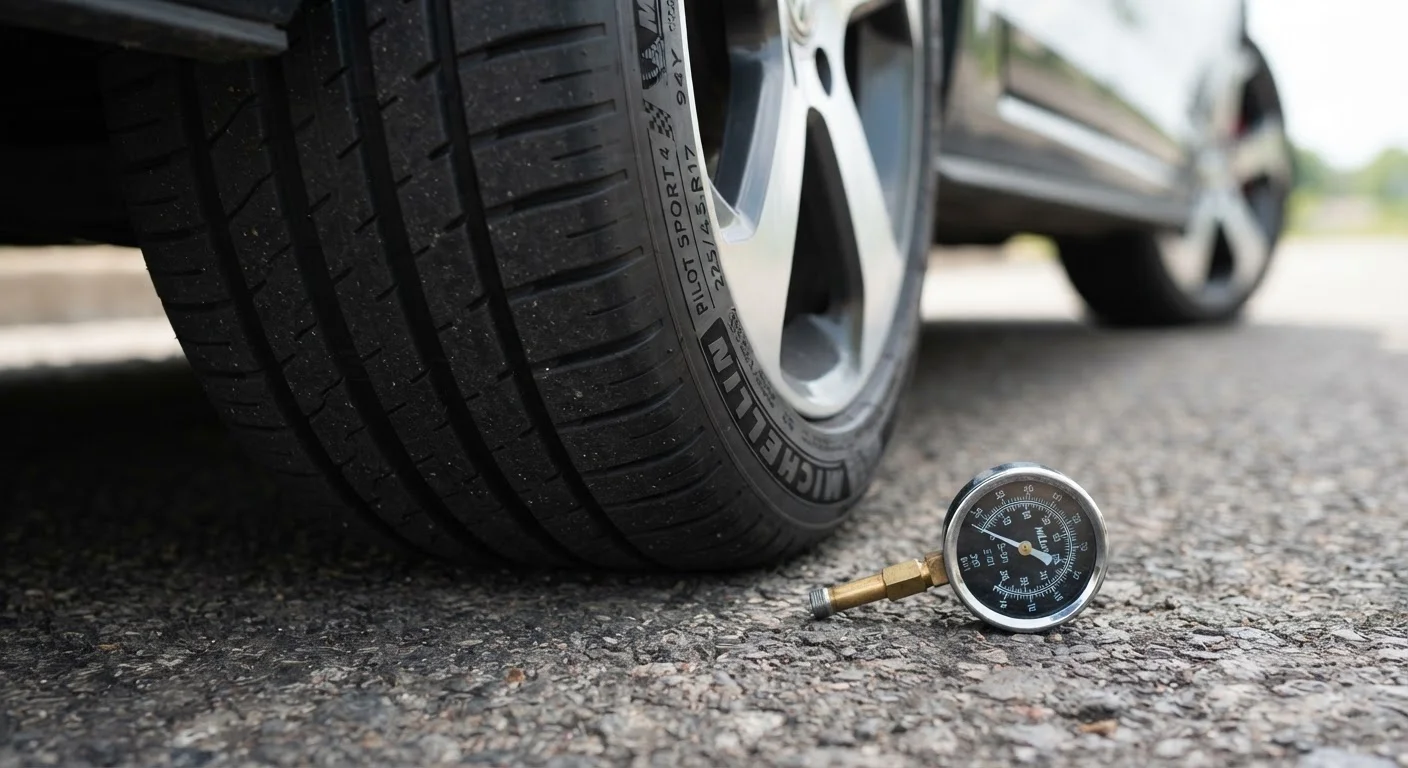
Pressure should be checked when tires are cold - meaning the car has been parked for at least three hours or driven fewer than a mile. Driving heats the air inside tires and raises pressure readings by several PSI, which can mask actual underinflation.
A standard digital or dial-type gauge from any auto parts store is sufficient for this task. Check pressure at least once a month and before any long highway trip. Temperature swings also matter: tire pressure drops roughly 1 PSI for every 10°F decrease in ambient temperature, so seasonal transitions warrant an extra check. See Seasonal Vehicle Prep for a fuller seasonal checklist.
If your dashboard shows a TPMS warning light, don't ignore it - that icon typically illuminates when pressure drops 25% or more below the recommended level. Warning Lights on Your Dashboard explains what each indicator means and how urgently to act.
Tread Depth: Knowing When Tires Are Worn
Tread channels water away from the contact patch, maintaining grip on wet roads. As tread wears down, this ability diminishes. The legal minimum tread depth in most U.S. states is 2/32 of an inch, but many safety organizations recommend replacing tires at 4/32" because wet-braking performance degrades significantly before the 2/32" mark is reached.
The simplest check is the penny test: insert a penny into a tread groove with Lincoln's head pointing down. If you can see all of Lincoln's head, tread is at or below 2/32" - replacement is overdue. For the 4/32" threshold, use a quarter: if Washington's head is fully visible, you're approaching the danger zone.
Dedicated tread-depth gauges, available at auto parts stores for a few dollars, give a precise reading and remove the guesswork. Check multiple grooves across the tire - uneven wear patterns (more worn on one edge than the other, for example) can indicate alignment or inflation problems worth addressing separately.
Tire Rotation: Balancing Wear Across All Four Tires
Front and rear tires wear differently. On front-wheel-drive vehicles, front tires handle steering, acceleration, and a significant share of braking, so they typically wear faster. Rotation moves tires to different positions on the vehicle so all four wear at a more similar rate - extending the usable life of the full set.
A common rotation interval is every 5,000 to 7,500 miles, though your owner's manual is the authoritative source for your specific vehicle. Many drivers align rotations with oil changes for convenience. The rotation pattern used (front-to-rear, cross, or side-to-side) depends on whether your tires are directional and whether all four tires are the same size.
Consistent rotation also gives a technician an opportunity to visually inspect tires for damage, check brake components nearby, and catch developing wear issues early. For a record-keeping habit that captures these service points over time, Keeping a Vehicle Maintenance Log explains why the paper trail matters. And if you want to understand where rotation fits among other brake and suspension checkpoints, Brake Pads, Rotors, and Fluid is a useful companion read.