

| Legal name | Monroney label (Automobile Information Disclosure Act, 1958) |
| Who must display it | All new passenger vehicle dealers in the U.S. |
| Who can remove it | Only the first retail purchaser (Federal law) |
| Fuel economy testing authority | U.S. Environmental Protection Agency (EPA) |
| Safety rating authority | NHTSA 5-Star Safety Ratings program |
| Destination charge | Federally required line item; not negotiable |
What the Monroney Label Is and Why It Exists
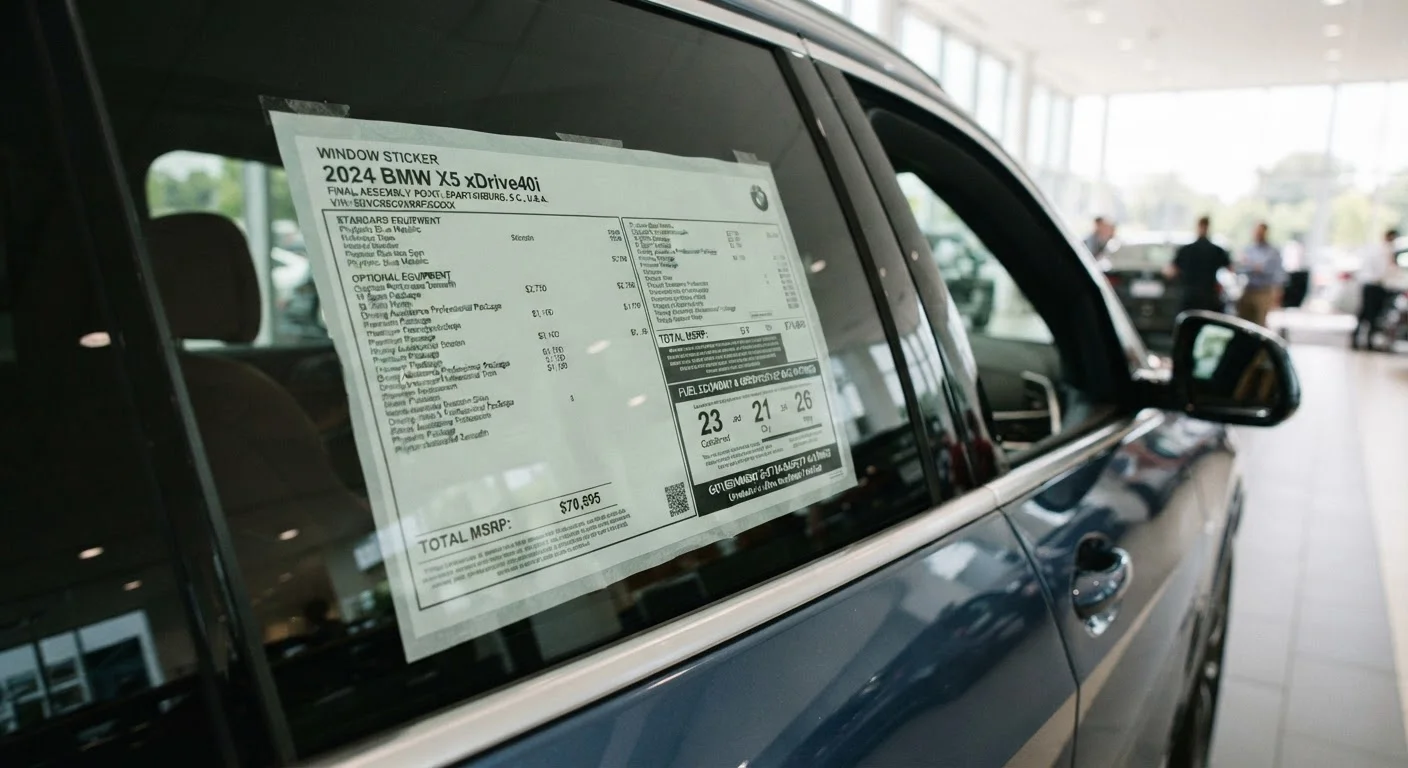
The window sticker on every new car sold in the United States is formally called the Monroney label, named after the late Senator Mike Monroney of Oklahoma, whose 1958 Automobile Information Disclosure Act made it mandatory. Federal law requires that the label remain on the vehicle until the first retail buyer removes it - dealers cannot take it down.
The label serves one core purpose: to give buyers a standardized, comparable snapshot of a vehicle's pricing, equipment, and fuel economy before they sign anything. Understanding each section puts you in a stronger position at the negotiating table and helps you compare vehicles on equal footing. For a broader look at how new-vehicle costs stack up against used alternatives, see our full cost comparison.
| Legal name | Monroney label (Automobile Information Disclosure Act, 1958) |
| Who must display it | All new passenger vehicle dealers in the U.S. |
| Who can remove it | Only the first retail purchaser (Federal law) |
| Fuel economy testing authority | U.S. Environmental Protection Agency (EPA) |
| Safety rating authority | NHTSA 5-Star Safety Ratings program |
| Destination charge | Federally required line item; not negotiable |
Breaking Down Every Section of the Label
Manufacturer's Suggested Retail Price (MSRP)
The MSRP is a baseline, not a mandate. It covers the base vehicle price, any factory-installed options, and destination and delivery charges - a federally required line item reflecting the cost to ship the vehicle from the plant to the dealership. The actual transaction price is negotiable.
Standard and Optional Equipment
This section lists what comes with the trim level as standard, followed by any factory-installed packages or individual options added to that specific unit. Each option carries a price. Comparing these line items across vehicles of the same class reveals where money is going.
EPA Fuel Economy Estimates
Perhaps the most referenced section, the EPA fuel economy block shows city, highway, and combined miles-per-gallon estimates based on standardized government testing. A 5-Year Fuel Cost estimate - calculated using EPA assumptions about annual mileage and a projected fuel price - is also included. These are estimates, not guarantees; real-world results vary by driving conditions, load, and habits.
Safety Ratings
If the vehicle has been tested, government crash-test and rollover ratings from the NHTSA 5-Star Safety Ratings program are displayed here. Not every model has ratings at the time of sale.
Emissions Information
An air pollution score and a greenhouse gas score, both on a 1-10 scale from the EPA, appear in this section. Higher scores reflect lower emissions relative to other vehicles of the same model year.
Monroney label
The federally mandated window sticker required on all new passenger vehicles sold in the U.S. It discloses pricing, equipment, fuel economy, and other standardized information.
MSRP
Manufacturer's Suggested Retail Price - the automaker's recommended selling price, including options and destination charges. It is a starting point for negotiation, not a fixed price.
Destination and delivery charge
A fee reflecting the cost of transporting the vehicle from the assembly plant to the dealership. It is set by the manufacturer and is the same for all buyers of that model regardless of location.
EPA fuel economy estimate
Miles-per-gallon figures produced through standardized government laboratory tests. Actual fuel economy varies based on individual driving behavior, road conditions, and vehicle load.
Supplemental sticker
A separate label added by the dealer - not the manufacturer - that may list dealer-installed accessories or additional markup. Items on a supplemental sticker are generally negotiable.
Trim level
A specific configuration variant of a vehicle model, usually designated by a name or alphanumeric code (e.g., LT, EX, Sport). Different trims include different standard features at different base prices.
Warranty Summary
A brief overview of the manufacturer's warranty - typically basic/bumper-to-bumper, powertrain, and corrosion coverage periods - is included. Exact terms are in the warranty booklet, not the sticker.
What the Monroney Label Doesn't Tell You
The label reflects the vehicle as configured at the factory. It does not account for dealer-added accessories or markups - sometimes listed on a separate supplemental sticker. Those add-ons are negotiable. The label also says nothing about financing terms, trade-in values, or taxes and fees, all of which significantly affect the total out-of-pocket cost of ownership.
For vehicles where a certified pre-owned designation is in play rather than new-car status, the Monroney label is no longer the relevant document - warranty and inspection details vary by program. Our CPO program explainer covers what that label actually guarantees.
Once you own the vehicle, a different kind of label-reading matters: understanding your auto insurance declarations page ensures you carry the coverage you expect.
This article provides general educational information about federally required vehicle labeling. It is not financial or legal advice. Actual transaction terms, coverage, and costs depend on individual circumstances and should be confirmed with a licensed professional or official sources.