

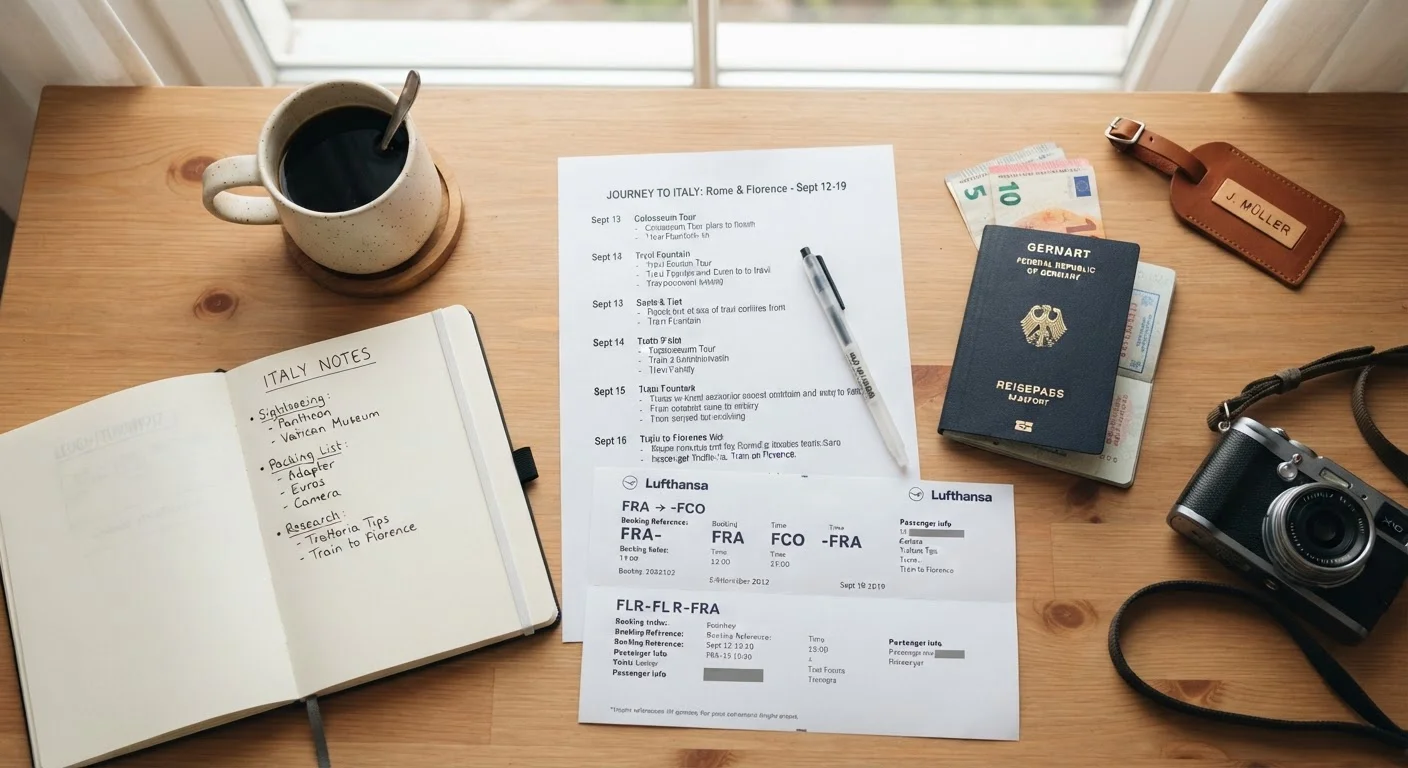
Key Takeaways
- A solid itinerary covers transportation, accommodations, daily activities, and contingency information in one place.
- Confirmation numbers and booking details should always be included - not just saved in email inboxes.
- Buffer time between activities is a structural element, not wasted time.
- Sharing your itinerary with someone at home is a basic but critical safety step.
- The right level of detail varies by traveler - over-planning can reduce flexibility.
- Digital and paper backup copies of your itinerary both have distinct advantages.
Travel Itinerary
A travel itinerary is a structured plan that outlines where you're going, when you're going, how you're getting there, where you're staying, and what you intend to do each day. It serves as a single reference document that keeps every part of your trip organized and accessible. A good itinerary doesn't just list bookings - it anticipates logistics and helps you make decisions before problems arise.
In professional travel contexts, an itinerary may also include supplier confirmation codes, passenger name records (PNRs), and ticketing details used by airlines and travel agents.
Why an Itinerary Is More Than a Schedule
Most people think of a travel itinerary as a day-by-day activity list. But a truly useful itinerary is more like a decision-support document. It captures the answers to questions you'd otherwise be scrambling to find mid-trip: What's the hotel address? What time does the train leave? What's the backup plan if that restaurant is closed?
When you build an itinerary thoughtfully, you shift problem-solving to before the trip rather than during it - which is where it belongs. That mental pre-work is what separates a smooth trip from a stressful one. If you're newer to planning trips independently, our first-timer's planning walkthrough covers the full process from destination research through departure.
The Core Elements Every Itinerary Needs
Regardless of destination or trip length, every solid itinerary shares the same foundational components:
- Transportation details: Flight numbers, departure times, terminal information, train or bus routes, and rental car pickup locations. Include confirmation codes - not just airline names.
- Accommodation information: Full address, check-in and check-out times, confirmation number, and a contact number for the property. Know how you're getting from the airport to the hotel before you land.
- A day-by-day framework: Not a minute-by-minute schedule, but a clear outline of what's happening each day - including any timed reservations like museum entry, tours, or restaurants.
- Emergency and practical contacts: The local equivalent of 911, the nearest embassy or consulate for international trips, your travel insurance provider's claims number, and a trusted contact at home.
- Buffer time: Build in transition time between activities. Underestimating travel between locations is one of the most common itinerary mistakes. Cities like Tokyo or Mexico City require realistic expectations about transit time - something our destination overviews on Japan for American visitors and Mexico City for U.S. travelers address directly.
74%
Travelers who experience trip stress from poor planning
A survey by the American Psychological Association found that vacation stress often originates in logistical uncertainty rather than the trip itself.
1 in 3
Travelers who face a flight disruption annually
U.S. Department of Transportation data consistently shows a significant share of domestic flights experience delays or cancellations each year, underscoring the value of contingency planning.
The Elements Travelers Most Often Forget
Even experienced travelers leave gaps in their itineraries. These are the most commonly missed components:
- Visa and entry requirements: Don't assume your passport alone is sufficient. Entry rules change, and verifying with official government sources before you travel is non-negotiable. Never rely on third-party summaries as your final authority.
- Backup documentation: A photo of your passport, a list of card numbers with issuer contact numbers, and copies of key reservations stored somewhere other than your primary phone. Email yourself a PDF.
- A contingency note: What will you do if a flight is cancelled, a hotel loses your reservation, or you get sick? You don't need a full alternate plan - just a note on who to call and what your options are. Our companion piece on what can go wrong on a trip walks through common scenarios in detail.
- Shared access: If you're traveling with others, every person in the group should have the itinerary - not just the person who built it. For coordinating across a group, see our guide on group travel planning.
Save Your Itinerary in Multiple Places
Email yourself a PDF version of your full itinerary before departure. Save a copy to your phone's offline storage or a notes app that doesn't require internet access. Print a physical copy for international travel where data connectivity may be unreliable. Redundancy costs almost nothing and pays off when technology fails.
How Much Planning Is Too Much?
There's a real tension in itinerary planning between being prepared and being over-scheduled. Filling every hour of a vacation eliminates the spontaneity that often produces the most memorable experiences. The goal is structure that enables flexibility - not a rigid program that turns sightseeing into a race.
A practical rule: anchor each day with one or two timed commitments (a museum reservation, a tour, a dinner booking), then leave the rest loosely defined. This gives your day shape without boxing you in. For a deeper look at planning assumptions that lead travelers astray, our article on travel planning myths challenges some common misconceptions worth revisiting before you finalize your plan.
Before you leave home, run your completed itinerary against a pre-departure checklist - our pre-trip checklist covers passport validity, travel alerts, medications, and other details that often slip through the cracks. You can also find additional everyday travel advice through our Travel Tips hub.