

Key Takeaways
- Airline carry-on size limits vary, so check your carrier's rules before every trip.
- The TSA 3-1-1 rule restricts liquids to 3.4 oz containers in one quart-sized clear bag.
- Rolling clothes and using packing cubes consistently frees up meaningful space.
- Shoes, bulky jackets, and full-sized toiletries are the most common packing mistakes.
- Budget airlines often charge for overhead bin bags - read the fine print when booking.
- Gate agents measure bags more frequently on full flights; size compliance matters.
Carry-On Bag
A carry-on bag is a piece of luggage small enough to be stored in the overhead bin or under the seat in front of you on a commercial flight. Airlines set specific size and weight limits for carry-ons, and those limits vary by carrier. Traveling with only a carry-on avoids checked baggage fees and the wait at baggage claim.
Most U.S. domestic carriers allow a carry-on bag up to approximately 22 x 14 x 9 inches (including wheels and handles), but budget carriers and regional jets often enforce stricter limits. Always confirm with your specific airline before flying.
Understanding Airline Size Rules
Before you fold a single shirt, confirm the carry-on dimensions your airline enforces. The often-cited standard of 22 x 14 x 9 inches applies to many major U.S. carriers, but it is not universal. Budget carriers frequently enforce smaller limits and may charge a fee simply for using the overhead bin - even if your bag fits.
A few things travelers often overlook:
- Wheels and handles count. Manufacturers sometimes advertise a bag's interior capacity, which may be smaller than the total external dimensions airlines measure.
- Regional jets are stricter. Smaller aircraft have narrower overhead bins. A bag that fits comfortably on a wide-body jet may be gate-checked on a 50-seat regional plane.
- International legs have different rules. If your trip includes a connecting international flight, that carrier's limits apply on its segment. Check each carrier separately.
For a fuller picture of when a carry-on makes more sense than a checked bag, see our guide to choosing the right bag strategy for different types of trips.
Always Verify Before You Fly
Airline policies change, and fee structures for carry-on bags - especially on budget carriers - are updated regularly. Check your specific airline's carry-on policy on their official website when you book and again a few days before departure. What was allowed on your last trip with that carrier may no longer apply.
The TSA 3-1-1 Rule and Liquids
The TSA's 3-1-1 rule governs what liquids you can carry through a security checkpoint in the United States. Each passenger may bring liquids, gels, creams, and aerosols that are:
- 3.4 oz (100 ml) or less per container
- Packed in one quart-sized, clear, zip-top bag
- Limited to one such bag per person
This is one of the leading reasons carry-ons get held up at security. Full-sized shampoo bottles, large tubes of toothpaste, travel-sized spray sunscreen canisters over 3.4 oz, and even some food items like hummus or peanut butter in larger containers will be confiscated. Decant what you need into travel-sized containers before you leave home.
If you take prescription or over-the-counter medications, the rules differ. See our overview of flying with medications for guidance on documentation and TSA framing.
What Actually Fits: Smart Packing Methods
Most standard carry-ons hold between 35 and 45 liters - enough for a week-long trip when packed efficiently. The method matters as much as the bag itself.
Rolling vs. Folding
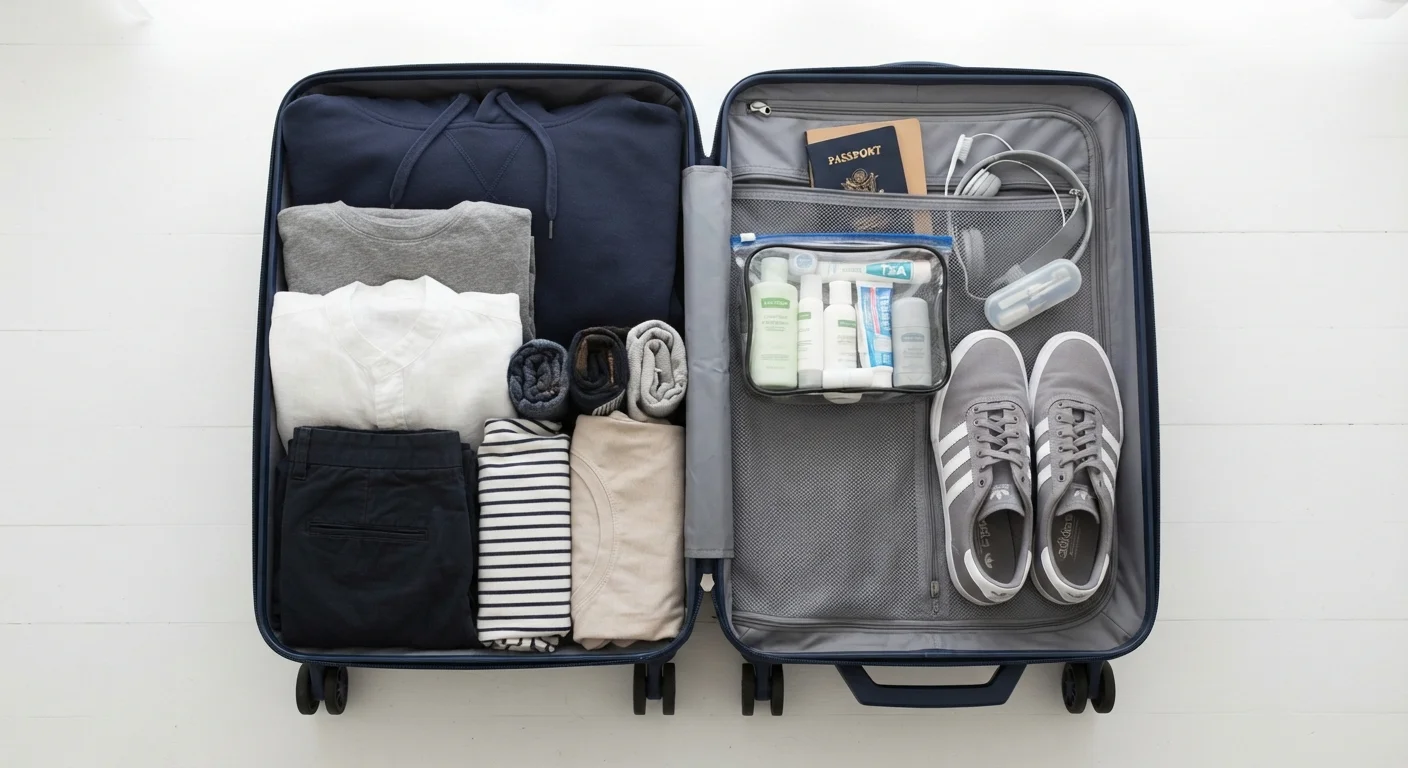
Rolling clothing compresses items and reduces wrinkles on casual fabrics like t-shirts, jeans, and knitwear. Flat folding is better for structured garments like dress shirts and blazers. Many experienced travelers use both: roll casual items, fold formal ones, and layer strategically.
Packing Cubes
Packing cubes are fabric organizers that compress clothing into discrete blocks. They don't create extra space, but they impose structure that prevents wasted gaps and makes unpacking at your destination faster.
Shoe Placement
Shoes are dense and awkward. Place them sole-to-sole near the wheels of your bag (the bottom when upright), then build clothing around them. Stuff socks inside shoes to reclaim otherwise dead space.
If your destination has variable weather, you don't necessarily need a bigger bag - you need smarter item choices. Our practical guide to packing for unpredictable weather explains layering strategies that work within a single carry-on.
Wear Your Bulkiest Items on the Plane
If you're traveling to a cold destination, wear your heaviest jacket, boots, and thickest layers onto the plane instead of packing them. This keeps your carry-on lighter and within size limits. You can always remove layers and store them in the overhead bin once you're seated.
What Doesn't Fit - and Why
Even experienced travelers routinely misjudge a few categories of items:
- Full-sized toiletries. A standard bottle of shampoo, conditioner, or body wash far exceeds the 3.4 oz limit and takes up meaningful space even if you were allowed to bring it.
- Bulky jackets and coats. A heavy winter coat can consume one-third of your bag's volume. Wear it on the plane or ship it ahead if you genuinely need it at your destination.
- More than two pairs of shoes. Shoes are the single heaviest, most space-consuming category in most people's bags. Limit yourself and choose footwear that works across multiple outfits.
- Oversized personal electronics. A full-sized DSLR camera with multiple lenses, a portable speaker, and a tablet can collectively exceed what reasonably fits alongside clothing.
- Prohibited sharp or sporting items. Knives, scissors with blades longer than 4 inches, and certain sporting equipment are barred from carry-ons entirely regardless of size.
Trip disruptions - including lost bags - are a real planning consideration. Our guide to planning for things that go wrong covers contingency strategies worth building in before you leave.
3-1-1
TSA liquid rule (oz / bag / person)
The TSA's 3-1-1 rule has been in effect for U.S. domestic and departing international flights since 2006 and remains one of the most frequently misunderstood checkpoint rules.
22×14×9 in
Common U.S. carry-on size limit
This dimension guideline is used by many major U.S. carriers but is not an FAA mandate - individual airlines set their own limits, and budget carriers frequently enforce smaller sizes.
40 L
Typical carry-on bag capacity
A standard hard-shell or soft carry-on bag holds roughly 35-45 liters of packing space - sufficient for most trips of up to a week when clothing is rolled and layered efficiently.