

| Liquid medication carry-on limit | No strict volume cap for medically necessary liquids; must be declared separately (TSA guidelines) |
| Original container required (domestic U.S.)? | Not legally required by TSA, but strongly recommended (TSA guidelines) |
| Needles and syringes permitted? | Yes, when accompanied by the associated medication (TSA guidelines) |
| Extra supply recommended | Full trip supply plus several days extra for delays (General travel health guidance) |
| International rules vary? | Yes - some U.S.-legal medications are restricted or banned abroad (Country-specific health ministry regulations) |
| When to declare at customs | Always declare medications when the arrival form requests it; when uncertain, declare (General customs guidance) |
TSA Rules for Medications at U.S. Airport Security
The Transportation Security Administration (TSA) allows both prescription and over-the-counter (OTC) medications in carry-on and checked bags. A few specific rules apply that every traveler should understand before reaching the checkpoint.
Liquid medications: Medically necessary liquids - including insulin, eye drops, and liquid oral medications - are exempt from the standard 3.4-ounce (100 mL) carry-on liquids rule. You must declare them separately at the checkpoint and remove them from your bag for screening. There is no strict volume cap, but quantities should be reasonable for the duration of your trip.
Solid medications: Pills, tablets, and capsules are not subject to liquid rules and can stay in your bag during screening. However, TSA may ask to inspect them, so keeping them accessible and clearly labeled reduces delays.
Needles and sharps: Insulin syringes and auto-injectors (such as EpiPens) are permitted in carry-on bags when accompanied by the medication they are used to administer. Inform the TSA officer before screening begins.
For a broader overview of what to expect at the checkpoint, see our guide to TSA checkpoint procedures.
| Liquid medication carry-on limit | No strict volume cap for medically necessary liquids; must be declared separately (TSA guidelines) |
| Original container required (domestic U.S.)? | Not legally required by TSA, but strongly recommended (TSA guidelines) |
| Needles and syringes permitted? | Yes, when accompanied by the associated medication (TSA guidelines) |
| Extra supply recommended | Full trip supply plus several days extra for delays (General travel health guidance) |
| International rules vary? | Yes - some U.S.-legal medications are restricted or banned abroad (Country-specific health ministry regulations) |
| When to declare at customs | Always declare medications when the arrival form requests it; when uncertain, declare (General customs guidance) |
Packaging, Labeling, and Documentation Best Practices
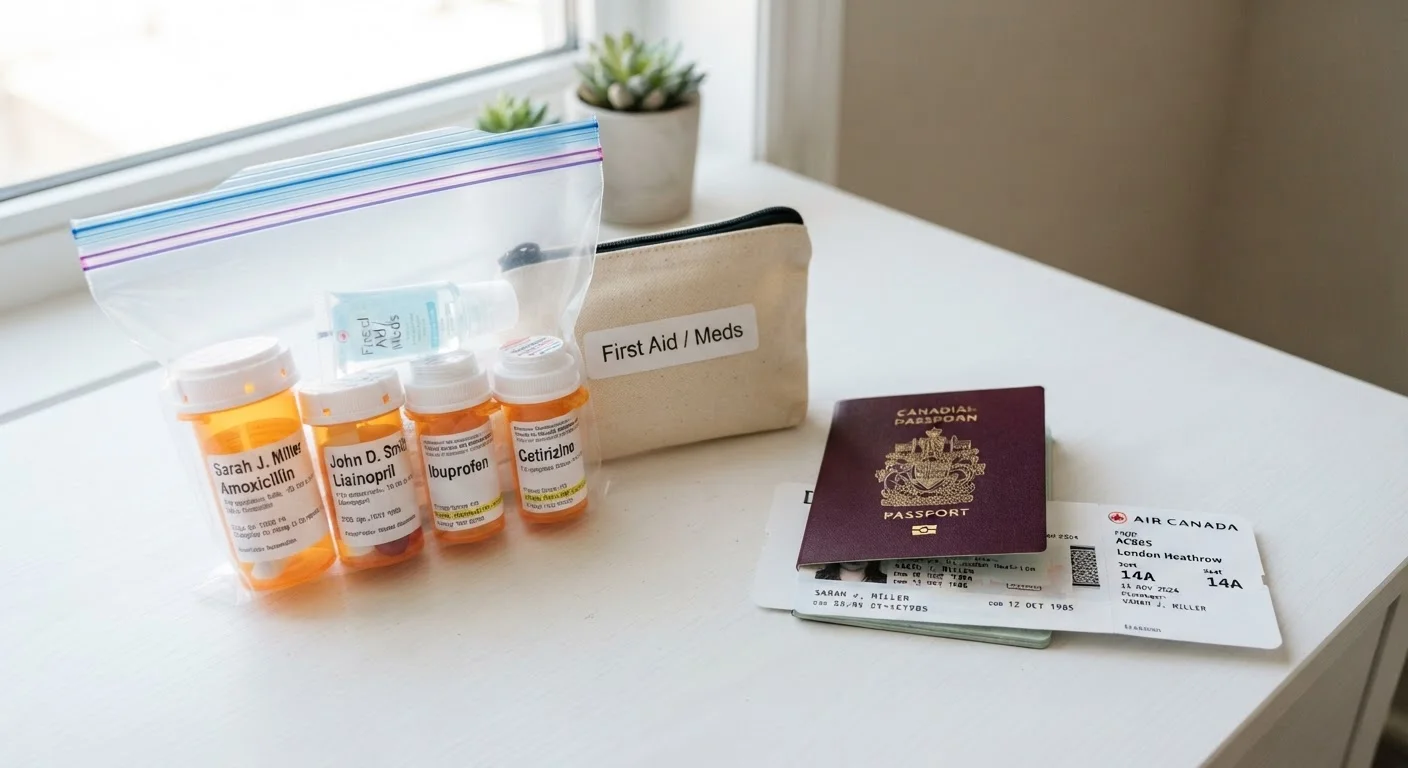
TSA does not legally require medications to be in their original pharmacy-labeled containers for domestic U.S. flights. That said, carrying medications in original, labeled bottles simplifies screening and is strongly recommended - especially for controlled substances or when traveling internationally.
What to bring as documentation
- Prescription labels: A current pharmacy label with your name, the drug name, and prescribing physician is the most universally accepted form of proof.
- Letter from your prescriber: For controlled substances, specialty injectables, or large quantities, a signed letter on official letterhead explaining your diagnosis (general terms are fine) and the need for the medication adds a layer of credibility.
- Original packaging: For international travel, customs officers in many countries expect to see original packaging with the manufacturer's label intact.
Tips for organized packing
- Group all medications in one dedicated pouch or clear zip-lock bag so they can be removed quickly for inspection.
- Bring enough supply for your entire trip plus a few extra days in case of delays - refilling a prescription abroad can be complicated and expensive.
- Split your supply between carry-on and checked luggage only if losing one bag would not leave you without a critical dose. For essential daily medications, keeping the full supply in your carry-on is generally more reliable.
Medication planning fits naturally into a broader pre-departure review. Our pre-trip checklist covers this alongside documents, insurance, and other essentials.
Controlled substance
A drug regulated under federal or international law due to its potential for dependence or misuse. Examples include certain opioids, stimulants, and sedatives. Traveling with these requires extra documentation and careful compliance with destination-country rules.
Medically necessary liquid
A liquid medication that a traveler requires for a health condition, which TSA exempts from the standard 3.4-ounce carry-on liquid limit. Travelers must declare these items separately at the checkpoint.
Customs declaration
A formal disclosure made to border authorities upon entering a country, listing items that may be subject to import rules. Many countries require travelers to declare medications, especially controlled substances, on arrival.
Import permit
An official authorization issued by a foreign government allowing a traveler to bring a specific medication into the country. Certain controlled or specialty drugs require this permit to be obtained in advance of travel.
OTC (over-the-counter) medication
A medication available for purchase without a prescription. While generally less scrutinized than prescription drugs, some OTC medications in the U.S. are restricted or banned in other countries.
International Travel: Customs Declarations and Country-Specific Rules
Rules that apply at a U.S. airport do not automatically apply at your destination. Many countries have strict controls on specific drug categories - including some common pain relievers, sleep aids, ADHD medications, and anxiety medications that are standard in the U.S.
Before you travel internationally
- Check the destination country's official health ministry or embassy website for rules on importing your specific medication. Some substances require advance import permits.
- Verify whether your medication is outright banned in the destination country. A small number of medications legal in the U.S. are controlled or prohibited elsewhere.
- Carry translated documentation if traveling to a non-English-speaking country, particularly for controlled substances.
Customs declarations
Most countries require travelers to declare medications, particularly controlled substances, on arrival customs forms. When in doubt, declare - failing to disclose is a far greater risk than the inconvenience of inspection. Customs declarations are a legal requirement, not optional.
Always verify entry requirements directly with the embassy or consulate of your destination country and with your airline before traveling. Rules change, and general information may not reflect current policy.
This article provides general travel information only and is not medical or legal advice. Consult your prescribing healthcare provider before traveling with any medication, especially controlled substances or specialty drugs.