

Key Takeaways
- Companion planting can reduce pest pressure, attract pollinators, and improve soil health.
- Some pairings - like the Three Sisters - have strong research support; others rely primarily on tradition.
- Nitrogen-fixing plants such as beans genuinely enrich soil for neighboring crops.
- Aromatic herbs and flowers can confuse or deter certain insects, though results vary by garden conditions.
- Good spacing, soil health, and watering still matter more than companion pairings alone.
- Companion planting works best as one tool within a broader, well-planned garden strategy.
Companion Planting
Companion planting is the practice of growing two or more plant species in close proximity so they benefit each other. These benefits can include deterring pests, attracting beneficial insects, improving soil nutrition, or making more efficient use of garden space. It is a foundational technique in organic and integrated garden management.
Some companion planting effects are well-documented in agricultural research (e.g., nitrogen fixation by legumes), while others are based on traditional practice with limited or mixed scientific evidence - it helps to distinguish between the two.
The Core Idea Behind Companion Planting
Companion planting is built on a straightforward premise: plants interact with their environment and with neighboring plants in ways that can be either helpful or harmful. By choosing neighbors deliberately, gardeners aim to create mutually supportive growing conditions.
These interactions happen through several mechanisms. Some plants release chemical compounds through their roots or foliage that repel specific insects or suppress weed growth. Others attract predatory insects that feed on common garden pests. Legumes like beans and peas host bacteria on their roots that convert atmospheric nitrogen into a form plants can absorb - genuinely enriching the soil for nearby crops.
If you're just getting started with food gardening, the concepts in our vegetable garden planning guide pair naturally with a companion planting strategy.
~80%
Nitrogen supplied by legume cover crops
Research from land-grant university extension programs indicates legume cover crops can supply a significant portion of the following crop's nitrogen needs, reducing reliance on synthetic inputs.
~47%
Nematode reduction with French marigolds
Studies published in peer-reviewed horticulture journals have found notable reductions in root-knot nematode populations following a full season of dense French marigold planting in vegetable beds.
3,000+ years
Estimated history of Three Sisters planting
Archaeological and historical evidence suggests Indigenous peoples in North America have practiced intercropping corn, beans, and squash for several thousand years, predating formal agricultural science.
Classic Pairings and the Science Behind Them
The most researched example of companion planting is the Three Sisters - corn, beans, and squash - cultivated together by many Indigenous peoples of North America for centuries. Corn provides a vertical structure for beans to climb; beans fix nitrogen that feeds corn and squash; squash leaves shade the ground, retaining moisture and suppressing weeds. Agricultural researchers have confirmed measurable benefits to this system.
Beyond the Three Sisters, some other pairings have reasonable evidence behind them:
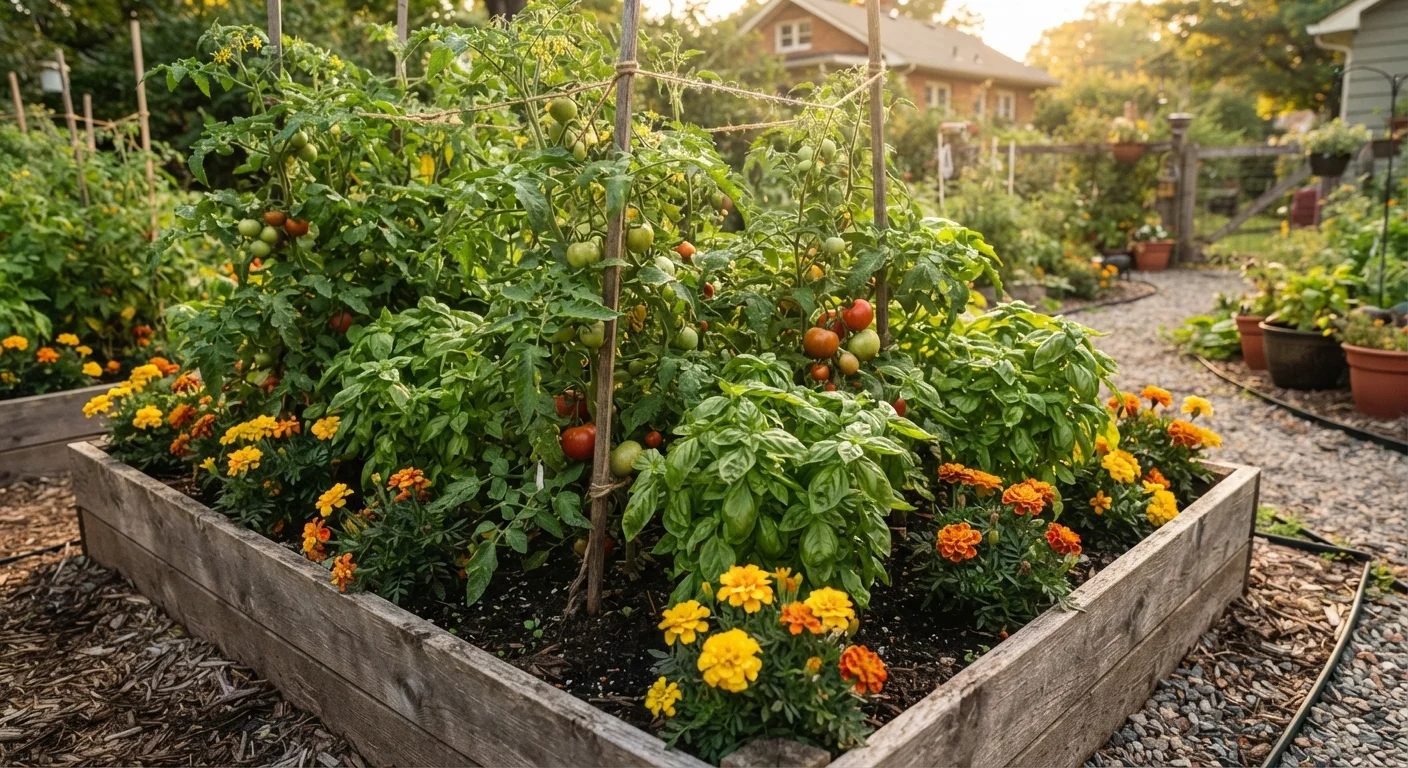
- Marigolds and vegetables: French marigolds (Tagetes patula) have been shown in multiple studies to reduce certain soil nematode populations when grown densely as a barrier or cover crop. Their pest-deterrent effect on above-ground insects is less consistent.
- Basil and tomatoes: A popular pairing, though research results are mixed. Many gardeners find value in the proximity, and basil also makes good use of the same bed space.
- Nasturtiums as trap crops: Nasturtiums attract aphids, drawing them away from nearby vegetables - an approach used in integrated pest management.
Where Companion Planting Has Limits
Not every folk pairing holds up under scrutiny. Some combinations recommended online are based on decades of repetition rather than evidence. The garden myths article offers a useful look at how gardening advice can persist long after the science moves on.
Results also depend heavily on local conditions: your pest populations, soil type, climate, and specific plant varieties all influence outcomes. A combination that works reliably in one region may have little effect in another.
Start Small and Observe
Rather than redesigning your entire garden around companion planting, try one or two documented pairings in a single bed for a full season. Compare that bed's pest pressure and yields to a similar bed without the companions. Your own observations over multiple seasons will give you far more reliable guidance than any general chart.
Companion planting also doesn't eliminate the need for strong foundational practices. Healthy soil remains the single most important factor in garden productivity - something home composting can support significantly over time.
Putting It Into Practice
Start with pairings that have documented support and match your garden's primary challenges. If aphids are a recurring problem, try interplanting nasturtiums. If you grow corn, add climbing beans. If you're working with limited beds, pair compact herbs with taller vegetables to make the most of vertical and horizontal space.
Keep notes across seasons. Because so many variables affect plant performance, your own observations in your specific garden are genuinely valuable. Track what you planted together, what pest pressure looked like, and what yields resulted. Over two or three seasons, patterns will emerge that are more reliable than any general recommendation.
Finally, remember that companion planting works best as part of a whole-garden approach - combined with good spacing, regular watering, quality soil amendments, and attentive observation. It's a technique worth using, as long as expectations stay grounded in what the evidence actually supports.