

Key Takeaways
- Pruning at the wrong time of year can remove flower buds or leave plants vulnerable to disease.
- Always cut just outside the branch collar to help trees seal wounds naturally.
- Removing more than one-third of a plant's canopy at once stresses most shrubs and trees.
- Clean, sharp tools reduce tearing and lower the risk of spreading plant disease.
- Knowing whether a shrub blooms on old or new wood determines the correct pruning window.
Why Timing Is the First Thing to Get Right
Most pruning damage isn't caused by cutting - it's caused by cutting at the wrong time. A lilac pruned in fall loses next spring's flower buds. An oak pruned in early spring in regions where oak wilt is prevalent can attract the beetles that spread it. Understanding your plant's biology before you pick up a tool is the single most important step.
The general rule for flowering shrubs: if it blooms before June, it likely flowers on old wood (growth from last year), so prune immediately after bloom. If it blooms after June, it likely flowers on new wood (current season's growth), so prune in late winter before growth begins. For most deciduous trees, late winter - while still dormant - is the safest window because disease pressure is lower and you can clearly see the branch structure.
Evergreen shrubs like boxwood and holly tolerate light shaping in late spring after the first flush of new growth hardens off. Heavy pruning during a summer heat wave stresses plants that are already working hard to manage moisture.
When in Doubt, Prune Less
If you're unsure of a plant's bloom timing or species-specific needs, err on the side of removing less rather than more. A conservative cut this season gives you time to research the plant properly. Over-pruning is far harder to reverse than under-pruning, and most healthy plants will tolerate a season without major work.
The Right Cut: Technique That Prevents Long-Term Harm
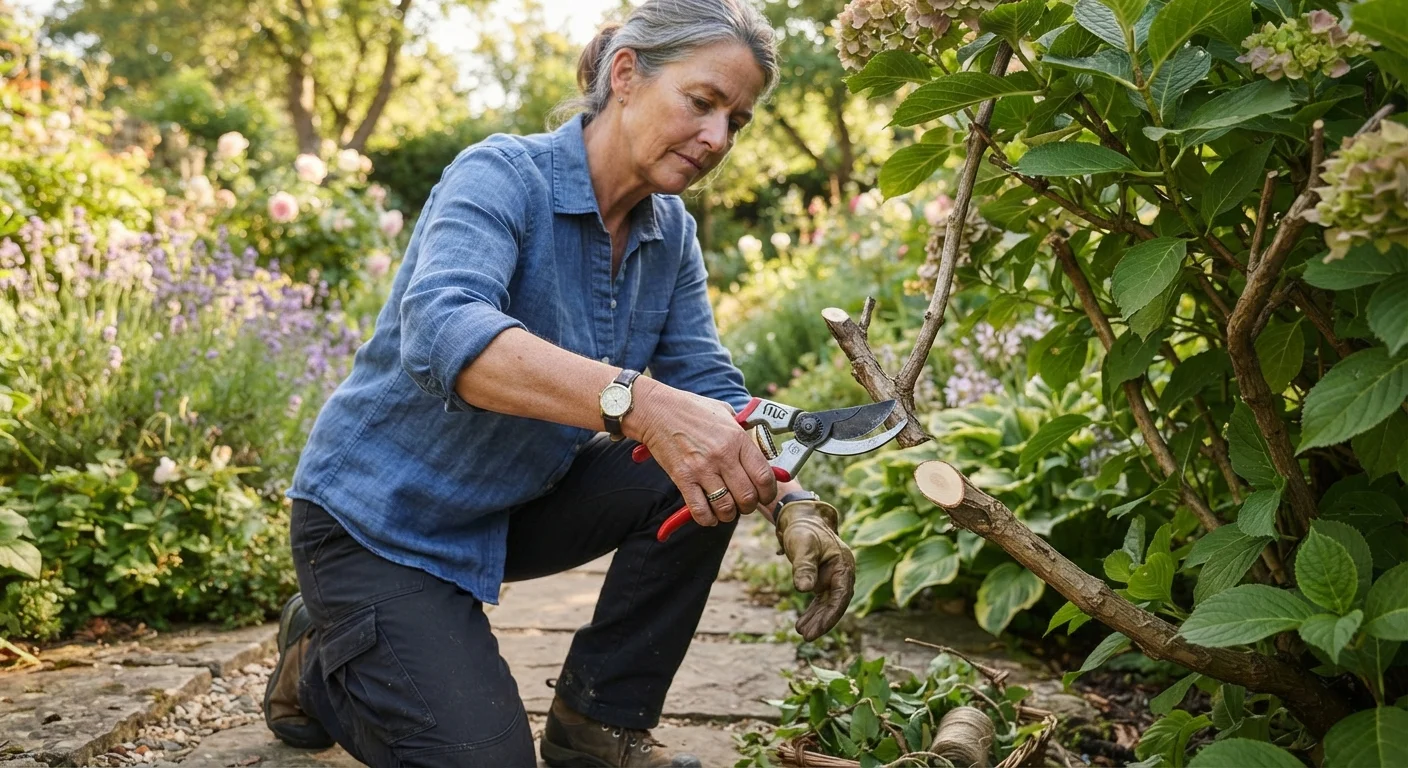
Where and how you make each cut determines whether the plant heals cleanly or develops decay. Every branch connects to the main stem or trunk at a slightly swollen base called the branch collar - a zone of specialized tissue that grows over wounds. Cutting flush with the trunk removes this collar and dramatically slows healing. Cutting too far out leaves a stub that dies back, creates an entry point for fungal rot, and never seals properly.
The correct technique: make the cut just outside the visible collar, angled slightly away from the bud or stem. On smaller shrubs, cut stems back to a healthy outward-facing bud at roughly a 45-degree angle, about a quarter-inch above the bud. This directs new growth outward and prevents moisture pooling on the cut surface.
Always use clean, sharp tools matched to the branch size.
Dull blades crush and tear plant tissue rather than cutting cleanly, creating ragged wounds that heal slowly and are more susceptible to fungal infection. Disinfecting blades between plants - particularly between diseased and healthy specimens - prevents pathogen transfer.
Cut just outside the branch collar, never flush with the trunk.
The branch collar contains tissue that actively grows over pruning wounds. Preserving it allows the tree to compartmentalize decay and seal the wound over time - a natural process arborists call CODIT (Compartmentalization of Decay in Trees).
Prune flowering shrubs according to whether they bloom on old or new wood.
Cutting at the wrong time removes the flower buds set during the previous season, eliminating a year's display without harming the plant structurally. Knowing bloom timing protects both the aesthetic and the plant's energy budget.
Limit removal to no more than one-third of the canopy per season.
Leaves are where photosynthesis happens. Removing too many at once depletes carbohydrate reserves the plant uses for root function, immune response, and stress tolerance. Heavy over-pruning can trigger excessive, weakly attached water sprouts rather than healthy structured growth.
Avoid pruning during periods of extreme heat or drought stress.
Plants under moisture stress are less able to mount the biological response needed to close wounds and resist infection. Pruning during a heat wave compounds the stress and can cause dieback beyond the cut site.
Wound sealants and tree paint were once widely recommended, but most horticultural research - including guidelines from university extension programs - now advises against them on healthy trees. They can trap moisture and interfere with the natural callus formation the branch collar performs on its own.
How Much to Remove - and What to Leave
The one-third rule is a widely cited benchmark in arboricultural guidance: avoid removing more than one-third of a plant's living canopy in a single season. Exceeding this threshold forces the plant to redirect substantial energy into regrowth rather than root development and disease resistance. On established trees, even this much removal can be stressful - consult a certified arborist before making major structural cuts on large or mature specimens.
Large Trees Require Professional Assessment
For any tree with branches larger than roughly two inches in diameter near a structure, power line, or high-traffic area, consulting a certified arborist is strongly recommended before pruning. Major structural cuts on mature trees carry risks - including branch failure and long-term structural weakness - that are difficult to assess without professional training. Many municipalities also have ordinances governing tree work near utility lines.
When thinning a shrub, prioritize removing dead, damaged, or crossing branches first. Crossed branches rub against each other, creating wounds that invite infection. Next, remove any branch growing toward the interior of the plant - good air circulation through the canopy reduces fungal disease. Shaping for aesthetics comes last.
For overgrown shrubs that have become woody and hollow, rejuvenation pruning - cutting the entire plant back hard - can be appropriate, but only for species that tolerate it (forsythia, spirea, and lilac generally do; rhododendrons and most needled evergreens do not). Even then, spread this process over two or three seasons when possible.
If you're also working to build a healthier outdoor space overall, pairing careful pruning with good mulching practices supports plant recovery. See our guide to mulch and how it works for details on keeping root zones insulated after pruning. And if you're developing your yard more broadly, the principles in native plant gardening can reduce how much pruning your landscape requires in the first place.