

Key Takeaways
- Your electrical panel splits incoming utility power into separate circuits, each protected by a dedicated breaker.
- Breakers trip automatically to prevent overheating, fires, and equipment damage - this is a safety feature, not a flaw.
- A tripped breaker usually signals an overloaded circuit, not a broken one; persistent tripping warrants professional evaluation.
- Panel labels describe which rooms or appliances each circuit serves - keeping them accurate is a simple but important safety practice.
- Most panel work beyond resetting a breaker should be handled by a licensed electrician.
Electrical Panel (Breaker Box)
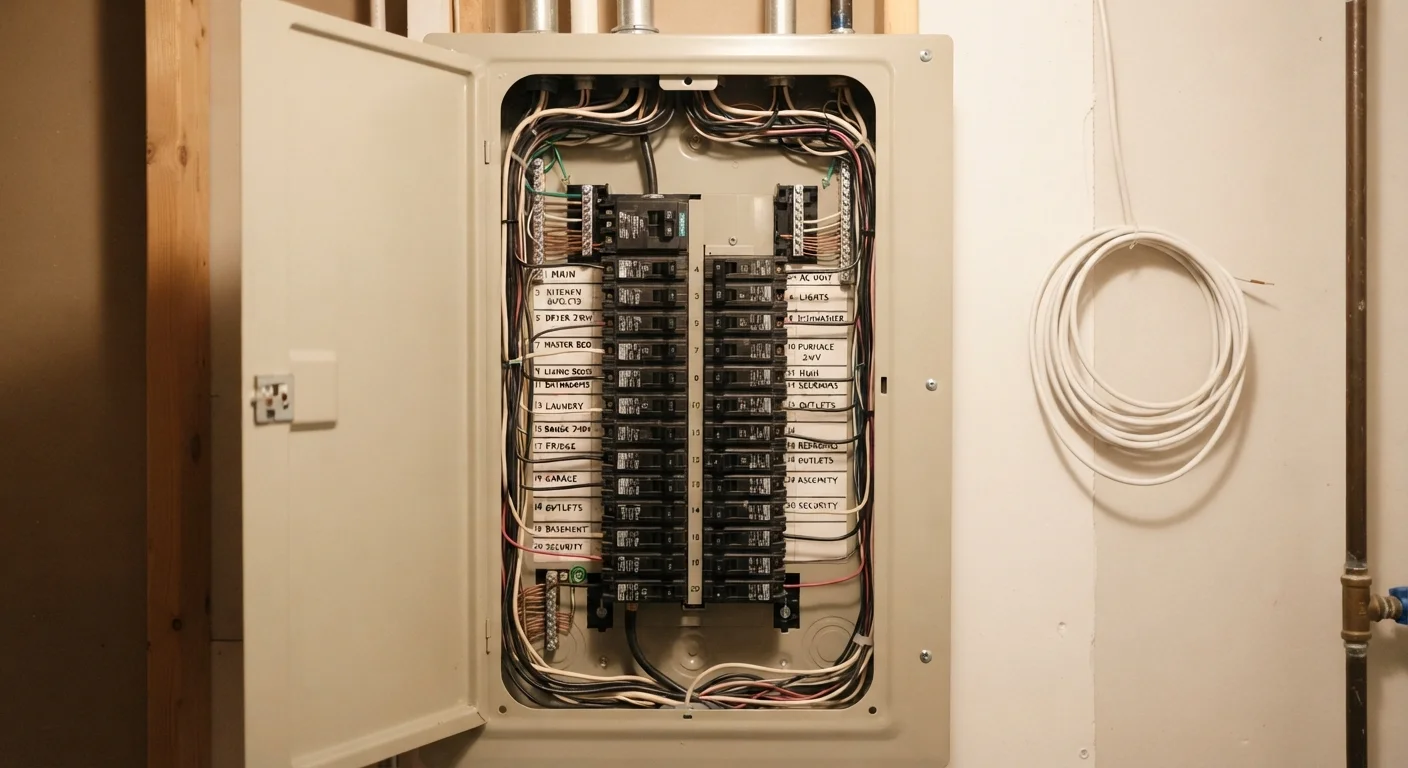
An electrical panel - often called a breaker box or load center - is the central hub where utility power enters your home and gets divided into individual circuits. Each circuit is protected by a breaker that automatically shuts off if too much current flows through it. Think of it as a traffic cop for electricity, keeping power organized and preventing overloads.
Modern residential panels are rated in amperes (typically 100A, 150A, or 200A), which describes the maximum current the panel can safely handle from the utility service entrance.
From the Street to Your Outlets: How Power Travels
Electricity arrives at your home through service entrance cables connected to the utility company's lines. Those cables feed directly into your electrical panel, passing first through a main breaker - a large switch, typically at the top of the panel, that can cut power to the entire house at once.
From the main breaker, power splits into individual branch circuits. Each branch circuit runs through its own breaker and then out through wiring to a specific area of the home: the kitchen outlets, the master bedroom lights, the bathroom, the HVAC system. This division serves two purposes: it ensures that a problem in one area doesn't knock out the whole house, and it limits how much current any single wire has to carry.
Residential wiring operates on two voltage levels. Standard outlets and light fixtures run on 120 volts, supplied by a single-pole breaker. Large appliances - electric ranges, central air conditioners, electric dryers - need 240 volts, delivered by a double-pole breaker that draws from both of the panel's incoming power legs simultaneously.
~51%
U.S. home electrical fires attributed to wiring and related equipment
According to the U.S. Fire Administration, electrical fires remain one of the leading causes of residential structure fires, with wiring equipment the most frequently cited factor.
200A
Panel capacity recommended for most modern homes
The National Electrical Contractors Association generally recommends 200-amp service for new residential construction to accommodate contemporary electrical demand, including HVAC and EV charging.
15-20A
Typical rating for standard branch circuit breakers
Most general-purpose household circuits use 15-amp breakers on 14-gauge wire or 20-amp breakers on 12-gauge wire, per National Electrical Code guidelines.
What a Breaker Is Actually Doing
A circuit breaker is an automatic switch that monitors the flow of current (measured in amperes, or amps) through a wire. Each breaker has a rating - typically 15A or 20A for standard household circuits - that reflects the maximum continuous current the associated wiring can safely handle.
When current exceeds that rating, the wire heats up. Left unchecked, that heat can damage insulation or ignite surrounding materials. The breaker detects the overload and trips: it mechanically opens the circuit, cutting power before damage occurs. This is entirely intentional - the breaker is sacrificing convenience to prevent a hazard.
Two main conditions cause tripping. An overload occurs when too many devices draw current simultaneously on one circuit - plugging a space heater, hair dryer, and toaster into outlets that share the same circuit is a classic example. A short circuit is more serious: it happens when electricity finds an unintended path, such as when a hot wire contacts a neutral or ground wire, causing a sudden surge of current. Short circuits often produce a loud pop and require inspection before the breaker is reset.
The Reset Sequence That Protects Your Breaker
Always unplug or switch off high-draw devices on the affected circuit before resetting a tripped breaker. Pushing the breaker back to ON while the overload condition still exists can cause it to trip again immediately, and repeated cycling can wear out the mechanism faster. Reduce the load first, then reset.
Reading the Panel Label - and Why It Matters
Inside the panel door, you'll find a directory - a small chart mapping each breaker number to the area or appliance it serves. Labels might read "Kitchen Outlets," "Master Bath," "Refrigerator," or "A/C Unit." In older homes, this chart may be incomplete, cryptic, or simply blank.
An accurate panel label is more than a convenience. In an emergency - a burning smell, flooding, or electrical shock - knowing which breaker controls a specific area can matter enormously. It also makes routine work, like cutting power before changing an outlet, much faster and safer.
If your panel labels are missing or inaccurate, mapping the circuits is a straightforward process using a circuit tracer tool or a helper moving through the house while you toggle breakers. Once mapped, write the labels in pencil (erasable for future changes) on the panel directory, or use printed adhesive labels designed for the purpose.
For a deeper look at what professionals examine when they assess a panel, see our article on what happens during a home electrical inspection.
Special Protective Devices in Modern Panels
Standard breakers protect wiring from overheating, but two additional breaker types guard against hazards that ordinary breakers can't detect.
Ground Fault Circuit Interrupters (GFCIs) monitor for current leaking outside the intended path - for instance, through a person in contact with water. They respond in milliseconds, far faster than a standard breaker, and are required by electrical codes in wet areas like bathrooms, kitchens, garages, and outdoors. GFCI protection can be built into individual outlets or into a GFCI breaker in the panel itself.
Arc Fault Circuit Interrupters (AFCIs) detect the erratic electrical arcing caused by damaged, pinched, or deteriorated wiring - a leading cause of home electrical fires. Modern building codes require AFCI breakers in most living areas of new construction. Ground fault vs. arc fault circuit interrupters serve different purposes, and understanding the distinction helps homeowners know what protection they already have - and what might be missing.
If your panel still uses older-style breakers throughout, a licensed electrician can assess whether upgrading to AFCI protection makes sense for your home's age and wiring condition.
When to Call a Professional
Resetting a tripped breaker is within any homeowner's reach. Everything beyond that - adding circuits, replacing breakers, upgrading panel capacity, or investigating repeated tripping - belongs in the hands of a licensed electrician. The interior of an energized panel contains lethal voltages even when the main breaker is off, because the service entrance conductors remain live.
Our guide on why DIY electrical work goes wrong explains in detail how well-intentioned panel work can create fire hazards or code violations that surface during a home sale inspection. Electrical permits and licensed trades are required for most panel work in U.S. jurisdictions - verify the requirements with your local building department before any project begins.
This article is for general informational purposes only. Electrical work involves serious shock and fire hazards. Always consult a licensed electrician for any work beyond basic breaker resets, and verify local code and permit requirements before starting any electrical project.