

Key Takeaways
- Dealer service centers specialize in your vehicle's make and use factory-trained technicians and OEM parts.
- Independent mechanics often charge lower labor rates and can handle most routine and preventive maintenance capably.
- Servicing at a dealership is generally not required to keep a factory warranty valid under federal law.
- Transparency and communication quality vary at both types of shops - always ask for a written estimate.
- Your vehicle's age, warranty status, and repair complexity can all influence which option makes more sense.
Our Verdict
Neither dealer service centers nor independent mechanics are universally better - the right choice depends on your vehicle's age, warranty status, and the complexity of the work needed. Dealers offer brand-specific expertise and seamless warranty integration, while independent shops frequently deliver comparable quality for routine maintenance at more competitive rates. Understanding both options helps you make a more confident decision each time your car needs service.
| Best for | Recommended |
|---|---|
| Owners of newer vehicles still under manufacturer warranty | Dealer Service Center |
| Drivers seeking routine maintenance at lower labor rates | Independent Mechanic |
| Those dealing with recalls, technical service bulletins, or complex electronic diagnostics | Dealer Service Center |
| Owners of older, out-of-warranty vehicles needing cost-effective upkeep | Independent Mechanic |
What Each Option Actually Provides
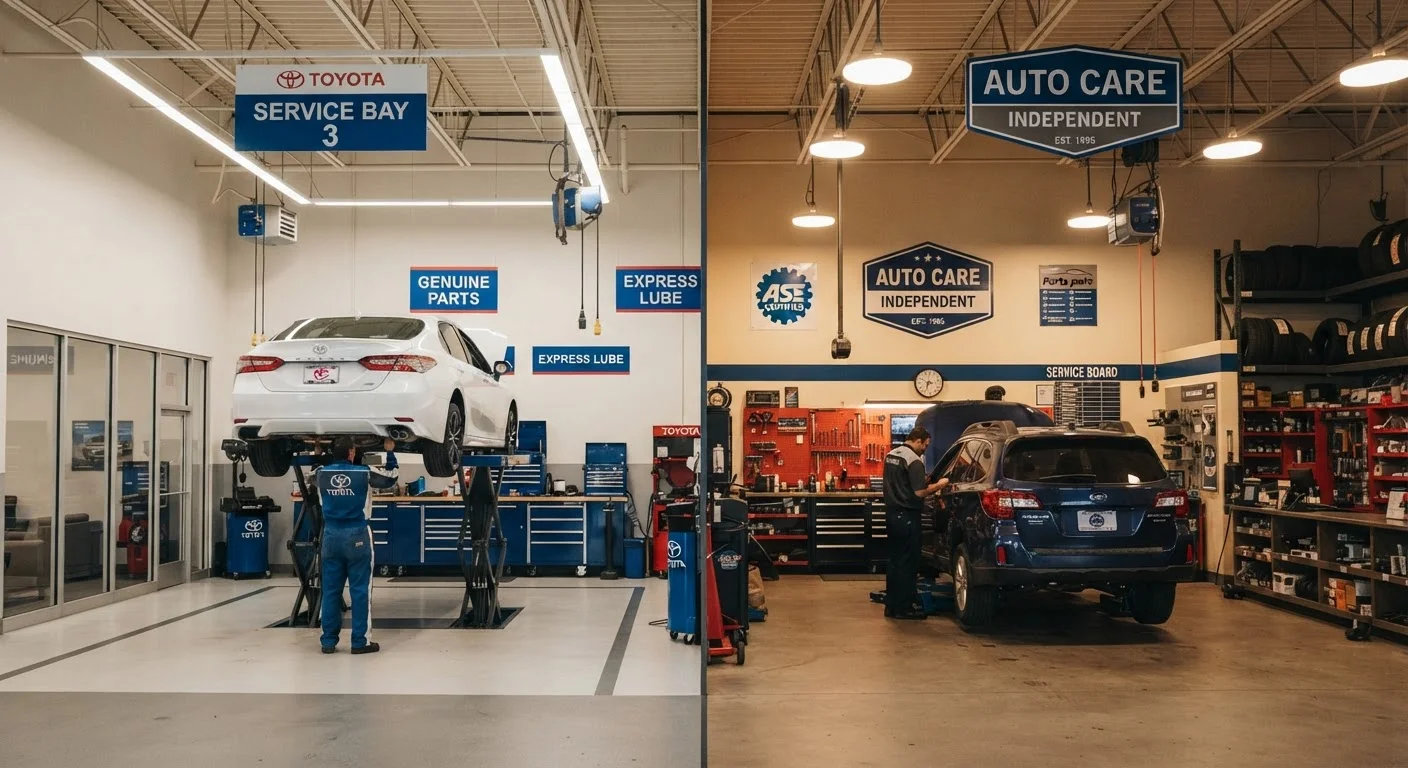
When your vehicle needs an oil change, brake inspection, or more significant repair, you have two primary choices: return to a franchised dealership's service department or visit an independently owned repair shop. Both are staffed by trained professionals, but they operate under different structures that affect pricing, parts sourcing, and specialization.
Dealer service centers are owned by franchised dealerships and staffed by technicians who receive manufacturer-specific training. They have direct access to Original Equipment Manufacturer (OEM) parts - components built to the same specifications as those installed during production - and proprietary diagnostic software designed for that brand's vehicles.
Independent mechanics operate outside any manufacturer relationship. They typically work on a broader range of makes and models and source parts through aftermarket suppliers or OEM distributors. Many independent technicians hold ASE (Automotive Service Excellence) certifications, which represent a widely recognized industry standard for competency. For a deeper look at how to interpret what a shop is actually proposing to do, see how to read a mechanic's estimate.
Cost and Pricing Transparency
Labor rates at dealership service centers are generally higher than those at independent shops, reflecting overhead costs, facility requirements, and manufacturer certification programs. For straightforward services - oil changes, tire rotations, cabin air filter replacements - this cost difference can be meaningful over time.
Independent mechanics frequently offer more flexible pricing and may be more willing to discuss part sourcing options, including the trade-off between OEM and quality aftermarket components. That said, pricing transparency is a shop-by-shop variable, not a categorical advantage of either type.
Always Get a Written Estimate
Regardless of where you take your vehicle, always request a written estimate before authorizing any work. This protects you and gives you a basis for asking questions if the final bill differs. Many states have consumer protection laws requiring shops to provide written estimates above a certain dollar threshold - verify what applies in your area.
Regardless of where you take your vehicle, always request a written estimate before authorizing any work. This protects you and gives you a basis for asking questions if the final bill differs. Many states have consumer protection laws requiring shops to provide written estimates above a certain dollar threshold - verify what applies in your area.
Warranty Considerations
A common misconception is that you must use a dealership's service center to keep your factory warranty intact. Under the federal Magnuson-Moss Warranty Act, manufacturers generally cannot void a vehicle's warranty solely because routine maintenance was performed at an independent shop, provided the service meets the manufacturer's specifications. However, warranty claims involving specific failures can become complicated if there's evidence of improper service or non-compliant parts.
If your vehicle is still within its bumper-to-bumper or powertrain warranty period, using the dealer is the path of least friction for warranty-related repairs - those are handled in-house at no charge when covered. For vehicles well past their warranty period, the calculus shifts, and an independent shop may offer better value without warranty implications.
| Dealer Service Center | Independent Mechanic | |
|---|---|---|
| Technician Training | Manufacturer-certified, brand-specific | ASE-certified, multi-make generalist |
| Parts Used | OEM parts standard | OEM or quality aftermarket options |
| Labor Rates | Generally higher | Often lower |
| Warranty Repairs | Handled in-house at no charge | Cannot perform recall or warranty work |
| Recall & TSB Access | Full access, no cost to owner | Not available |
| Diagnostic Capability | Proprietary tools for that brand | General tools; may have limitations |
| Routine Maintenance Quality | Reliable, brand-specified | Comparable for most standard services |
| Pricing Flexibility | Less room to negotiate | More flexible on parts and labor |
Expertise, Diagnostics, and Special Situations
Dealer technicians have an edge in brand-specific diagnostic situations. Modern vehicles rely heavily on proprietary software systems, and manufacturer scan tools can access data that generic aftermarket tools sometimes cannot. For complex electronic issues, transmission relearns, or recalls, the dealership is typically better equipped.
Recalls and Technical Service Bulletins (TSBs) - manufacturer-issued notices about known defects or recommended fixes - are handled exclusively through authorized dealerships at no cost to the consumer. Independent shops cannot perform recall repairs.
For routine preventive maintenance, however, the diagnostic complexity is low. Services like oil changes, belt inspections, coolant flushes, and brake pad replacements are well within the capability of a competent independent technician. If you're evaluating a used vehicle before purchase, an independent inspection can be particularly valuable - see how a pre-purchase inspection works for what to expect from that process.
Understanding your oil specification is one practical example where manufacturer guidance matters regardless of where you go - your owner's manual will specify whether your engine calls for synthetic or conventional oil, a distinction covered in detail in our synthetic vs. conventional motor oil guide.