

| Legal requirement | Liability only (in nearly all U.S. states) |
| Covers damage to others | Liability |
| Covers your vehicle in a crash | Collision |
| Covers theft, weather, animals | Comprehensive |
| Deductible applies to | Collision and comprehensive (not liability) |
| Lender requirement | Both collision and comprehensive for financed/leased vehicles |
Why These Three Coverage Types Form the Foundation
Auto insurance policies can seem like a maze of terms and options, but nearly every policy in the U.S. is built around three core coverage categories: liability, collision, and comprehensive. Knowing what each one does - and doesn't - cover is essential before you can make an informed decision about your policy. For a broader orientation to how auto insurance works overall, see our full auto insurance primer.
| Legal requirement | Liability only (in nearly all U.S. states) |
| Covers damage to others | Liability |
| Covers your vehicle in a crash | Collision |
| Covers theft, weather, animals | Comprehensive |
| Deductible applies to | Collision and comprehensive (not liability) |
| Lender requirement | Both collision and comprehensive for financed/leased vehicles |
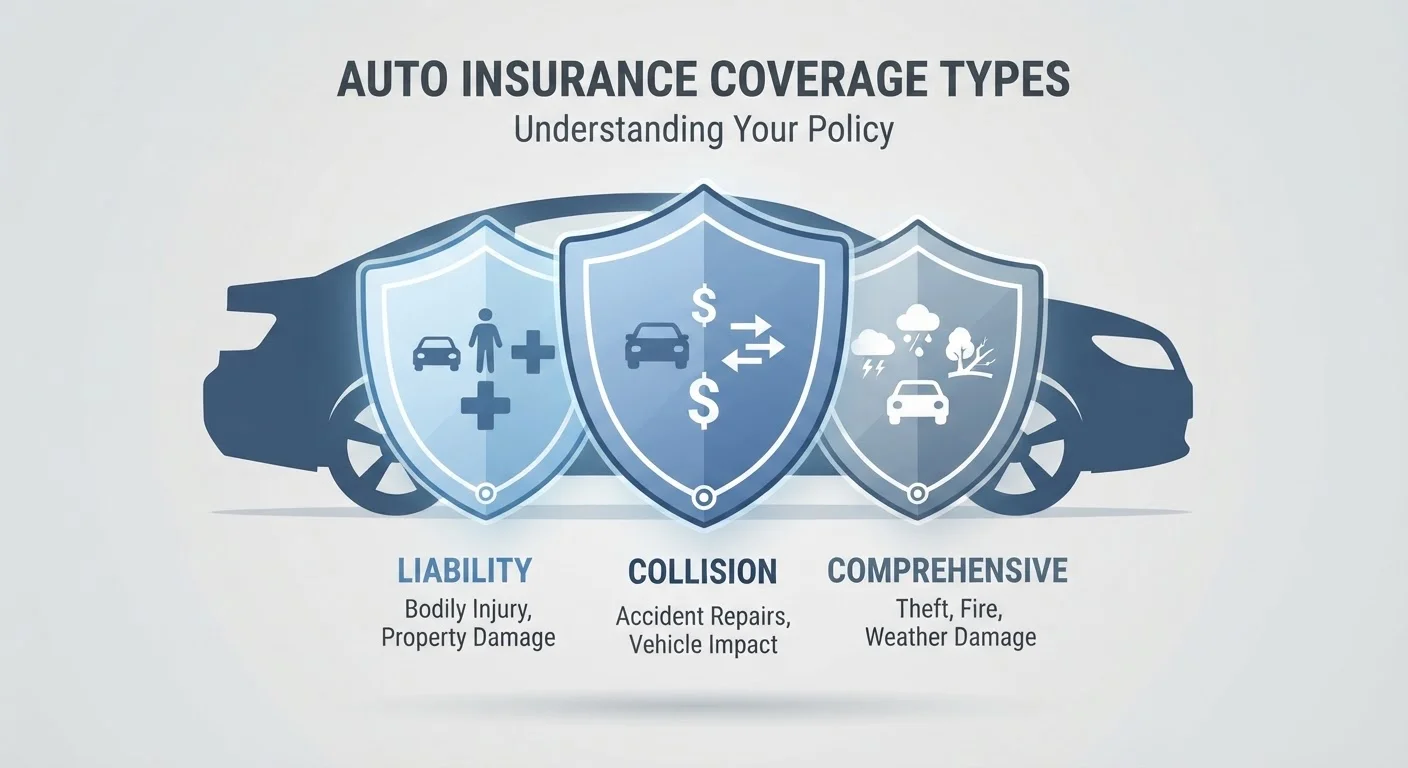
Each coverage type responds to a different category of risk. Liability covers harm you cause to others. Collision covers damage to your own vehicle from crashes. Comprehensive covers your vehicle from a wide range of non-collision events. Together, they address the most common and financially significant scenarios drivers face.
Liability Coverage: Protecting Others From Your Mistakes
Liability coverage is the legally required minimum in nearly every U.S. state. It pays for injuries and property damage you cause to other people in an at-fault accident - it does not pay for your own injuries or vehicle damage.
Liability is typically expressed as a split limit (for example, 25/50/25), representing:
- Bodily injury per person - the maximum paid for one injured individual
- Bodily injury per accident - the maximum paid for all injuries in one accident
- Property damage per accident - the maximum paid for damage to others' property
State minimums are often lower than what serious accidents actually cost. Carrying only the minimum leaves you personally responsible for any expenses above the policy limit. Many drivers choose higher limits to protect their personal assets. For clarity on the terminology used in actual policy documents, our auto insurance glossary is a useful reference.
Liability coverage
Pays for bodily injury and property damage you cause to others in an at-fault accident. It does not cover your own vehicle or injuries.
Collision coverage
Pays to repair or replace your vehicle after it is damaged in a crash with another vehicle or object, subject to your deductible.
Comprehensive coverage
Pays for damage to your vehicle from non-collision events such as theft, fire, hail, flooding, and animal strikes, subject to your deductible.
Deductible
The fixed dollar amount you pay out of pocket when you file a claim before your insurer covers the remaining cost. Higher deductibles generally mean lower premiums.
Split limit
A way of expressing liability coverage as three separate numbers - bodily injury per person, bodily injury per accident, and property damage per accident.
Subrogation
The process by which your insurance company seeks reimbursement from the at-fault party's insurer after paying your claim.
Collision Coverage: When Your Car Takes the Hit
Collision coverage pays to repair or replace your vehicle after it is damaged in a crash - whether you collide with another vehicle, a guardrail, a fence, or any other object. It applies regardless of who caused the accident, though if another driver is at fault, your insurer may pursue reimbursement from theirs through a process called subrogation.
Collision coverage always comes with a deductible - the amount you pay out of pocket before your insurer covers the rest. Choosing a higher deductible generally lowers your premium, but increases your costs after a claim. Our article on how deductibles work breaks down this trade-off in detail.
Collision is not required by law, but lenders typically require it when you're financing or leasing a vehicle. For older vehicles with low market value, some owners choose to drop it - comparing the coverage cost against what the insurer would actually pay is key.
Comprehensive Coverage: Protection Beyond the Road
Despite its name, comprehensive coverage doesn't cover everything - but it does cover a broad range of events that have nothing to do with collisions. Common examples include:
- Theft or vandalism
- Weather events: hail, flooding, wind damage
- Fire
- Falling objects (tree limbs, debris)
- Animal strikes (such as hitting a deer)
Like collision, comprehensive carries a deductible and is not legally mandated. Lenders routinely require it alongside collision for financed or leased vehicles. For a direct side-by-side look at how collision and comprehensive differ, see our collision vs. comprehensive breakdown.
If you owe more on a vehicle than it is currently worth, gap insurance can work alongside comprehensive and collision to cover that financial shortfall after a total loss.
This article provides general educational information about auto insurance coverage types and is not personalized insurance or legal advice. Coverage terms, limits, and requirements vary by state and insurer. Always review your actual policy documents and consult a licensed insurance professional for guidance specific to your situation.