

Key Takeaways
- Zigbee operates on the 2.4 GHz band and supports a broader, more varied device ecosystem at generally lower price points.
- Z-Wave uses a dedicated 908.42 MHz frequency in the U.S., largely avoiding interference from Wi-Fi and Bluetooth devices.
- Both protocols use mesh networking, meaning devices relay signals and extend network range automatically.
- Z-Wave limits each network to 232 devices; Zigbee networks can theoretically support far more nodes.
- Hub compatibility - not the protocol alone - often determines which standard works best for your existing setup.
Option A
Zigbee
The open-standard, device-rich mesh protocol.
Best for: Consumers who want a wide variety of compatible devices and are comfortable managing a more open ecosystem.
Option B
Z-Wave
The dedicated, interference-resistant home automation standard.
Best for: Homeowners who prioritize a stable, interference-free network and are willing to pay a slight premium for certified interoperability.
If you want the widest possible device selection
Zigbee
Zigbee's open standard has been adopted by a larger number of manufacturers, giving you more devices at more price points to choose from.
If interference and reliability are your top priorities
Z-Wave
Z-Wave's dedicated sub-GHz frequency avoids the crowded 2.4 GHz band, reducing the chance of signal conflicts with Wi-Fi and Bluetooth gear.
If you're building a large-scale smart home with dozens of devices
Zigbee
Zigbee's higher node capacity makes it better suited to complex installations where you expect to add many devices over time.
If you value strict certification and guaranteed interoperability
Z-Wave
Z-Wave Alliance certification requires rigorous backward-compatibility testing, so certified devices are reliably designed to work together.
If you already own a multi-protocol hub
Zigbee
Many popular smart home hubs include Zigbee support as standard, making it the path of least resistance for hub-first setups.
What Zigbee and Z-Wave Actually Are
Zigbee and Z-Wave are both wireless mesh protocols - communication standards that let smart home devices talk to each other and to a central hub without relying on your home's Wi-Fi network. Unlike Wi-Fi-connected smart devices, which put every gadget directly on your internet router, these protocols use a dedicated radio layer designed specifically for low-power home automation. For a broader look at how these fit alongside other wireless options, see the wireless protocols powering smart homes.
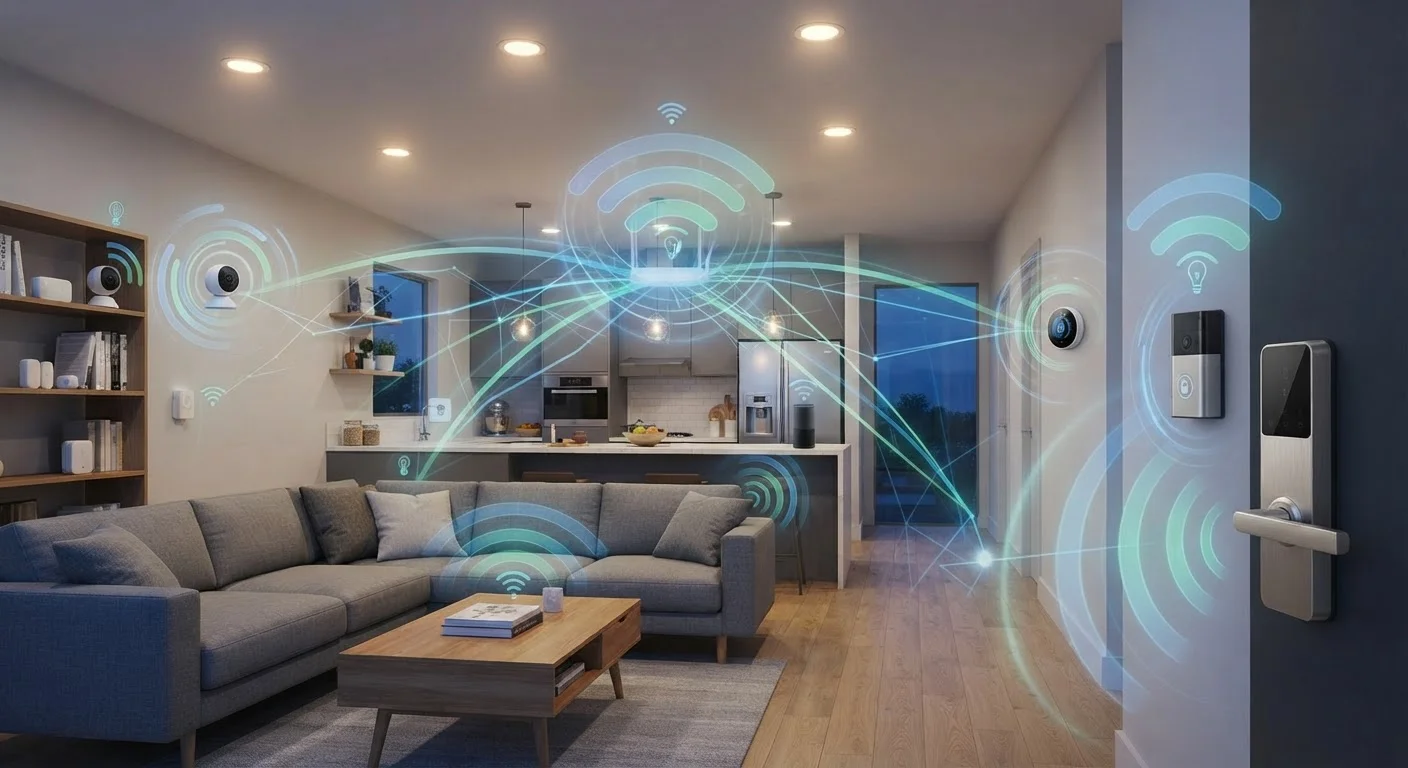
In a mesh network, each device acts as both an endpoint and a signal repeater. A smart plug across the house can relay a command from your hub to a door lock that would otherwise be out of direct range - the network routes around obstacles automatically. This is a key advantage both protocols share over simple point-to-point radio systems.
The differences start with the radio frequency each uses and the standards body controlling the specification. Zigbee is governed by the Connectivity Standards Alliance (CSA) and operates on the 2.4 GHz band, the same crowded frequency used by most Wi-Fi routers and Bluetooth devices. Z-Wave is managed by the Z-Wave Alliance and transmits on 908.42 MHz in the United States - a sub-gigahertz band largely free of competition from consumer electronics.
| Criterion | Zigbee | Z-Wave |
|---|---|---|
| Frequency band | 2.4 GHz (shared) | 908.42 MHz U.S. (dedicated) |
| Typical indoor range per hop | 30-60 feet | Up to 100 feet |
| Max devices per network | 65,000+ (theoretical) | 232 devices |
| Interference risk | Higher (shared with Wi-Fi, BT) | Lower (dedicated sub-GHz) |
| Device ecosystem size | Very large, broad price range | Large, skews higher-end |
| Standard type | Open, royalty-free | Proprietary, Alliance-certified |
| Interoperability guarantee | Improved with Zigbee 3.0 | Strong backward compatibility |
| Hub required | Yes | Yes |
Range, Interference, and Network Resilience
Z-Wave's lower frequency gives its signals better ability to penetrate walls and travel longer distances per hop - roughly 100 feet indoors under typical conditions. Zigbee's 2.4 GHz signals are more susceptible to absorption by building materials and to interference from nearby Wi-Fi networks and microwave ovens. In practice, individual Zigbee hops average closer to 30-60 feet indoors, though the mesh architecture compensates by routing signals through multiple devices.
For most homes, interference rarely causes noticeable problems with either protocol when the network is properly set up. Where Z-Wave has a tangible edge is in dense urban environments - apartments or townhomes surrounded by dozens of competing 2.4 GHz networks - where Zigbee's shared band can become genuinely congested.
232
Max Z-Wave devices per network
The Z-Wave specification caps each network at 232 nodes - sufficient for most homes but a firm ceiling for very large installations.
2.4 GHz
Zigbee's shared radio frequency
Zigbee operates on the same band as most home Wi-Fi routers and Bluetooth devices, which can create signal competition in dense environments.
908.42 MHz
Z-Wave's U.S. operating frequency
This sub-gigahertz band is largely free of consumer electronics interference, a deliberate design choice by the Z-Wave Alliance for reliability.
Both protocols are self-healing: if a device drops off the network, traffic reroutes automatically through other nodes. This resilience makes them far more dependable for automations like security sensors or smart locks than simple Bluetooth or IR-based devices. If you're thinking about how your home network infrastructure supports all this, a well-structured home network is still foundational even when smart devices run on their own protocols.
Device Ecosystems and Hub Requirements
Neither Zigbee nor Z-Wave connects directly to your phone or router out of the box - both require a compatible hub or gateway to bridge commands between the protocol and your app or voice assistant. Popular hubs like SmartThings, Home Assistant, and Hubitat support both protocols, often on the same device, giving you flexibility to mix and match.
Where the two diverge sharply is in the breadth of available products. Because Zigbee is an open standard with no licensing fee for manufacturers, it has been adopted by a significantly larger number of device makers. You'll find Zigbee radios in everything from budget smart bulbs to professional-grade sensors. Z-Wave's ecosystem, while substantial - with thousands of certified devices - tends to skew slightly toward higher-end hardware, reflecting the Alliance's certification overhead.
Z-Wave's strict certification process is a double-edged sword: it means every certified device must meet backward-compatibility requirements going back to earlier protocol versions, but it also means fewer ultra-low-cost options. Zigbee's openness has occasionally produced interoperability headaches between devices from different manufacturers, though the newer Zigbee 3.0 standard has significantly improved cross-brand consistency.
If you're just getting started, Smart Home 101 explains how hubs, protocols, and devices fit together in plain language - a useful foundation before committing to either standard.
A Note on Matter and Future Compatibility
The Matter smart home standard - backed by Apple, Google, Amazon, and the CSA - is designed to unify smart home ecosystems across brands. While Matter currently focuses on Wi-Fi and Thread as its transport layers, the CSA (which also governs Zigbee) has outlined bridging strategies. Z-Wave has announced its own Matter integration path. Neither protocol is being abandoned, but if long-term interoperability is a priority, it's worth checking whether your chosen hub has a stated Matter roadmap.
Making the Call for Your Home
For most first-time buyers, the decision often comes down to what hub you already own or plan to buy, and what devices are available for it. If your hub supports both protocols, you're not locked in - you can run Zigbee bulbs and Z-Wave door locks on the same system simultaneously.
If you're starting from scratch, consider your environment. A larger home with thick walls and fewer neighboring Wi-Fi networks is a reasonable match for either protocol. A densely packed apartment building or a setup that will eventually include 50-plus devices may benefit from Z-Wave's cleaner frequency or Zigbee's higher node ceiling, respectively. And if you're worried that smart home setups are inherently complicated, common home automation myths are worth separating from reality before you decide.
The good news: neither protocol is a dead end. Both are mature, actively maintained standards with strong manufacturer support. Choosing one over the other is far less consequential than selecting a hub ecosystem that suits your long-term needs.