

Key Takeaways
- MVNOs lease tower access from major carriers and resell it under their own brand names.
- Your signal quality depends on which major network the MVNO uses as its host.
- MVNO customers are often deprioritized during network congestion compared to the host carrier's own subscribers.
- MVNOs typically offer lower monthly costs by cutting out retail stores and device subsidies.
- Switching to an MVNO is straightforward and you can usually keep your existing phone number.
- Not all MVNOs offer the same features - international roaming, hotspot access, and 5G availability vary widely.
MVNO (Mobile Virtual Network Operator)
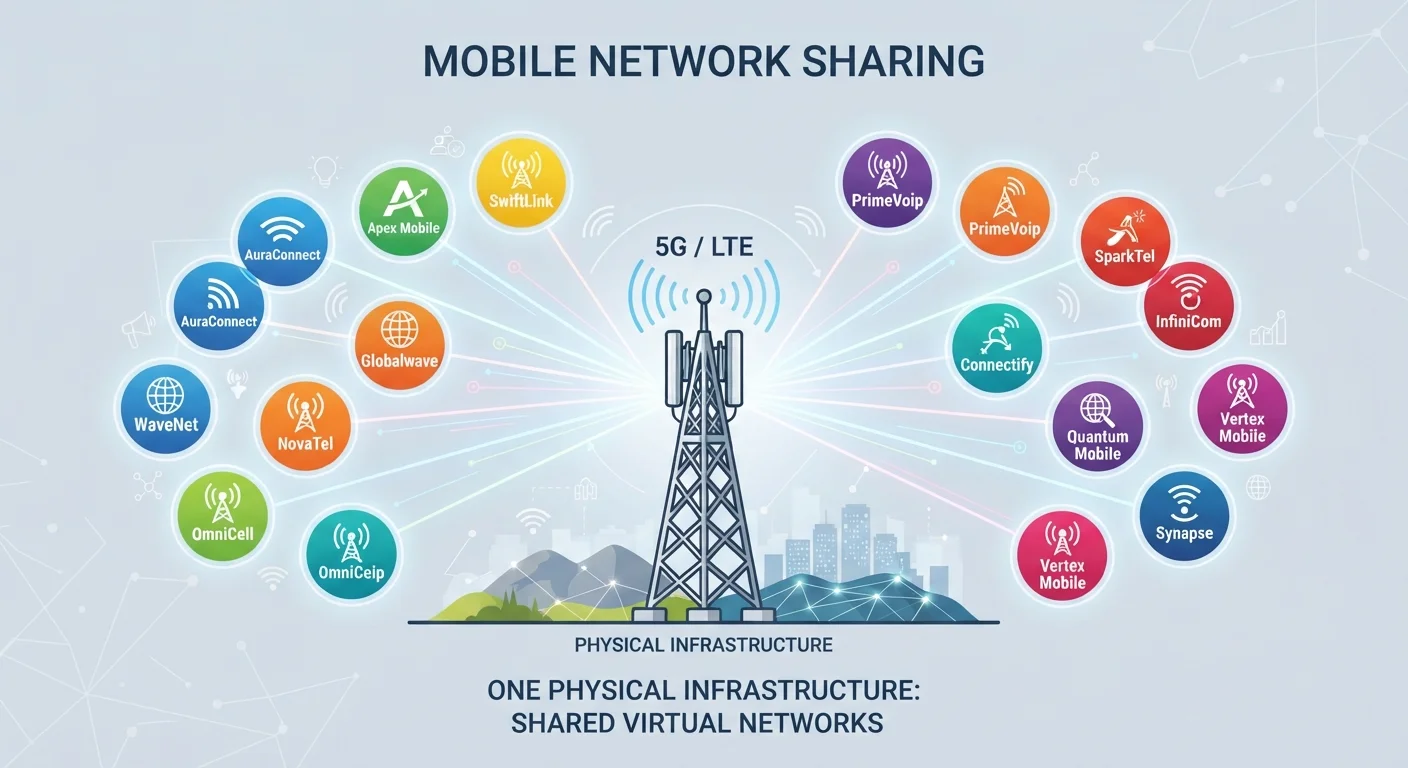
An MVNO is a wireless carrier that doesn't own the cell towers or spectrum it uses. Instead, it buys network capacity in bulk from one of the major carriers and resells it to customers under its own brand and pricing. You get real cellular service on real towers - just through a middleman who often charges less.
MVNOs negotiate wholesale access agreements with host networks (called MNOs, or Mobile Network Operators). The terms of these agreements - including how much data priority they receive - vary and are rarely disclosed publicly.
What an MVNO Actually Is
When most people think about choosing a wireless carrier, they picture the handful of major names with storefront locations in every mall. But dozens of smaller carriers operate on the same infrastructure - connecting to the same towers, using the same spectrum - without anyone realizing it.
These are MVNOs, or Mobile Virtual Network Operators. They don't build or maintain cell towers. Instead, they purchase wholesale access to an existing carrier's network and package that access into their own plans, at their own price points, under their own branding.
The major carriers that own the physical infrastructure - AT&T, T-Mobile, and Verizon - are called MNOs, or Mobile Network Operators. MVNOs piggyback on one (sometimes more) of these networks through behind-the-scenes wholesale agreements.
Your Phone Can't Tell the Difference
From a technical standpoint, your phone has no way of knowing whether it's on an MVNO or the host MNO directly. The signal path is identical. What differs is the billing relationship, customer support structure, and how your data traffic is prioritized when the network gets busy.
From a technical standpoint, your phone has no way of knowing whether it's on an MVNO or the host MNO directly. The signal path is identical. What differs is the billing relationship, customer service, and how you're treated during periods of network congestion.
Why MVNOs Often Cost Less
The price gap between MVNOs and major carriers is real, and it's not a trick. MVNOs typically operate with a fundamentally leaner business model:
- No physical retail stores - Most MVNOs are online-only or sold through third-party retailers, cutting enormous overhead.
- No device subsidies - Major carriers spend billions subsidizing flagship smartphones as customer acquisition tools. MVNOs generally don't.
- Simpler plan structures - Fewer tiers, fewer add-ons, and less bundling keep operations streamlined.
Those savings get passed along as lower monthly rates. A plan on an MVNO that uses the same network as a major carrier might cost significantly less per month for comparable data allowances. That said, the trade-offs are real and worth understanding before you switch.
60+
Active MVNOs operating in the U.S.
Industry estimates suggest more than 60 MVNOs actively sell wireless service to American consumers, spanning budget brands, regional carriers, and niche providers.
~20%
U.S. wireless subscribers on MVNOs
Analysts estimate roughly one in five U.S. wireless subscribers is served by an MVNO rather than a major network operator directly, a share that has grown steadily over the past decade.
The Key Trade-Offs You Should Know
The most important difference between being an MVNO customer and a direct carrier customer isn't coverage on a map - it's network priority. When a cell tower gets congested, host carriers typically serve their own postpaid subscribers first. MVNO customers, regardless of how much data their plan includes, are commonly placed lower in the priority queue.
In practice, this means you may experience slower speeds during peak hours in dense urban areas, sporting events, or crowded venues - even if your coverage map looks identical to what a major carrier shows.
Other trade-offs to consider:
- Customer support - MVNOs often have limited phone support, relying more on chat, email, or community forums.
- International roaming - Many MVNOs offer limited or no international roaming, or charge significantly more for it.
- Hotspot access - Some MVNOs restrict mobile hotspot usage or cap it at low speeds. See our overview of hotspot and tethering rules for context.
- Device compatibility - Phones must be unlocked and compatible with the host network's bands. eSIM support varies by MVNO as well.
MVNOs also tend to lean toward prepaid billing structures. If you're weighing prepaid versus postpaid options more broadly, our article on prepaid vs. postpaid wireless walks through those structural differences in detail.
Who MVNOs Work Best For
MVNOs aren't for everyone, but they're genuinely well-suited for a broad group of consumers:
- People who use Wi-Fi heavily at home and work, reducing reliance on cellular data
- Those who don't travel internationally often or can plan around limited roaming options
- Households looking to reduce monthly bills without changing phones or coverage areas
- Light-to-moderate data users who don't need premium streaming perks bundled into their plan
If you're considering making the move, it's worth understanding the switching process. You can transfer your existing phone number to an MVNO - that right is protected under FCC rules. Our guide to switching carriers without losing your number covers the porting process and timing in plain terms.
Before locking into any plan - MVNO or otherwise - it's also worth reading the fine print carefully. Promotional pricing, data caps, and autopay conditions exist across both MVNOs and major carriers. The same discipline that applies to reviewing a two-year carrier contract applies here, even when there's no long-term commitment involved.