

Key Takeaways
- Fiberglass batts are the most cost-accessible option and work well in open, standard-framed wall cavities.
- Spray foam offers the highest air-sealing performance but requires professional installation and carries a higher upfront cost.
- Blown-in insulation excels at filling irregular spaces like attic floors and is a strong retrofit choice.
- R-value per inch varies significantly across types, affecting how much space each option needs to meet code.
- The right insulation type depends on the specific space, your climate zone, your budget, and whether it's new construction or a retrofit.
Our Verdict
No single insulation type wins across every scenario. Fiberglass batts remain a practical, widely available choice for standard framing; spray foam delivers superior air sealing in complex or high-performance applications; and blown-in insulation is often the most practical solution for attics and hard-to-reach retrofit spaces. Matching the material to the job - rather than defaulting to one type - consistently produces better energy performance and value.
| Best for | Recommended |
|---|---|
| Budget-conscious projects with open wall cavities and standard framing | Fiberglass Batts |
| High-performance builds or spaces needing both insulation and air sealing | Spray Foam |
| Attic retrofits or filling irregular, hard-to-reach areas | Blown-In |
How These Three Insulation Types Work
All three insulation types slow heat transfer, but they do so through different physical mechanisms - and that difference shapes where each performs best.
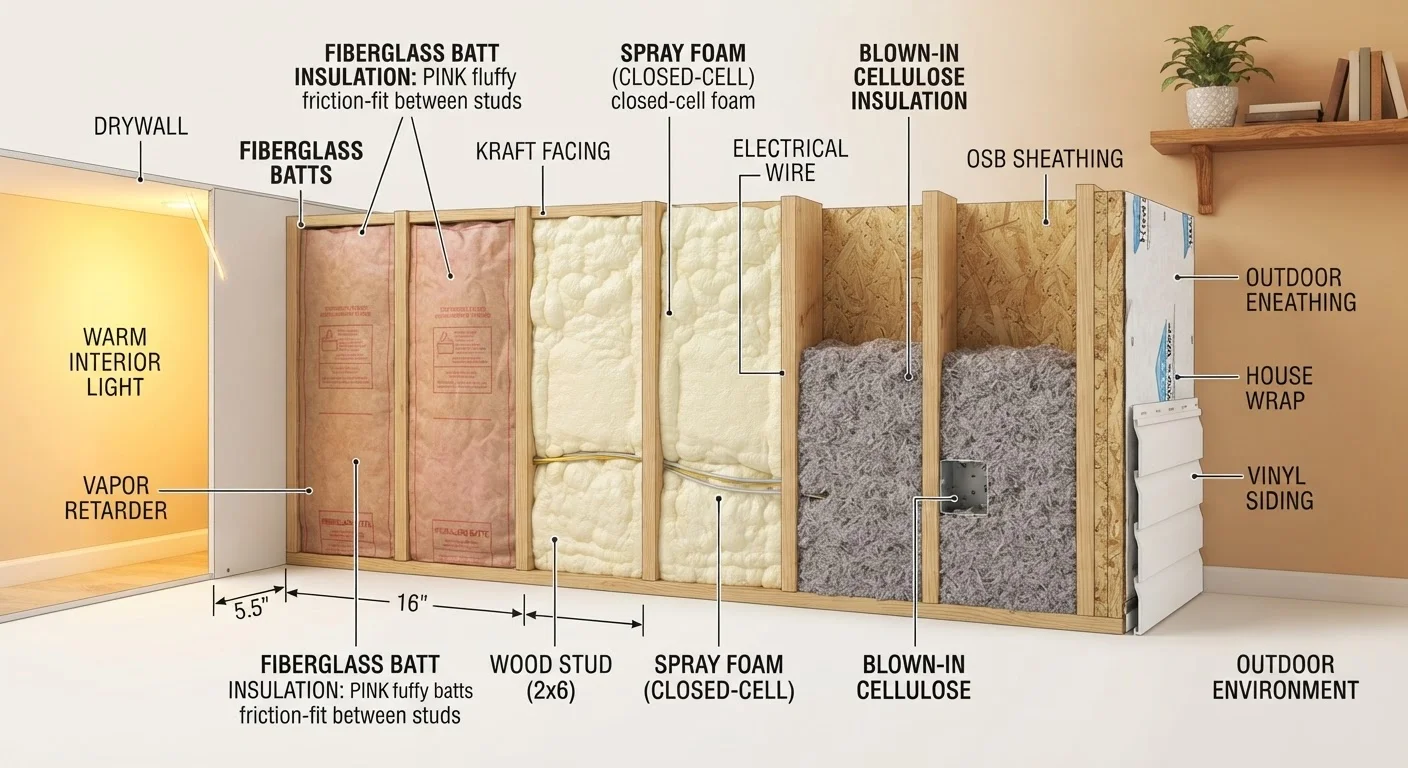
Fiberglass batts are pre-cut panels of spun glass fibers that trap air within their matrix. They're designed to fit snugly between standard wall studs or floor joists spaced 16 or 24 inches apart. Because they come in set dimensions, installation is relatively straightforward for DIY-capable homeowners in open framing situations.
Spray polyurethane foam (SPF) is applied as a liquid that expands and hardens, filling cavities and bonding to surfaces. Open-cell foam remains soft and flexible; closed-cell foam cures rigid and dense. Closed-cell spray foam also acts as a vapor retarder, which matters in certain climate zones. Because spray foam involves chemical components and specialized equipment, professional installation is typically required and strongly recommended for safety reasons.
Blown-in insulation - usually made from cellulose (recycled paper) or fiberglass - is pneumatically blown into place using a hose and blower machine. It can conform to obstructions like wiring and joists without cutting, making it especially effective in attic floors and enclosed wall cavities during retrofits. Before choosing any type, it helps to understand common insulation misconceptions that can lead homeowners toward the wrong material for their situation.
R-Value, Air Sealing, and Performance Differences
R-value measures resistance to heat flow - the higher the number, the greater the insulating effect. But raw R-value doesn't tell the whole story, because air leakage can dramatically undercut an insulation material's rated performance.
| Fiberglass Batts | Spray Foam (Closed-Cell) | Blown-In (Cellulose) | |
|---|---|---|---|
| R-Value per Inch | ~R-3.1 to R-3.7 | ~R-6.0 to R-7.0 | ~R-3.2 to R-3.8 |
| Air Sealing Ability | Low (gaps likely) | Excellent (seals and insulates) | Moderate (denser than batts) |
| Typical Application | Open wall cavities, floors | Rim joists, rooflines, crawlspaces | Attic floors, wall retrofits |
| DIY Feasibility | Yes, with precautions | No - professional required | Partial (attics accessible) |
| Relative Material Cost | Lower | Higher | Moderate |
| Vapor Retarder Properties | None | Yes (closed-cell) | None |
Fiberglass batts are susceptible to air movement through and around them if not paired with proper air-sealing work (caulk, house wrap, or rigid foam at penetrations). Gaps or compression from poor installation can reduce effective R-value substantially.
Closed-cell spray foam simultaneously insulates and air-seals, which is why it often outperforms materials with similar nominal R-values in real-world energy testing. Open-cell foam provides air sealing as well, though it is vapor-permeable and typically used in different climate applications than closed-cell.
Blown-in cellulose resists air movement better than fiberglass batts, and its density when properly installed helps reduce convective loops within the insulation layer. It also carries a strong sustainability profile, as cellulose is primarily made from post-consumer recycled content.
Pair Batts With Proper Air Sealing
If you choose fiberglass batts for walls or an attic, don't skip the air-sealing step. Caulk around electrical boxes, seal penetrations with foam, and address gaps at top and bottom plates before insulating. Air movement around - not through - batts is one of the most common reasons insulation underperforms in existing homes.
Cost, Installation, and Best-Use Scenarios
Material and labor costs vary widely, and so does the complexity of installation. Here's a practical breakdown of where each type fits best:
- Fiberglass batts are the most accessible from a cost standpoint and are widely available at home improvement stores. They're appropriate for new construction with open framing and for homeowners comfortable with careful DIY installation. Always wear protective gear - gloves, goggles, and an N95 or better respirator - when handling fiberglass.
- Spray foam carries the highest upfront material and labor cost of the three. However, in applications like rim joists, cathedral ceilings, and conditioned crawl spaces where air sealing is critical, the added cost may be offset over time by reduced energy bills. This is general guidance - actual energy savings depend on many home-specific variables and cannot be guaranteed. Licensed contractors should handle all spray foam application.
- Blown-in insulation sits between the other two in cost and is particularly cost-effective for attic floors, where large areas can be covered quickly. Many home improvement retailers loan or rent blower machines when homeowners purchase a minimum quantity of bags, making this the most DIY-accessible option for attic work. Enclosed wall retrofits, however, require drilling access holes and are usually better left to experienced installers.
Local building codes specify minimum R-values by climate zone and application (walls, attics, floors). Always verify your local requirements with your municipality or contractor before starting any insulation project, and confirm whether a permit is needed for your scope of work.