

Key Takeaways
- DTI measures what share of your pre-tax income is already committed to debt payments.
- A DTI below 36% is widely considered healthy; above 43% can limit your borrowing options.
- Lenders weigh DTI alongside credit score - both matter when you apply for credit.
- Lowering DTI requires either paying down debt, increasing income, or both.
- DTI doesn't capture savings rate or net worth, so it's one piece of your full financial picture.
Debt-to-Income Ratio (DTI)
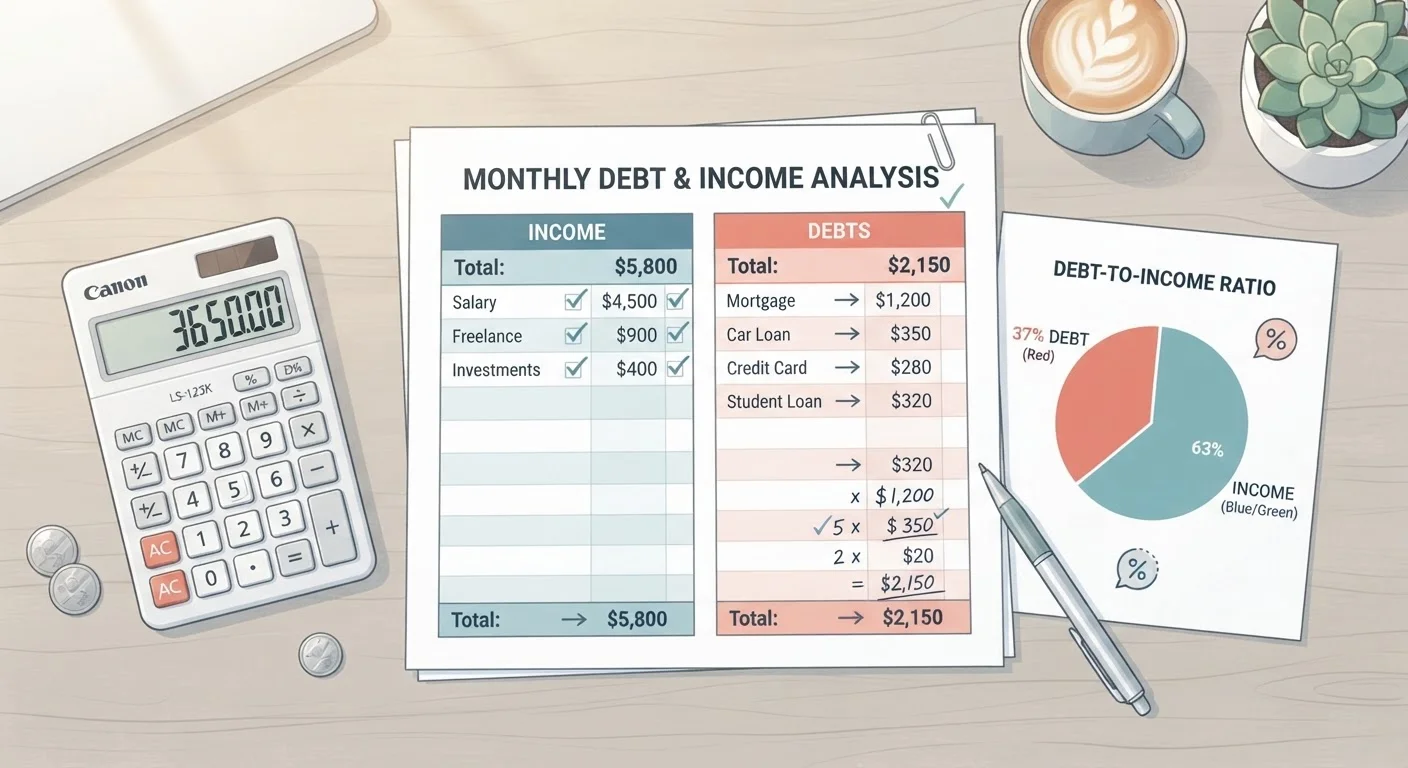
Your debt-to-income ratio (DTI) is the percentage of your gross monthly income that goes toward paying debts. It's calculated by dividing your total monthly debt payments by your gross (pre-tax) monthly income. Lenders use it to gauge whether you can realistically take on more debt without financial strain.
Lenders typically assess two versions: front-end DTI (housing costs only) and back-end DTI (all recurring debt obligations). Mortgage underwriters most often focus on back-end DTI.
How DTI Is Actually Calculated
The math is straightforward. Add up every recurring monthly debt payment you owe - your car loan, student loan, minimum credit card payments, personal loans, and your current mortgage or rent. Then divide that total by your gross monthly income (what you earn before taxes and deductions). Multiply by 100 to get a percentage.
Example: If your monthly debt payments total $1,500 and your gross monthly income is $5,000, your DTI is 30%.
What doesn't go into the calculation matters just as much. Utilities, groceries, health insurance premiums, and streaming subscriptions are not counted - only formal debt obligations with a payment schedule. This is why DTI can look favorable even for people who are genuinely cash-strapped after fixed living expenses.
43%
Maximum DTI for most qualified mortgages
The Consumer Financial Protection Bureau (CFPB) identifies 43% back-end DTI as the general cap for qualified mortgage eligibility under federal guidelines.
36%
DTI threshold widely considered healthy
Financial guidance from multiple consumer credit organizations cites 36% as the benchmark below which borrowers have adequate financial flexibility.
~$1.14T
U.S. credit card debt outstanding
Federal Reserve data indicates total revolving consumer credit in the U.S. routinely exceeds one trillion dollars, contributing meaningfully to household DTI levels.
For mortgage applications specifically, lenders calculate both a front-end ratio (proposed housing payment ÷ income) and a back-end ratio (all debts ÷ income). Most underwriting guidelines focus on the back-end number. See how DTI functions in a mortgage application for a closer look at lender thresholds.
Why It Matters Beyond Getting a Loan
DTI is widely understood as a lending metric, but its value to you personally goes further. A high DTI signals that a large portion of every dollar you earn is already spoken for before you make a single choice about it. That leaves less room for saving, investing, emergencies, or simply enjoying income you worked to earn.
Think of DTI as a measure of financial flexibility. When debt obligations eat 45 cents of every pre-tax dollar, you're running with a short operational runway. One job disruption, one medical bill, one car repair can trigger a cascade because the buffer simply isn't there.
Calculate Your DTI Before You Apply
Run your own DTI calculation before approaching any lender. Knowing your number in advance lets you address weak spots - like paying off a small loan - before a lender sees your application. Even a few points of improvement can shift you from a borderline to a clearly qualified applicant.
This is also why landlords and some employers review debt loads during application processes. Rental applications increasingly include income-to-debt evaluations - not just credit scores. Similarly, understanding housing affordability at the market level requires the same DTI logic applied across entire populations.
DTI also interacts with your credit health. While it doesn't directly calculate into your credit score, the habits that push DTI up - maxing out revolving credit, layering on installment loans - damage your score separately. Both numbers move in the same direction for the same underlying reasons. It's worth reviewing how credit scores are built alongside your DTI picture.
How to Improve Your DTI - and When Carrying Debt Is Rational
There are exactly two ways to improve your DTI: reduce the numerator (debt payments) or increase the denominator (income). Both are valid and often work best in combination.
- Target high-payment debts first. Eliminating a loan entirely removes its monthly payment from your DTI calculation, even if the balance isn't your largest. A $250/month car loan paid off does more for DTI than partially paying down a large credit card.
- Avoid new debt during major application windows. Taking on a new loan or opening a new credit card before a mortgage application raises DTI immediately.
- Boost gross income strategically. A raise, freelance work, or a second income stream raises the denominator and improves DTI without requiring debt payoff.
- Refinance where it makes sense. Extending the term on a loan lowers the monthly payment, which reduces DTI - though it increases total interest paid over time. That trade-off deserves careful thought.
Not all debt is a problem, though. There are specific situations where carrying debt is financially rational - particularly when borrowing at a low rate frees capital for higher-return uses. DTI is a ratio, not a moral judgment. The goal is keeping it at a level that preserves your options, not eliminating debt at any cost.
This article is for general informational purposes only and does not constitute personalized financial or legal advice. Consult a licensed financial professional before making decisions about your specific situation.