

Key Takeaways
- Preventive maintenance replaces or services parts based on wear patterns before failure occurs.
- Manufacturers determine service intervals using engineering data, not arbitrary timelines.
- A single skipped service can trigger a chain of more expensive failures downstream.
- Routine maintenance records can protect your warranty and improve resale value.
- Most preventive services are straightforward; knowing their purpose helps you make informed decisions.
Start here
What Preventive Maintenance Actually Means
Build understanding
The Engineering Case: Why Parts Have Predictable Lifespans
See the value
The Economic Case: Why Waiting Usually Costs More
Get specific
Common Preventive Services and Their Purpose
Take action
How to Put This into Practice
What Preventive Maintenance Actually Means
Preventive maintenance is the practice of servicing or replacing vehicle components on a set schedule - based on time, mileage, or operating cycles - before those components fail. It stands in contrast to reactive maintenance, where you wait for something to break and then fix it.
The concept isn't unique to cars. Airlines, hospitals, and manufacturing plants all rely on preventive maintenance to manage complex equipment predictably. Applying the same logic to a vehicle makes engineering and financial sense for the same reasons: failure rarely happens at a convenient time, and failure is almost always more disruptive than planned service would have been.
Preventive maintenance
Servicing or replacing vehicle parts on a scheduled basis before they fail, rather than waiting for a breakdown.
Service interval
The mileage or time limit set by the manufacturer after which a specific service should be performed.
Interference engine
An engine design where the pistons and valves occupy overlapping paths - meaning a snapped timing belt can cause the two to collide and destroy the engine.
Thermal cycling
The repeated expansion and contraction of materials as an engine heats up and cools down, which gradually fatigues rubber and metal components.
Severe service conditions
Driving patterns - such as frequent towing, extreme temperatures, or heavy stop-and-go traffic - that accelerate component wear and typically require shorter maintenance intervals.
Chemical degradation
The breakdown of fluids like coolant and brake fluid over time due to heat, moisture, and contamination, reducing their ability to protect the vehicle.
See Your Car's Maintenance Schedule, Explained for a detailed walkthrough of how those schedules are structured and what the intervals actually represent.
The Engineering Case: Why Parts Have Predictable Lifespans
Manufacturers determine service intervals through durability testing - running components under controlled stress until they reach the boundary of reliable performance. That data produces the intervals published in your owner's manual. They aren't conservative guesses; they reflect where statistically significant failure rates begin to appear.
Several mechanisms explain why parts wear on predictable timelines:
- Thermal cycling: Components expand and contract with every heat-and-cool cycle. Rubber seals, belts, and hoses fatigue over thousands of these cycles regardless of mileage.
- Chemical degradation: Fluids like coolant, brake fluid, and transmission fluid absorb moisture and contaminants over time, reducing their protective properties even when the car sits unused.
- Abrasive wear: Metal-on-metal contact points - brake pads, clutch friction material - lose material gradually and measurably with use.
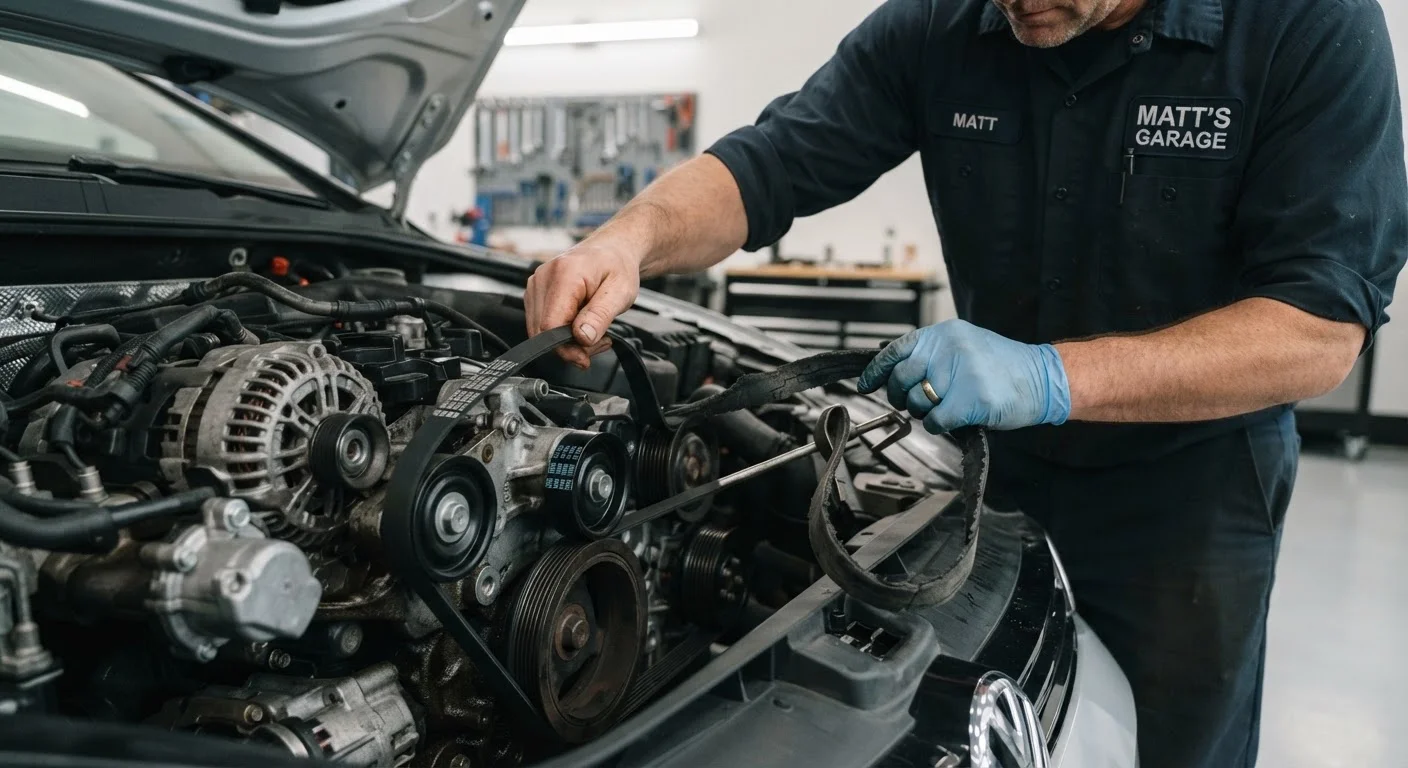
- Fatigue cracking: Rubber belts and timing components develop microscopic cracks under repeated flexion that are invisible to casual inspection until they propagate to failure.
This is why a timing belt that looks fine at 80,000 miles may be engineering-specified for replacement. The surface tells you very little about the internal stress state of the material.
The Economic Case: Why Waiting Usually Costs More
Preventive maintenance has an upfront cost, which makes skipping it feel like a saving. In practice, deferred service tends to produce compounding costs.
Think in Terms of Total Cost
When weighing a scheduled service against its price, compare it to the cost of the failure it's designed to prevent - not just to zero. A coolant flush that costs a fraction of a radiator replacement looks very different when framed that way. This is the calculation that makes preventive maintenance economically rational for most drivers.
Consider a few common failure chains:
- Neglected engine oil breaks down, loses viscosity, and allows metal-on-metal contact - leading to bearing wear that can cost several times what the oil changes would have.
- An ignored coolant flush allows acidic coolant to corrode the water pump, heater core, and radiator - components far more expensive to replace than the coolant itself.
- A skipped brake fluid exchange allows moisture accumulation, which lowers the fluid's boiling point and can contribute to brake fade or caliper corrosion.
Beyond repairs, preventive records also have tangible financial value. A documented service history can support warranty claims, strengthen your position in a dispute with a dealer, and increase resale or trade-in value. See why a maintenance log matters for practical guidance on building that record.
Common Preventive Services and Their Purpose
Understanding what each service actually does helps you evaluate recommendations rather than simply accepting or dismissing them.
| Service | Primary Purpose | Typical Interval (general range) |
|---|---|---|
| Engine oil and filter change | Remove contaminants; restore lubrication film | 5,000-10,000 miles (varies by oil type and engine) |
| Air filter replacement | Maintain clean airflow; protect mass airflow sensor | 15,000-30,000 miles |
| Spark plug replacement | Ensure complete combustion; protect ignition coils | 30,000-100,000 miles (depends on plug type) |
| Timing belt replacement | Prevent catastrophic engine damage from belt failure | 60,000-105,000 miles (check your manual) |
| Coolant flush | Remove acidic degraded coolant; protect metal surfaces | Every 2-5 years or 30,000-50,000 miles |
| Brake fluid exchange | Remove moisture; maintain boiling point and corrosion protection | Every 2-3 years or per manufacturer spec |
Intervals shown are general ranges only. Always verify against your specific vehicle's owner's manual, as they vary significantly by make, model, engine, and driving conditions.
Timing Chain vs. Timing Belt
Some vehicles use a metal timing chain instead of a rubber timing belt. Chains are generally designed to last the life of the engine and don't have a scheduled replacement interval in most cases. Check your owner's manual - or ask a qualified mechanic - to confirm which your vehicle uses, as the service implications are very different.
How to Put This into Practice
The most reliable starting point is your vehicle's owner's manual. It contains the manufacturer's maintenance schedule in full - not the service center's upsell sheet, but the engineering-backed baseline. If your manual is missing, manufacturer websites and reputable automotive databases typically publish this information by vehicle identification number (VIN).
Two practical habits reinforce the logic of preventive care:
- Track mileage and dates against the schedule. A simple log - even a notes app or a paper sheet in the glove compartment - lets you anticipate upcoming services before they become overdue.
- Understand severe service conditions. If you regularly tow, drive in extreme heat or cold, or spend significant time in stop-and-go traffic, your owner's manual likely has a shorter-interval schedule for those conditions. Applying the standard schedule when severe conditions apply is a common source of premature wear.
If you're deciding which tasks to handle yourself versus leaving to a professional, DIY Car Maintenance: What's Reasonable to Tackle Yourself offers an honest breakdown of where that line typically falls.
Preventive maintenance isn't about spending money for its own sake. It's about managing a complex machine in a way that's consistent with how it was engineered - and making deliberate, informed choices about its care rather than reacting to failures after they happen.