

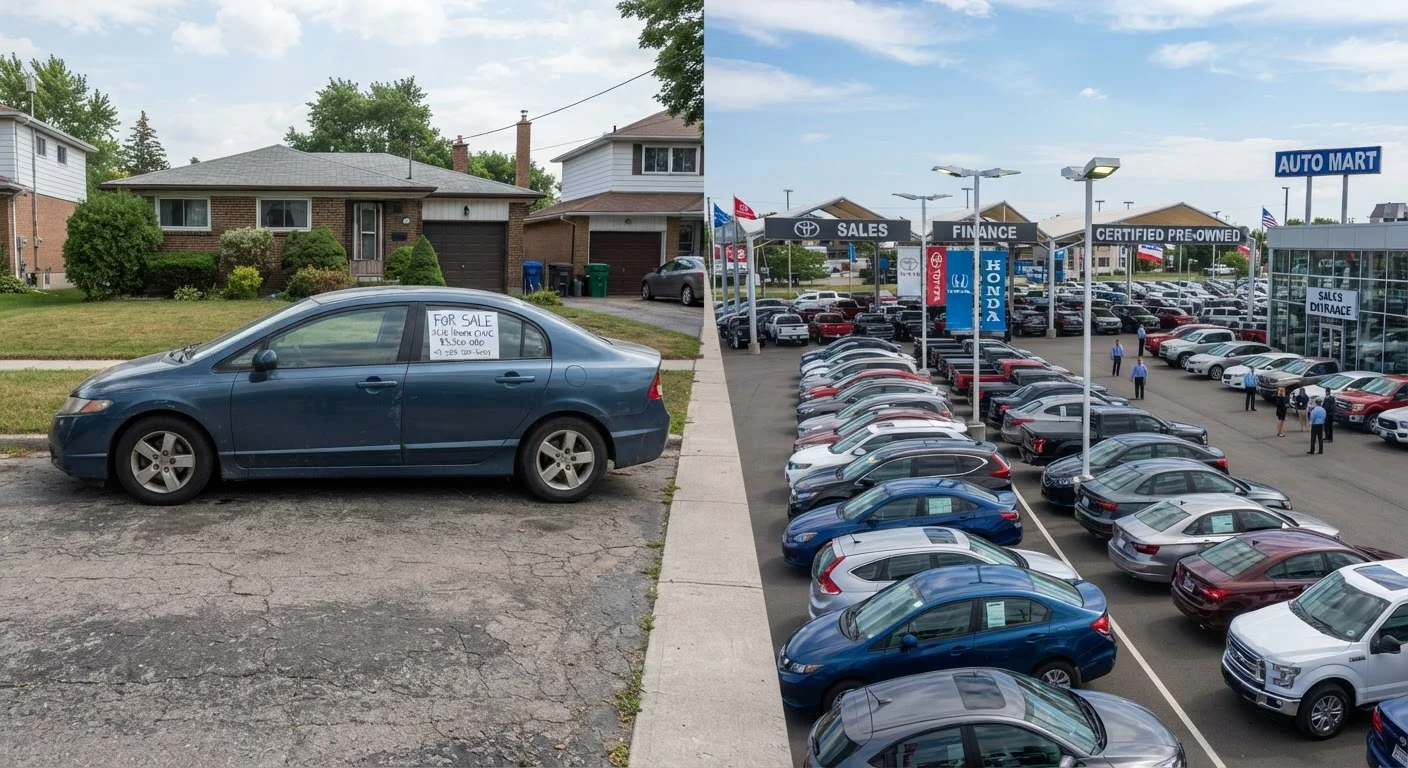
Key Takeaways
- Private sales typically offer lower asking prices, but buyers assume more risk without warranties or recourse.
- Dealerships provide financing, certified inspections, and legal protections that private sellers cannot match.
- A pre-purchase inspection by an independent mechanic is essential in any private sale.
- Title transfer and paperwork are generally simpler at a dealership, but both routes are legally binding.
- Neither option is universally better - the right choice depends on your budget, risk tolerance, and vehicle knowledge.
Option A
Private Sale
The direct, no-frills transaction between two individuals.
Best for: Budget-focused buyers comfortable doing their own research, inspections, and paperwork.
Option B
Dealership Purchase
The structured, full-service buying experience with institutional backing.
Best for: Buyers who want financing options, trade-in convenience, and consumer protections under one roof.
If you want the lowest possible purchase price and are comfortable vetting a vehicle yourself
Private Sale
Private sellers typically price below dealer retail and have no overhead to recover, leaving more room to negotiate. Buyers who know what to look for - or hire a mechanic to inspect - can find genuine value.
If you need financing and don't have a pre-arranged loan
Dealership Purchase
Dealerships offer on-site financing and can often accommodate buyers across a range of credit profiles. Private sellers almost universally require cash or a pre-arranged loan.
If you want a warranty or certified pre-owned assurance
Dealership Purchase
Certified pre-owned programs and limited dealer warranties provide a meaningful safety net. Private sales are almost always 'as-is,' with no obligation to fix problems discovered after purchase.
If you're trading in a current vehicle as part of the deal
Dealership Purchase
Dealers handle trade-ins directly, simplifying the transaction and potentially reducing your taxable purchase price in many states. Private sales require you to sell your current vehicle separately.
If you have strong automotive knowledge and want maximum selection
Private Sale
The private market - through classified listings and peer-to-peer platforms - often offers a broader range of older, specialty, or unusual vehicles that dealerships don't stock.
How Each Buying Route Works
Buying from a private seller means transacting directly with an individual - typically the vehicle's current owner - with no third-party business involved. You find the car through a listing, arrange a viewing, negotiate price, and handle the title transfer yourself. The entire process is informal by design.
Buying through a dealership involves a licensed business that buys, reconditions, and resells vehicles. Dealers must comply with federal and state consumer protection laws, maintain proper licensing, and handle all registration and title paperwork on your behalf. Many also offer financing, extended service contracts, and certified pre-owned programs as part of a packaged experience.
For a broader look at every stage involved, see The Car-Buying Process, Start to Finish.
| Criterion | Private Sale | Dealership Purchase |
|---|---|---|
| Typical price | Often below market retail | At or above market retail |
| Negotiation | Direct with owner | With trained sales staff |
| Financing available | No - must arrange separately | Yes - on-site lenders |
| Warranty | Almost always as-is | Often available; CPO option |
| Consumer protections | Limited; state law varies | FTC Used Car Rule applies |
| Trade-in handling | Not applicable | Handled on-site |
| Title/registration | Buyer and seller handle it | Dealer processes paperwork |
| Vehicle selection | Broader, especially older models | Curated, reconditioned inventory |
Price, Negotiation, and Hidden Costs
Private sellers generally ask less than dealers because they don't carry overhead costs - no sales staff, lot fees, or reconditioning markup. That pricing gap can be meaningful, particularly on older or high-mileage vehicles. Negotiation is often more direct: you're talking to the owner, not a salesperson working within a structured pricing system.
Dealerships, however, bundle services into their pricing that have real value: title and registration processing, financing arrangements, and in many cases, multi-point vehicle inspections. Some states also allow buyers to reduce their taxable purchase price when trading in a vehicle at a dealer - a benefit unavailable in private transactions. Understanding how dealership dynamics affect your final price is covered in detail in Why Buyers Overpay at the Dealership.
~40%
Used vehicles sold privately each year
Industry estimates suggest a significant share of used vehicle transactions in the U.S. occur outside of dealerships, reflecting the scale of the peer-to-peer market.
As-is
Legal status of most private sales
In the majority of U.S. states, private vehicle sales carry no implied warranty of merchantability, placing the burden of due diligence squarely on the buyer.
Varies by state
Trade-in tax credit availability
Many states reduce the sales tax basis by the trade-in value when purchasing through a dealer - a benefit that does not apply to private transactions.
Risk, Recourse, and Vehicle History
The most significant difference between these two routes is what happens when something goes wrong after the sale. Private sales in most U.S. states are completed 'as-is,' meaning the seller has no legal obligation to repair defects - even undisclosed ones, in many cases. Your main protection is due diligence before you sign: a vehicle history report and a pre-purchase inspection from an independent mechanic are not optional in a private sale, they're essential. Use the right questions before a test drive to surface red flags early.
Dealerships are subject to the FTC's Used Car Rule, which requires them to display a Buyers Guide disclosing whether a vehicle is sold as-is or with a warranty. Franchise dealers selling certified pre-owned vehicles must meet manufacturer standards and back those vehicles with a limited warranty. That accountability layer doesn't eliminate risk, but it does give buyers a formal path for recourse.
Always Get a Pre-Purchase Inspection
Regardless of how compelling a private listing appears, paying a licensed mechanic to inspect the vehicle before purchase is one of the most cost-effective steps a buyer can take. An inspection typically costs between $100 and $200 and can reveal mechanical issues that aren't visible during a test drive. Most honest private sellers will accommodate a reasonable inspection request - reluctance to allow one is itself a warning sign.
Financing, Paperwork, and What Comes Next
Financing is where the dealership route holds a structural advantage. Dealers work with multiple lenders and can arrange loans on-site, often within the same visit. If you're financing a private sale, you'll need to secure a loan independently - through a bank or credit union - before you can close the deal. Financing through a dealership vs. a bank or credit union breaks down how those two loan paths compare on terms and incentives.
Title transfer in a private sale falls entirely on the buyer and seller. Requirements vary by state and include submitting a signed title, a bill of sale, odometer disclosure, and applicable fees to your state's DMV. Dealers handle this process for you, which reduces administrative friction but doesn't mean buyers should skip reviewing the documents.
Whichever route you take, your responsibilities as a vehicle owner don't end at purchase. Budget for ongoing upkeep - see the Car Maintenance hub for what to prioritize - and make sure you have appropriate auto insurance in place before you drive the vehicle off the lot or out of the seller's driveway.