

Key Takeaways
- Dealership financing is convenient but may carry a higher interest rate due to dealer markup.
- Banks and credit unions give you a pre-approved offer before you set foot in a showroom.
- Manufacturer-sponsored promotional rates (e.g., 0% APR) are only available through dealerships.
- Getting pre-approved from an outside lender gives you a benchmark to negotiate against.
- Your credit score significantly shapes the offers available through either channel.
Our Verdict
Neither dealership financing nor direct lending is universally superior - the right choice depends on your credit profile, the vehicle you're buying, and what incentives are on the table. For most buyers, applying to a bank or credit union first creates a useful baseline, while keeping manufacturer promotional offers in view as a potential alternative.
| Best for | Recommended |
|---|---|
| Buyers who qualify for a manufacturer promotional rate | Dealership financing |
| Buyers who want rate certainty before negotiating | Bank or credit union pre-approval |
| Members with strong credit history seeking member-focused terms | Credit union |
| Buyers prioritising a one-stop, same-day transaction | Dealership financing |
How Each Financing Path Works
When you finance a vehicle, you're borrowing money to pay the dealer and repaying the lender over time with interest. The two most common routes differ primarily in who originates that loan and when you lock in your rate.
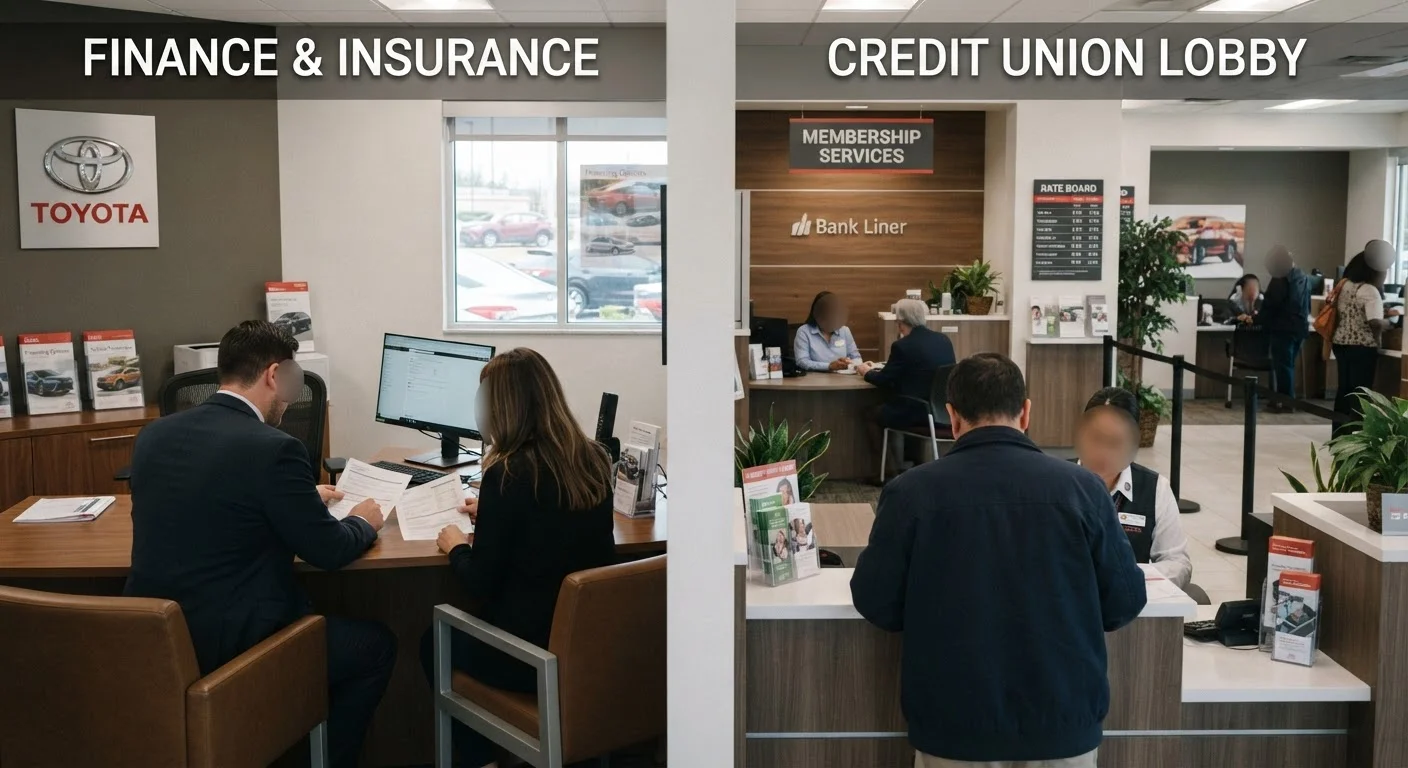
Dealership financing (also called indirect lending) works like this: the dealer submits your credit application to a network of lenders - banks, captive finance arms run by automakers, or both - and presents you with an offer. The dealer often receives a fee for arranging the loan, sometimes by marking up the lender's base rate. This markup is legal and common, though its size varies.
Direct lending means you contact a bank or credit union before visiting the dealership, apply for a loan, and receive a pre-approval with a set interest rate and loan amount. You walk into the showroom essentially as a cash buyer, with financing already arranged.
Understanding how both work is a foundational step in the full car-buying process.
The Case for Dealership Financing
Convenience is the clearest advantage. Applying, getting approved, and signing paperwork all happen in a single visit. For buyers with limited time or those purchasing in a competitive market, that efficiency matters.
More significantly, manufacturer-subsidised rates are only accessible through franchised dealerships. Automakers periodically offer below-market or promotional APRs on specific models to move inventory - offers that no bank or credit union can match because the manufacturer is effectively subsidising the rate. If you qualify, these promotions can represent genuine savings.
The trade-off is transparency. Because the dealer acts as an intermediary, the rate you see may not be the base rate the lender offered. Buyers who don't compare offers elsewhere may not realise they're paying a premium. Dealership finance offices also present add-on products - extended warranties, gap insurance, paint protection - that can complicate your ability to evaluate the total cost of the deal. Our overview of what dealers offer in the finance office explains each product in plain terms.
| Dealership Financing | Bank or Credit Union | |
|---|---|---|
| When rate is set | At the dealership, day of purchase | Before visiting the dealership |
| Access to promotional rates | Yes - manufacturer offers available | No - must qualify through standard underwriting |
| Rate transparency | Dealer markup may apply | Rate is fixed at pre-approval |
| Convenience | High - one-stop process | Requires a separate application step |
| Negotiating leverage | Lower without outside offer | Higher - you have a benchmark rate |
| Vehicle restrictions | Typically none within dealer inventory | May limit by age, mileage, or loan-to-value |
The Case for a Bank or Credit Union
Pre-approval from a bank or credit union puts a concrete number in your hand before negotiations begin. You know your rate, your maximum loan amount, and your likely monthly payment - which helps you evaluate the vehicle price independently of the financing, a discipline that protects buyers from common overpayment traps.
Credit unions, in particular, are member-owned nonprofits and often offer competitive rates compared to commercial banks, especially for members with established relationships or solid credit histories. They may also be more willing to work with buyers whose credit profiles are less straightforward.
The practical limitation of direct lending is logistics. You need to apply and receive approval before finalising a vehicle choice, and some lenders restrict which vehicles qualify (age, mileage, or loan-to-value thresholds can all be factors). Pre-approvals also carry expiration dates - typically 30 to 60 days - so timing matters.
Apply to Multiple Lenders Strategically
When shopping for a pre-approved auto loan, multiple credit inquiries from different lenders within a short window - typically 14 to 45 days depending on the scoring model - are usually treated as a single inquiry for scoring purposes. This means you can compare offers from several banks or credit unions without compounding the impact on your credit score. Check the specifics of your scoring model before applying.
For a plain-language explanation of how APR, loan term, and monthly payments interact, see our guide to auto loan terms decoded.
How to Use Both Options Together
The most informed approach isn't choosing one path and ignoring the other - it's using them in combination. Apply for pre-approval at a bank or credit union before visiting dealerships. That gives you a benchmark rate. When you sit down in the finance office, ask what rate the dealer can offer. If the dealer's rate is lower, take it. If it isn't, use your pre-approval.
This approach also reinforces good negotiating habits. Keeping the vehicle price conversation separate from the financing conversation - rather than negotiating around a monthly payment figure - makes it easier to evaluate what you're actually paying for the car. Our article on why buyers overpay at dealerships covers the dynamics that lead to this confusion in more detail.
Whichever lender you choose, your credit score will be a primary driver of the rate you're offered. Checking your credit report before applying - and addressing any errors - is a practical step that costs nothing and can meaningfully affect your options. This is general financial information; consult a licensed financial adviser for guidance specific to your situation.
This article is for general informational and educational purposes only and does not constitute personalised financial or legal advice. Loan terms, rates, and availability vary by lender and individual circumstances. Consult a qualified financial professional before making financing decisions.