

Key Takeaways
- Fiber transmits data via light through glass strands; cable uses electrical signals over coaxial copper lines.
- Fiber typically offers symmetrical upload and download speeds; cable upload speeds are often much slower.
- Cable internet is far more widely available across the U.S. than fiber infrastructure.
- Network congestion affects cable more noticeably during peak hours than fiber.
- Availability, not preference, is often the deciding factor for most American households.
Option A
Fiber Internet
The newer, technically superior broadband architecture.
Best for: Households that need consistent speeds, low latency, and symmetrical upload and download performance for work, gaming, or multiple simultaneous users.
Option B
Cable Internet
The widely available, proven broadband workhorse.
Best for: Households in areas where fiber hasn't been deployed yet, or those who need reliable high-download speeds at a broadly accessible price point.
If you work from home and rely on video calls or large file uploads
Fiber Internet
Fiber's symmetrical speeds mean your upload bandwidth matches your download, which is critical for smooth video conferencing and cloud-based workflows.
If fiber isn't available in your area
Cable Internet
Cable delivers genuinely fast download speeds and is available to the vast majority of U.S. households, making it a solid choice where fiber simply isn't an option.
If your household has multiple heavy users streaming, gaming, and video-calling simultaneously
Fiber Internet
Fiber's dedicated line architecture handles concurrent demand more consistently than cable's shared-node model during peak usage periods.
If you primarily stream video and browse the web in a smaller household
Cable Internet
For download-heavy, everyday use, a mid-tier cable plan can perform well enough that the absence of fiber won't be noticeable in practice.
How Each Technology Actually Works
Understanding why fiber and cable perform differently starts with the physical medium each uses to carry data.
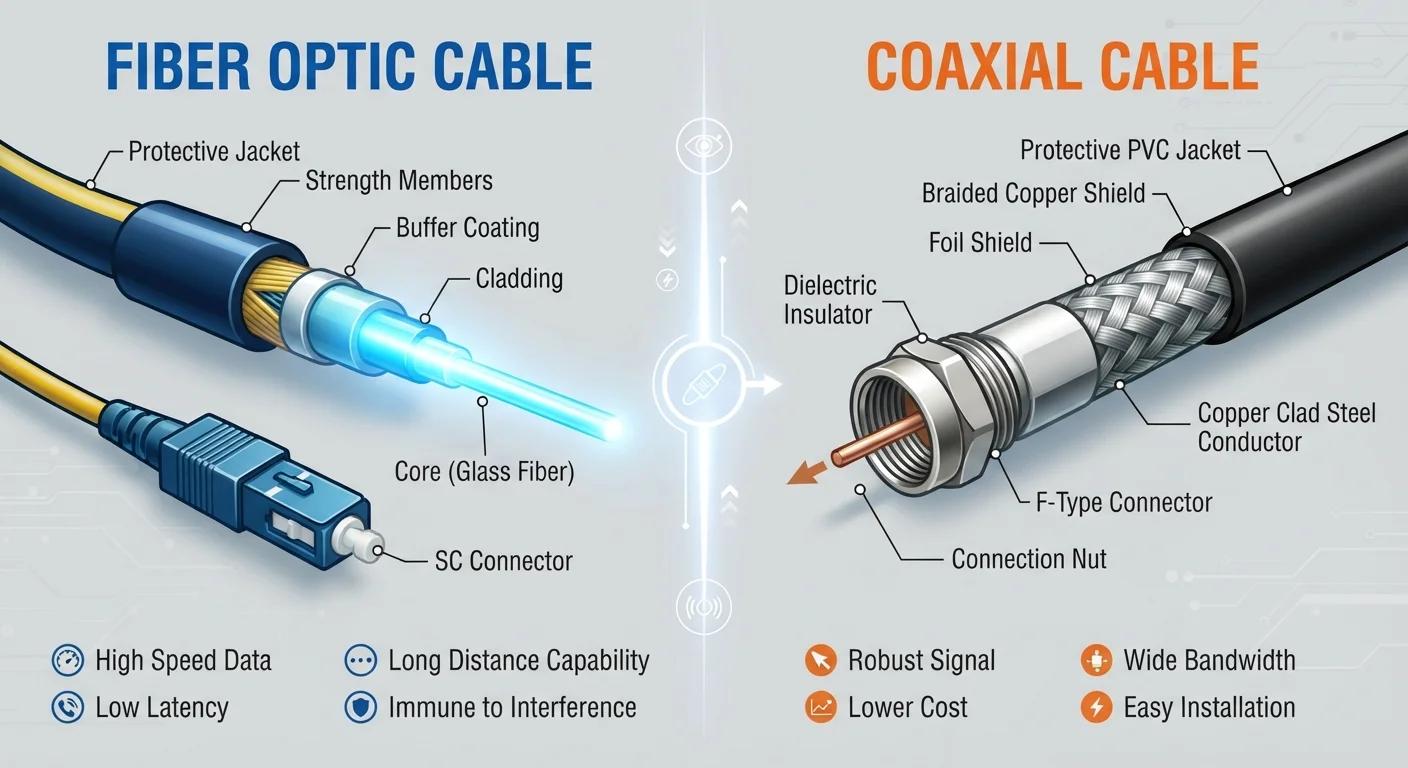
Fiber optic internet transmits data as pulses of light through thin strands of glass or plastic. Because light travels at - well, the speed of light - and is immune to electromagnetic interference, fiber connections are inherently fast and stable. The signal doesn't degrade meaningfully over the distances typical of home broadband runs.
Cable internet uses the same coaxial copper infrastructure originally built for cable television. It carries data as electrical signals, which are more susceptible to interference and signal degradation over distance. Cable networks also use a shared-node architecture: multiple households in a neighborhood share a segment of bandwidth, which can affect performance during peak hours.
This fundamental difference - light versus electricity, dedicated versus shared - explains nearly every performance gap between the two technologies. For a deeper look at how network architecture affects what you actually experience day-to-day, see why your internet feels slow even on a fast plan.
| Criterion | Fiber Internet | Cable Internet |
|---|---|---|
| Transmission medium | Light through glass/plastic strands | Electrical signal over coaxial copper |
| Download speeds | Up to 1-10 Gbps (varies by plan) | Typically 100 Mbps - 1.2 Gbps |
| Upload speeds | Symmetrical (matches download) | Often 10-20% of download speed |
| Latency | Generally lower and more stable | Acceptable; more variable under load |
| Peak-hour congestion | Minimal (dedicated line) | More noticeable (shared nodes) |
| U.S. household availability | Growing; still limited in rural areas | Widely available nationwide |
| Infrastructure age | Newer build-outs | Established; being upgraded (DOCSIS 3.1) |
Speed, Latency, and the Upload Problem
Advertised speeds can be misleading. Both fiber and cable providers market plans in the hundreds of megabits per second (Mbps) or even gigabit range - but those numbers don't tell the whole story.
Download vs. upload symmetry is where fiber and cable diverge most sharply in practice. Fiber connections are typically symmetrical, meaning upload speeds match download speeds. Cable plans, by contrast, are heavily asymmetrical: a plan advertised at 500 Mbps download may offer only 20-50 Mbps upload. For most streaming and browsing, that asymmetry is invisible - but for video calls, cloud backups, live streaming, or remote desktop work, upload speed matters enormously.
Latency - the time it takes a data packet to travel from your device to a server and back, measured in milliseconds - is also generally lower on fiber. Lower latency matters most for real-time applications: online gaming, voice and video calls, and financial transactions. Cable latency is acceptable for most uses but is more variable, especially under load.
~43%
U.S. homes with access to fiber broadband
According to FCC broadband deployment data, fiber availability has grown but still trails cable's near-universal reach across American households.
5-10x
Typical cable upload speed gap vs. download
Cable plans commonly deliver upload speeds that are a fraction of advertised download speeds, a disparity that affects video calls and cloud work significantly.
<10 ms
Typical fiber round-trip latency
Fiber connections frequently achieve single-digit millisecond latency under normal conditions, compared to 15-35 ms commonly seen on cable connections.
Not sure how much speed your household actually needs? Our guide to estimating the right speed tier walks through the real math behind streaming, gaming, and smart home usage.
Reliability and the Congestion Factor
One of the most common complaints about cable internet is that speeds drop in the evening - the so-called "network rush hour." Because cable nodes are shared, heavy simultaneous use by neighbors can slow everyone's connection. Fiber's point-to-point architecture (in its most common form, FTTH) doesn't work this way; your connection isn't shared at the neighborhood level.
That said, cable reliability has improved significantly as providers have upgraded their infrastructure. Modern cable standards - particularly DOCSIS 3.1 - deliver much better performance than older cable hardware. Outages can affect both technologies; neither is immune to infrastructure failures, weather events, or equipment issues at your home.
DOCSIS 3.1 and What It Changes
DOCSIS 3.1 is the latest widely deployed cable modem standard, and it significantly narrows the gap with fiber on download speeds - supporting theoretical maximums above 10 Gbps. However, it does not solve the upload asymmetry problem or eliminate shared-node congestion, which remain structural limitations of the cable architecture. If your cable modem is several years old, it may predate DOCSIS 3.1 and limit the speeds your plan can actually deliver.
For a frank assessment of claims ISPs make about their networks, our breakdown of common home internet myths separates marketing language from technical reality.
Availability: The Factor That Overrides Everything Else
All of the performance advantages of fiber are irrelevant if fiber isn't available where you live. As of recent years, fiber coverage in the United States remains significantly lower than cable. The FCC's broadband mapping data indicates that cable reaches the large majority of U.S. households, while fiber deployment - though expanding - is still concentrated in urban and suburban areas, with large gaps in rural regions.
This means that for many consumers, the fiber-vs.-cable decision isn't a choice at all: cable may be the only wired broadband option available. If you do have both options at your address, the performance case for fiber is strong, particularly if you work from home or have a bandwidth-intensive household.
Before signing any contract, it's worth understanding what you're agreeing to. Promotional pricing, data caps, equipment rental fees, and early termination clauses can significantly affect total cost. Reading the fine print on your broadband contract before you commit can prevent expensive surprises.
If neither fiber nor cable reaches your location, other options exist. Satellite internet has improved substantially but still carries distinct trade-offs worth understanding before committing.