

Key Takeaways
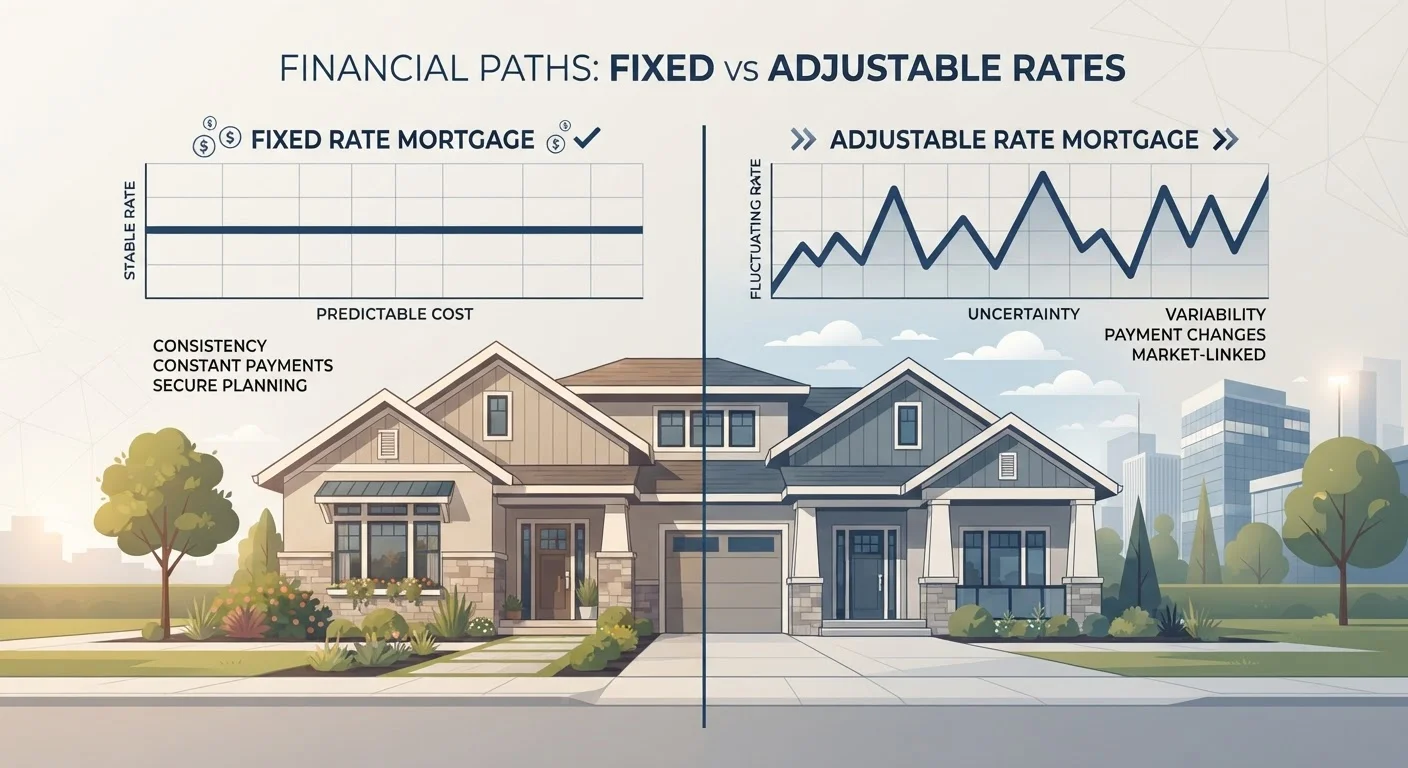
- A fixed-rate mortgage keeps the same interest rate for the entire loan term, making payments predictable.
- An ARM starts with a fixed introductory rate, then adjusts periodically based on a market index.
- ARMs typically offer lower initial rates but carry the risk of payment increases over time.
- Fixed-rate loans are generally better for long-term homeowners; ARMs can suit shorter time horizons.
- Rate caps on ARMs limit how much your rate can change per adjustment and over the life of the loan.
- Your personal financial situation and how long you plan to stay in the home are key factors in choosing.
Option A
Fixed-Rate Mortgage
The predictable, stable long-term choice.
Best for: Buyers who plan to stay in their home long-term and want consistent monthly payments regardless of market conditions.
Option B
Adjustable-Rate Mortgage (ARM)
The flexible, lower-entry-cost alternative.
Best for: Buyers who expect to move or refinance within a few years and want to take advantage of a lower initial interest rate.
If you plan to stay in your home for 10 or more years
Fixed-Rate Mortgage
Long-term stability protects you from rate increases and makes budgeting straightforward over the life of the loan.
If you expect to sell or refinance within 5-7 years
Adjustable-Rate Mortgage (ARM)
You can take advantage of the lower introductory rate and likely sell or refinance before the first adjustment hits.
If your income is fixed or you have limited financial flexibility
Fixed-Rate Mortgage
A consistent payment amount removes the risk of an unexpected rate increase straining your monthly budget.
If you anticipate rising income or a significant financial change
Adjustable-Rate Mortgage (ARM)
A lower initial payment frees up cash flow now, and future income growth may absorb any rate adjustments later.
If market interest rates are currently high and expected to decline
Adjustable-Rate Mortgage (ARM)
An ARM could automatically benefit from falling rates during adjustment periods, potentially reducing your payment without refinancing.
How a Fixed-Rate Mortgage Works
A fixed-rate mortgage locks in one interest rate for the entire duration of the loan - whether that's 10, 15, 20, or 30 years. Every monthly payment of principal and interest stays exactly the same from the first payment to the last.
The rate you receive at closing is determined by your credit profile, loan size, down payment, and prevailing market rates at the time. Once set, it doesn't move - even if the broader interest rate environment rises or falls dramatically. This is the defining feature that gives fixed-rate mortgages their appeal: certainty.
Understanding how this stability fits into your overall financial picture is worth examining. See how fixed costs like a mortgage compare to other monthly obligations in our guide to fixed vs. variable expenses. Fixed-rate loans also tend to be straightforward to compare across lenders, since the rate and term are the primary variables. Common terms are 30 years (lower monthly payment, more total interest paid) and 15 years (higher monthly payment, substantially less total interest paid).
| Criterion | Fixed-Rate Mortgage | Adjustable-Rate Mortgage (ARM) |
|---|---|---|
| Interest Rate | Stays the same for entire loan term | Fixed initially, then adjusts periodically |
| Initial Rate | Typically higher than ARM intro rate | Usually lower during introductory period |
| Monthly Payment Stability | Fully predictable | Can increase or decrease after fixed period |
| Rate Caps | Not applicable | Initial, periodic, and lifetime caps apply |
| Common Terms | 15- or 30-year | 3/1, 5/1, 7/1, 10/1, or similar |
| Best Horizon | Long-term homeownership (10+ years) | Shorter ownership or refinance plans (3-7 years) |
| Risk Profile | Low - no payment surprise | Moderate - rate increases are possible |
How an Adjustable-Rate Mortgage Works
An adjustable-rate mortgage (ARM) begins with a fixed introductory interest rate for a set period - commonly 3, 5, 7, or 10 years - then adjusts periodically based on a financial index, such as the Secured Overnight Financing Rate (SOFR). After the initial period, the rate can move up or down with the market, subject to limits called rate caps.
ARMs are typically described using a notation like 5/1 or 7/6. The first number is the length of the fixed period in years; the second is how often the rate adjusts afterward (1 = annually, 6 = every six months). A 5/1 ARM, for example, holds its initial rate for five years, then adjusts once per year.
Rate caps are a critical protection built into ARMs. They come in three forms: the initial cap (limits the first adjustment), the periodic cap (limits each subsequent adjustment), and the lifetime cap (limits total rate change over the loan's life). A common cap structure is 2/2/5 - meaning the rate can rise no more than 2% at first adjustment, 2% at each later adjustment, and 5% total.
What Happens When an ARM Adjusts
When your ARM exits its introductory period, the lender calculates a new rate by adding a fixed margin (set in your loan documents) to the current index value. For example, if the index is 4.5% and your margin is 2.5%, your new rate would be 7%. The rate caps then limit how far above or below that calculation your actual rate can go. Reviewing your loan's specific index and margin before signing is essential to understanding your exposure.
To understand the broader context in which ARM rates move, see our explainer on how mortgage interest rates affect the housing market.
Comparing the Two Side by Side
Both mortgage structures have legitimate advantages depending on your circumstances. The key variables are how long you plan to own the home, your tolerance for payment variability, and your view of where interest rates may head - though predicting that is inherently uncertain.
~90%
Share of U.S. mortgages that are fixed-rate
According to Freddie Mac research, the vast majority of American homeowners have historically preferred fixed-rate loans for their payment predictability.
5/1
Most common ARM structure in the U.S.
The 5/1 ARM - with a five-year fixed period followed by annual adjustments - is among the most widely issued adjustable-rate products by U.S. lenders.
If you're exploring loan programs beyond just rate structure, our overview of conventional, FHA, VA, and USDA loans covers how eligibility and costs differ across the main program types. And once you've narrowed down your rate preference, reviewing mortgage points, buydowns, and rate locks can help you understand what levers you have before closing.
This article is for general informational purposes only and does not constitute personalized financial or mortgage advice. Consult a licensed mortgage professional or financial adviser before making decisions specific to your situation.