

Key Takeaways
- Bodyweight training is accessible, cost-free, and effective for building functional strength and endurance.
- Gym machines offer guided movement patterns, adjustable resistance, and easier progressive overload.
- Neither approach is universally superior - the right choice depends on your goals, budget, and lifestyle.
- Many people benefit from combining both methods rather than committing to one exclusively.
- Consistency over time matters more than which method you choose.
Our Verdict
Bodyweight training and gym machines are genuinely different tools that serve overlapping but distinct purposes. Bodyweight exercise wins on accessibility, flexibility, and functional movement; gym machines win on structured resistance progression and targeted muscle loading. For most everyday Americans, the most sustainable approach is the one that fits realistically into their life - and for many, that means a mix of both.
| Best for | Recommended |
|---|---|
| Those with limited time, budget, or gym access | Bodyweight Training |
| Those focused on building measurable muscle mass or rehabilitating an injury | Gym Machines |
| Beginners wanting a structured, lower-risk introduction to resistance training | Gym Machines |
| Those prioritising functional strength, travel-friendly workouts, or flexibility in scheduling | Bodyweight Training |
What Each Approach Actually Involves
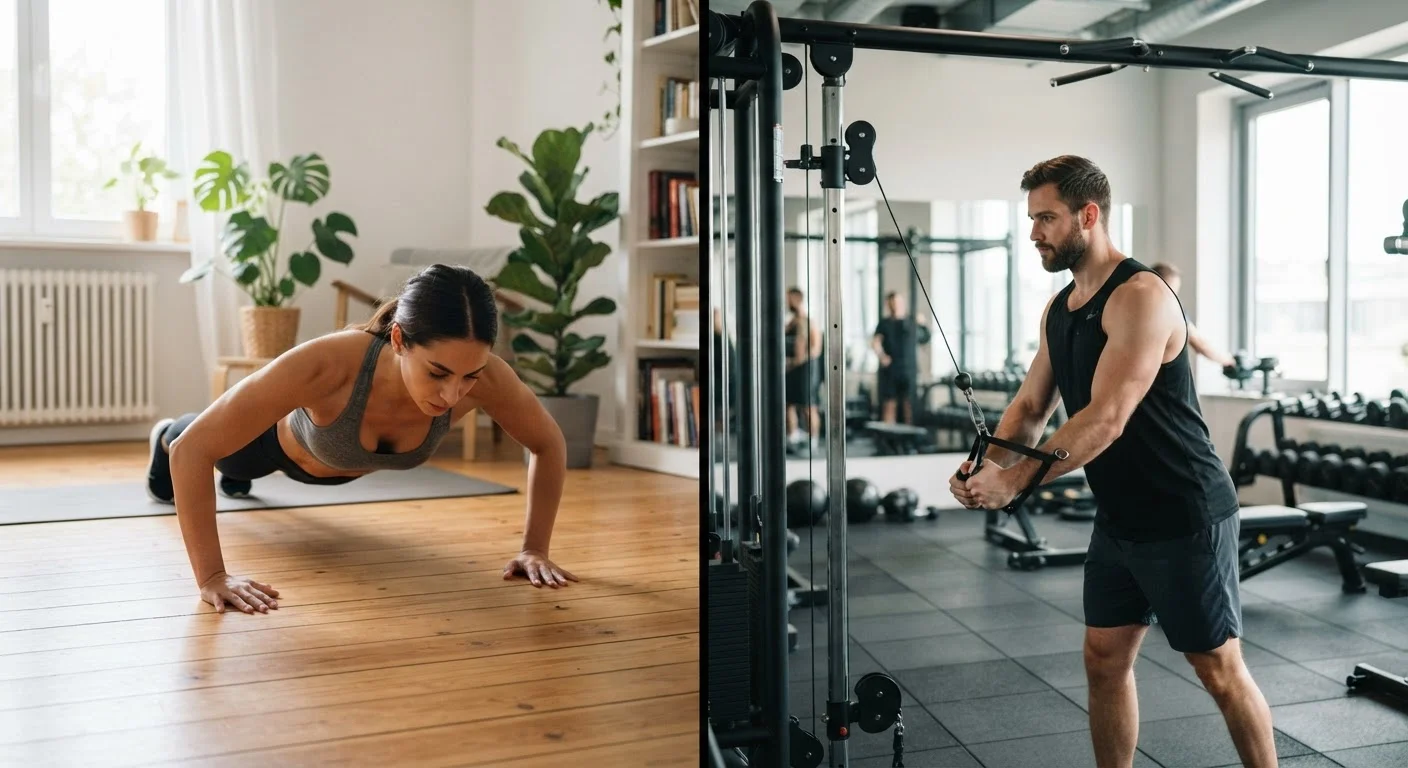
Bodyweight training uses your own body as resistance - push-ups, squats, lunges, planks, pull-ups, and their many progressions. No equipment is required beyond, occasionally, a pull-up bar or a set of rings. Gym machines, by contrast, use cables, weight stacks, or guided lever systems to isolate or load specific muscle groups through a controlled range of motion.
Both qualify as resistance training, which research consistently links to improved muscle strength, bone density, metabolic health, and functional capacity. If you're not familiar with the terminology around resistance work, our plain-English fitness glossary is a useful starting point before diving into comparisons.
The core distinction isn't quality - it's how resistance is applied and how easily it can be adjusted as you get stronger.
Where Bodyweight Training Has the Edge
The most obvious advantage is accessibility. You can train at home, in a park, or in a hotel room - no membership, no commute, no cost. That removes several of the most common barriers to consistency.
Bodyweight exercises also tend to require coordinated effort from multiple muscle groups simultaneously, which can support what researchers call functional strength - the kind that translates to everyday movement. A single-leg squat, for instance, challenges balance, hip stability, and leg strength in combination.
Progression is still possible, though it looks different: you advance by changing leverage (elevating feet for push-ups), reducing stability (single-limb variations), slowing tempo, or adding explosive movement (jump squats). The learning curve for these progressions is real, and without guidance it can be hard to know when or how to advance safely.
You Don't Have to Choose Just One
Many people get the most out of a hybrid approach - using bodyweight exercises on days they can't get to a gym and machines when they can. Even a few machine sessions per week can fill the progressive overload gap that pure bodyweight training sometimes leaves. Flexibility in your method tends to support long-term consistency.
For people juggling desk-heavy schedules, bodyweight moves can also be slotted into breaks throughout the day. See practical ideas in our article on fitting movement into a desk job.
Where Gym Machines Have the Edge
Machines excel at progressive overload - the practice of incrementally increasing resistance over time. Adding five pounds to a weight stack is straightforward in a way that finding an equivalent bodyweight progression often isn't. This makes machines particularly valuable for those focused on building muscle mass systematically.
Guided movement paths also reduce the coordination demand, which can be an advantage for beginners learning a movement pattern, or for individuals recovering from injury who need to load a muscle while limiting stress on surrounding joints. A leg press, for example, allows significant quad loading without the balance and hip-mobility demands of a barbell squat.
Machines can also help address muscle imbalances - using a unilateral cable row to ensure each side of the back works equally, for instance.
| Bodyweight Training | Gym Machines | |
|---|---|---|
| Cost | Minimal to none | Membership or equipment fees |
| Accessibility | Anywhere, anytime | Requires gym access or home equipment |
| Progressive overload | Possible but requires creativity | Straightforward via weight increments |
| Beginner-friendliness | Moderate - progressions can be unclear | Higher - guided range of motion |
| Functional movement | High - multi-joint coordination | Lower - movement often isolated |
| Joint accommodation | Variable by exercise | Often easier to modify around injuries |
| Muscle isolation | Difficult to isolate specifically | Strong - targeted loading possible |
That said, gym access carries real costs: membership fees, travel time, and fixed operating hours. For some people, these friction points quietly erode consistency over time.
Thinking About Your Specific Situation
The evidence doesn't clearly crown one approach as superior for general fitness. Both can build strength, support cardiovascular health, and improve body composition when practised consistently. What differs is the context in which each works best.
Age is one factor worth naming. As the body changes across decades, resistance training remains valuable - but the way you approach it may shift. If you're over 40, our article on strength training after 40 covers relevant considerations in detail.
Joint health is another consideration. Those with existing knee, shoulder, or back concerns may find that certain bodyweight positions aggravate symptoms, while some machines allow around-the-issue loading. Equally, poor machine setup can cause problems too. Before starting any new program - bodyweight or machine-based - a self-assessment of your readiness is worthwhile. Our guide on starting a new workout program walks through that process.
Ultimately, the most effective workout is one you'll return to regularly. Once you've weighed the trade-offs, building a routine you'll actually keep is the practical next step.
This article is for general informational purposes only and does not constitute medical or professional fitness advice. Consult a qualified healthcare provider or certified fitness professional before beginning a new exercise program, particularly if you have existing health conditions or injuries.