

Key Takeaways
- Compound interest grows on both your original balance and previously accumulated interest.
- Compounding frequency (daily vs. monthly vs. annually) meaningfully changes the outcome.
- On savings accounts, compounding builds wealth passively over time.
- On credit card and loan balances, compounding accelerates how fast debt grows.
- Starting early is the single most important factor in benefiting from compounding.
- Understanding which side of compounding you are on is essential to smart financial decisions.
Compound Interest
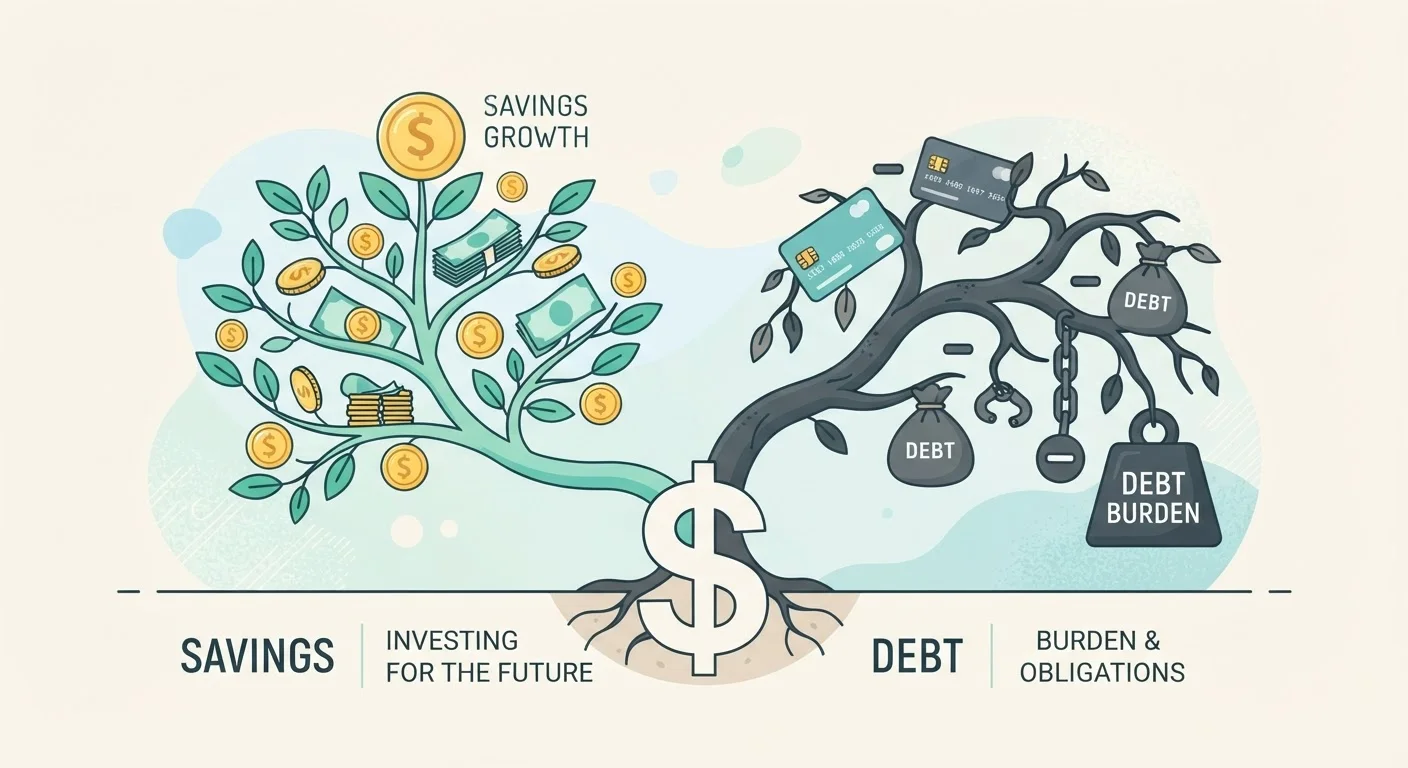
Compound interest is interest calculated on both the original amount (the principal) and any interest already earned or owed. Unlike simple interest - which applies only to the original sum - compound interest causes balances to grow at an accelerating rate over time. This makes it a powerful tool for building savings, and an equally powerful force for inflating debt.
The compounding frequency - daily, monthly, or annually - matters significantly. More frequent compounding produces faster growth. Lenders and savings institutions are required by U.S. law to disclose the Annual Percentage Yield (APY), which reflects the true annual return after compounding.
The Basic Math - Explained Simply
Start with $1,000 in a savings account earning 5% annual interest. In year one, you earn $50 - straightforward. But in year two, you don't earn 5% of $1,000 again. You earn 5% of $1,050. That's $52.50. By year three, you're earning interest on $1,102.50. The base keeps growing because earned interest is folded back in.
Over 30 years - with no additional deposits - that $1,000 grows to roughly $4,322 at 5% annual compounding. With simple interest, it would be $2,500. The difference: $1,822 earned by doing nothing except letting time work.
The formula behind this is: A = P(1 + r/n)^(nt), where P is the principal, r is the annual interest rate, n is the number of compounding periods per year, and t is time in years. You don't need to memorize it - but it's worth knowing that each variable matters. Especially n: daily compounding produces more growth than annual compounding at the same stated rate.
$4,322
Value of $1,000 after 30 years at 5% compounded annually
Compared to $2,500 under simple interest - a difference of $1,822 generated entirely by reinvested earnings.
3.3 years
Time for debt to double at 22% APR (Rule of 72)
Using the Rule of 72, a credit card balance at 22% interest doubles in just over three years if unpaid - a common rate on U.S. consumer credit cards.
Daily
How often most credit card interest compounds
Most major U.S. credit card issuers compound interest daily, making unpaid balances grow faster than many borrowers realize.
When Compounding Works Against You
The same math that patiently builds a savings balance will just as patiently balloon a debt balance - and it moves faster on the debt side because credit cards typically compound daily and carry interest rates well above what any savings account pays.
Consider a $3,000 credit card balance at 22% APR. If you make no payments, that balance doesn't just add $660 in year one and stop - it compounds. By the end of year two, you'd owe closer to $4,460. By year five, assuming no payments, the balance would exceed $8,800 according to straightforward compound interest math. The card issuer isn't doing anything unusual; that's just the math compounding daily at a high rate.
Even modest monthly payments can be outpaced if the rate is high enough. This is why minimum payment schedules on high-rate cards can leave borrowers paying for years while barely reducing the principal.
Pay More Than the Minimum When You Can
On high-rate credit card debt, even an extra $25-$50 per month beyond the minimum payment can meaningfully shorten the repayment timeline and reduce total interest paid. The goal is to reduce the principal faster than compounding can inflate it. Check your card's payoff calculator or ask your issuer for an amortization breakdown.
For a deeper look at how to prioritize when you have both savings and debt obligations, see our guide on emergency funds vs. paying down debt.
Time Is the Key Variable
Compound interest rewards patience on the savings side and punishes delay on the debt side. Two savers putting away identical amounts - but starting a decade apart - can end up with vastly different results. The earlier saver's contributions have more time to compound, and the gap widens with every passing year.
The widely cited Rule of 72 makes this intuitive: divide 72 by your interest rate to estimate how many years it takes a balance to double. At 6%, a savings balance doubles in 12 years. At 22% (a common credit card rate), a debt balance doubles in roughly 3.3 years - a timeline that catches many borrowers off guard.
“Compound interest is the eighth wonder of the world. He who understands it, earns it; he who doesn't, pays it.”
— Attributed to Albert Einstein, Quote widely used in financial education contexts; original attribution is disputed but the principle is broadly accepted by financial educators
This is why financial educators consistently emphasize starting early. Even small, regular contributions to a savings or retirement account outperform larger contributions made later, because the early money has more compounding cycles to work through. See savings habits that compound over time for practical starting points.
Reading Your Account Disclosures
When evaluating a savings account, the number to focus on is the APY (Annual Percentage Yield) - not the stated interest rate. APY already accounts for compounding frequency, making it a true apples-to-apples comparison across accounts. A higher APY means more money in your pocket, regardless of how the institution structures its compounding schedule.
On the debt side, look for the APR (Annual Percentage Rate) and how frequently interest compounds. Credit card agreements are required to disclose both. Federal regulations also require lenders to present a summary of key terms, including the APR, in a standardized format called the Schumer Box - named after the federal legislation that mandated it.
Understanding these disclosures helps you evaluate different savings account types and compare loan costs honestly. This article provides general financial education - for guidance specific to your situation, consult a licensed financial adviser or credit counselor.
This article is for general informational purposes only and does not constitute personalized financial, tax, or investment advice. Please consult a qualified financial professional for advice suited to your individual circumstances.