

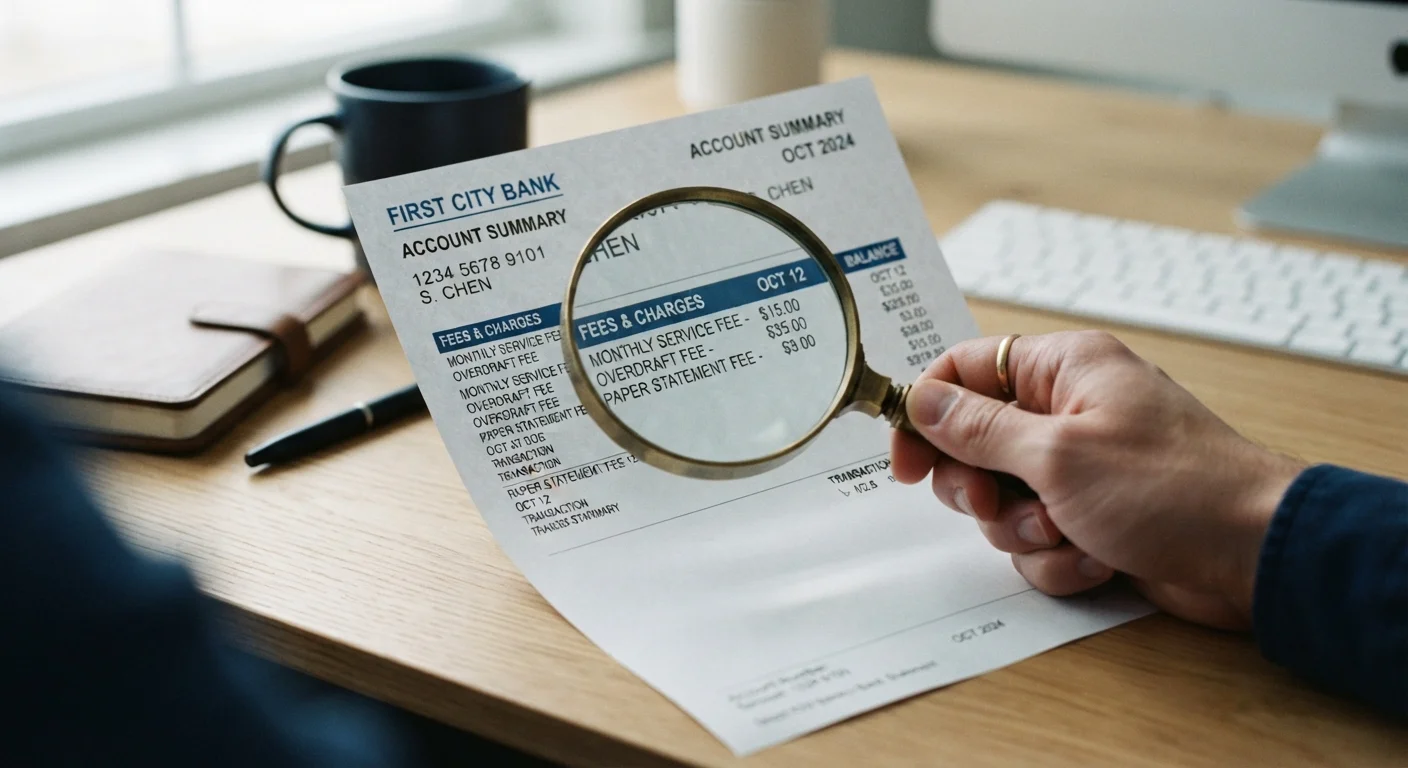
Key Takeaways
- Monthly maintenance fees are common but often waivable by meeting simple account conditions.
- Overdraft fees can stack multiple times in a single day, making them one of the costliest banking charges.
- Out-of-network ATM withdrawals typically trigger fees from two separate sources simultaneously.
- Dormant account and paper statement fees are easy to avoid once you know they exist.
- Reading your account's fee schedule - usually available online - is the single most useful starting point.
Why Bank Fees Are Easy to Miss
Most people assume their bank account is free. And technically, many accounts are - until they aren't. Bank fees tend to be small enough to scroll past on a statement but significant enough to add up over a year. A $12 monthly maintenance fee alone costs $144 annually. Stack in a couple of overdrafts or out-of-network ATM withdrawals and you could easily lose $300 or more without making a single impulsive purchase.
The good news is that most of these fees are avoidable once you know what triggers them. Your bank is required to disclose all fees - they're listed in the account agreement and usually on the bank's website under a fee schedule. If you've never looked at yours, that's the most useful thing you can do after reading this. This article is general financial education, not personalized advice for your specific account or situation.
Below are the most common fees that quietly chip away at account balances - and what to watch for with each one. If you want to see where fees fit into your broader spending picture, the full spending breakdown guide is a solid companion read.
Monthly Maintenance Fee
This is the flat charge many banks apply just for holding an account - typically ranging from $5 to $25 per month depending on the account type and institution. The trigger is usually simple: your balance dropped below a minimum threshold, you didn't set up direct deposit, or you didn't use the account enough times in a billing cycle.
Most of these fees are waivable. Check your account agreement for the exact conditions - common waiver options include maintaining a minimum daily balance (often $1,500 or more), having a qualifying direct deposit, or linking multiple accounts at the same institution.
Monthly maintenance fees are often waivable - the conditions are spelled out in your account agreement.
Overdraft Fee
Overdraft fees are charged when a transaction is approved despite insufficient funds. Historically, these ran $25-$35 per transaction, and banks could charge them multiple times in a single day. Regulatory pressure has pushed some major banks to reduce or eliminate overdraft fees, but many institutions still charge them.
Watch for two things: whether your bank allows overdraft at all (you may have opted in without realizing it), and whether it offers overdraft protection linking to a savings account - which typically carries a smaller transfer fee instead.
Overdraft fees can stack multiple times a day - check whether you've opted into overdraft coverage.
Out-of-Network ATM Fee
Using an ATM outside your bank's network typically triggers two separate fees: one from the ATM operator (usually $2-$5) and one from your own bank for using a non-network machine. That's potentially $8 or more for a single withdrawal - before you've spent a dollar of the cash.
The fix is straightforward: know where your bank's in-network ATMs are located, or choose an account that reimburses ATM fees. Many online banks offer nationwide ATM reimbursement as a differentiator.
Out-of-network ATM withdrawals often trigger fees from two sources simultaneously.
Paper Statement Fee
Some banks charge $1-$3 per month if you receive paper statements by mail instead of opting into e-statements. It's a small fee on its own, but it's one of the easiest to eliminate - simply log in and switch your statement delivery preference to electronic.
This fee also serves as a reminder that many banks use default settings that favor the bank's interests. It's worth reviewing your notification and delivery preferences periodically to make sure you're not paying for something you didn't consciously choose.
Switching to e-statements typically eliminates this fee in under five minutes.
Dormant or Inactive Account Fee
If an account goes unused for an extended period - often 12 months or more with no transactions - some banks begin charging an inactivity fee. This is particularly common with accounts people open for a specific purpose and then forget about.
The practical fix: make at least one small transaction on any account you want to keep open, and periodically review whether you actually need multiple accounts. Unused accounts can also create complications if their balances eventually get turned over to state unclaimed property programs.
A single small transaction can reset the inactivity clock and prevent dormancy fees.
Wire Transfer and Returned Item Fee
Domestic wire transfers often cost $15-$30 to send and sometimes carry a receiving fee too. Returned item fees (charged when a check or electronic payment bounces due to insufficient funds) typically run $25-$35 - and both you and the payee may face charges.
For large transfers, it's worth comparing wire fees against alternatives like ACH transfers, which are usually free but slower. For checks and payments, confirming your balance before scheduling is the simplest protection against returned item fees.
ACH transfers are usually free - wire transfers are faster but carry a cost worth checking first.
What to Do With This Information
The pattern across nearly all bank fees is the same: they're disclosed upfront, triggered by specific behaviors, and - in most cases - either avoidable or negotiable. Many banks will waive a fee once, especially for long-standing customers with no history of issues. It's worth a phone call.
If your current account's fee structure doesn't work for your habits, that's useful information too. Credit unions and online banks often carry lower or no maintenance fees, though they come with their own trade-offs in branch access or product availability. Comparing accounts is worth the effort, but go beyond the headline and read the actual fee schedule before switching.
Start With Your Fee Schedule
Every bank is required to publish a complete list of its fees. Search your bank's website for 'fee schedule' or 'account disclosures' - it's usually a PDF. Read through it once and note which fees apply to your account type. Many people discover fees they didn't know existed simply by looking at this document.
Autopay is a related area worth watching: automatic payments save time but can trigger overdrafts if your balance dips unexpectedly. The risks of autopay article covers what to check before turning it on. And if you want to surface all the small recurring charges - not just bank fees - the household spending audit is worth your time.
This article is for general informational purposes only and does not constitute personalized financial advice. Consult a qualified financial professional for guidance specific to your situation.