

Key Takeaways
- Zero-based budgeting assigns every dollar of income a specific job before the month begins.
- The envelope method uses physical or digital cash limits to control spending by category.
- Zero-based budgeting suits people who want detailed control; the envelope method works better for tactile, habitual spenders.
- Both methods require knowing your monthly income and tracking spending - the difference is in execution.
- Neither method is universally better; the right choice depends on your habits and financial goals.
Our Verdict
Zero-based budgeting offers granular control and adapts well to variable or complex finances, but demands consistent attention each month. The envelope method is simpler to stick with day-to-day and works especially well for managing discretionary spending categories. For many people, the best system is the one they'll actually maintain.
| Best for | Recommended |
|---|---|
| Those who want detailed visibility into every dollar | Zero-Based Budgeting |
| People who overspend in specific categories like groceries or dining | Envelope Method |
| Households with variable income or irregular expenses | Zero-Based Budgeting |
| Beginners who prefer a simple, low-maintenance system | Envelope Method |
How Zero-Based Budgeting Works
Zero-based budgeting (ZBB) starts with a simple rule: income minus expenses equals zero. Every dollar of take-home pay gets assigned to a category - rent, groceries, savings, debt payments, entertainment - until nothing is left unallocated. The goal isn't to spend everything; it's to plan everything so no dollar floats without a purpose.
At the start of each month, you list your expected income, then build your spending plan from scratch. If your expenses don't add up to your income, you adjust - either by reassigning what's left to savings or debt payoff, or by trimming a category that's over-allocated. The plan is rebuilt each month, which makes it especially useful when income or expenses vary.
The trade-off is time. ZBB requires a monthly planning session and ideally some weekly check-ins to stay on track. If you skip the maintenance, the system loses its teeth. For new budgeters, understanding the core vocabulary - like the difference between net pay and gross pay - makes this setup much easier.
Start With One Month of Data
Before committing to either system, look at two or three recent bank statements to see where your money actually goes. Most people find a few surprising categories. That real spending data makes it much easier to set realistic category amounts - whether you're building a zero-based plan or filling envelopes.
How the Envelope Method Works
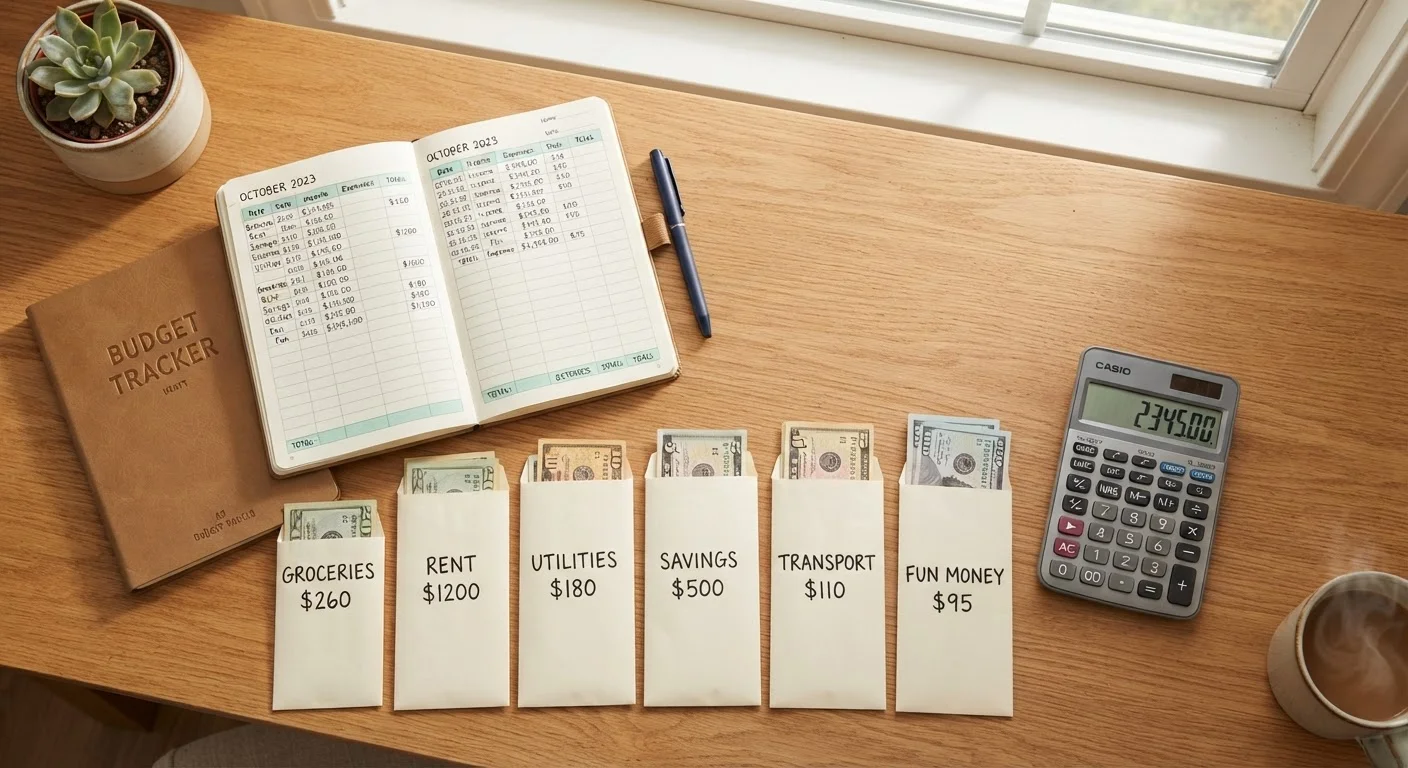
The envelope method is a cash-based system. You divide your income into spending categories and put the designated cash into a labeled envelope for each one - groceries, gas, dining out, personal spending. When the envelope is empty, spending in that category stops until the next pay period. No envelope, no purchase.
Traditionally this meant literal paper envelopes and physical cash. Today, digital versions exist through apps that replicate the same logic without requiring you to visit an ATM. The underlying principle is identical: visible, finite limits per category create a natural spending boundary that's hard to ignore.
The method works particularly well for people who struggle with specific spending categories rather than their overall budget. It's concrete, low-tech, and doesn't require rebuilding a plan every month - once you set your envelope amounts, you mostly just spend and stop when the money runs out. That simplicity is both its strength and its limitation.
| Zero-Based Budgeting | Envelope Method | |
|---|---|---|
| Core principle | Every dollar assigned a job | Cash limits per spending category |
| Time commitment | Monthly rebuild + weekly check-ins | Set once, minimal upkeep |
| Flexibility | High - reallocate freely mid-month | Low - moving cash undermines the system |
| Best for variable income | Yes - rebuilt each pay period | Harder to adapt mid-cycle |
| Tracking method | Spreadsheet or budgeting app | Cash envelopes or digital app |
| Learning curve | Moderate | Low |
| Works for all spending? | Yes - covers every category | Best for discretionary categories |
Key Differences That Actually Matter
The biggest practical difference is flexibility vs. friction. Zero-based budgeting lets you move money between categories during the month - if you underspend on groceries, you can redirect that surplus to savings or an upcoming expense. The envelope method is more rigid: moving money between envelopes is allowed in theory, but it undermines the system's purpose.
Tracking also differs. ZBB typically requires a spreadsheet or budgeting app and active monitoring of transactions. The envelope method tracks itself - when the cash is gone, you know. For couples managing shared finances, this distinction can matter a lot. See how shared budgeting dynamics play out when two people have different spending habits.
Neither approach is inherently strict or lenient. A zero-based budget can be built with generous allowances; an envelope system can be set with very tight limits. The structure is the tool - how tightly it's applied depends on you. If you're unsure how much structure you actually want, the case for and against strict budgeting lays out that trade-off directly.
Choosing the Method That Fits Your Life
Start by being honest about two things: how much time you're willing to spend managing money each month, and where your spending tends to break down. If your whole budget feels chaotic, zero-based budgeting gives you the map. If one or two categories keep blowing up - restaurants, Amazon, whatever - the envelope method applies targeted friction exactly where you need it.
It's also worth noting that these methods aren't mutually exclusive. Some people use a zero-based framework for their overall plan and apply envelope-style limits to the two or three categories where they tend to overspend. That hybrid approach captures the planning rigor of ZBB and the behavioral nudge of physical limits.
If you haven't made a budget before, a practical starting point for your first household budget walks through the foundational steps before you commit to any particular system. And if doubt or past failures are holding you back, common budgeting myths worth examining addresses some of the misconceptions that stop people before they begin.
This article is for general informational purposes only and does not constitute personalized financial advice. Consider consulting a qualified financial professional for guidance specific to your situation.