

Key Takeaways
- The 50/30/20 rule splits after-tax income into needs, wants, and savings or debt repayment.
- It's a guideline, not a strict rule - the percentages can and should be adjusted for your situation.
- Knowing the difference between a need and a want is often the hardest part of applying it.
- High-cost-of-living areas or low incomes may make the 50% needs target difficult to hit.
- The 20% savings bucket can cover emergency funds, retirement contributions, or paying down debt.
The 50/30/20 Rule
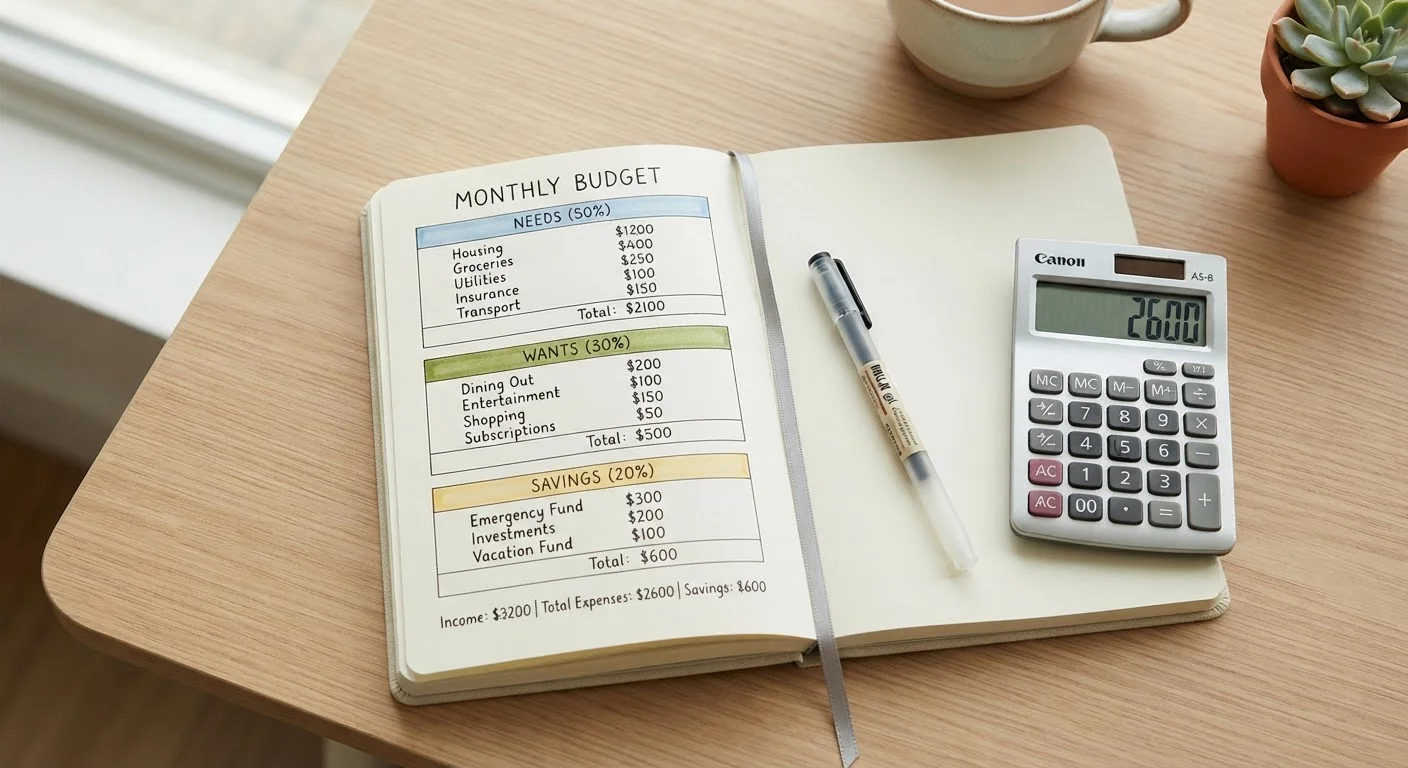
The 50/30/20 rule is a budgeting framework that divides your after-tax income into three categories: 50% for needs, 30% for wants, and 20% for savings or debt repayment. It's designed to give people a simple, flexible starting point for managing money without tracking every dollar. The idea is that a reasonable budget doesn't have to be complicated to be effective.
The framework is commonly credited to Senator Elizabeth Warren and her daughter Amelia Warren Tyagi, who outlined the concept in their 2005 book 'All Your Worth.' It uses after-tax (net) income, not gross income, as the baseline.
How the Three Buckets Work
The 50/30/20 rule starts with one number: your monthly after-tax income. From there, it assigns a percentage to each of three categories.
- 50% - Needs: Essential expenses you can't reasonably cut - rent or mortgage, utilities, groceries, health insurance, minimum loan payments, and basic transportation. These are non-negotiable costs of living.
- 30% - Wants: Discretionary spending that improves your life but isn't strictly required. Streaming subscriptions, restaurants, travel, hobbies, and clothing beyond basics all land here.
- 20% - Savings and debt repayment: Money directed toward your financial future - emergency fund, retirement accounts, investments, or paying down debt beyond the minimums.
The math is intentionally simple. If your take-home pay is $4,000 a month, that's $2,000 for needs, $1,200 for wants, and $800 for savings or debt. You're not tracking every latte - you're making sure each bucket roughly fills to the right level.
For a deeper look at separating needs from wants in practice, see how to draw that line in your budget.
Where the Rule Works Well - and Where It Struggles
The 50/30/20 framework is popular because it's low-friction. It doesn't demand a spreadsheet of every transaction; it just requires a rough accounting of where your money goes. For people who find detailed budgeting exhausting, that simplicity is genuinely useful.
But the framework assumes a few things that don't hold for everyone:
- It assumes your needs are manageable. In cities like New York, San Francisco, or Boston, rent alone can consume well over 50% of a moderate income. The rule doesn't solve that problem - it just highlights it.
- It assumes a stable income. When your income varies month to month, fixed percentages are harder to apply consistently. The framework is a starting point, not a law, and adapting it matters more than following it precisely.
- It treats all savings equally. A 20% savings rate means very different things depending on whether you're building a starter emergency fund or maxing a Roth IRA. The bucket is a beginning, not a complete savings strategy.
Use Round Numbers to Start
Don't wait until you have perfect data to try the 50/30/20 rule. Estimate your monthly spending in each bucket using last month's bank and credit card statements. Even a rough first pass is more useful than no budget at all. You can refine the numbers over two or three months as patterns become clearer.
Despite its limits, the rule gives households a useful diagnostic: if your needs are consistently consuming 65% of take-home pay, that's a signal to examine fixed costs - not a reason to skip saving entirely.
Applying the 20% Savings Bucket Effectively
The 20% bucket is often where people feel the most uncertainty. Here's a practical sequence that aligns with widely accepted personal finance principles:
- Build a basic emergency fund first. Most financial educators suggest three to six months of essential expenses. If you're starting from zero, prioritizing this provides a buffer before anything else. See how much emergency fund is typically enough for context.
- Capture any employer 401(k) match. If your employer matches retirement contributions, not contributing enough to get the full match is generally considered leaving compensation on the table.
- Pay down high-interest debt. Beyond minimum payments - which sit in the needs bucket - accelerating repayment on high-rate debt is often a better return than many savings vehicles.
The specific order depends on your circumstances, interest rates, and goals. This article provides general information, not personalized financial advice - a licensed financial adviser can help you sequence priorities for your situation.
57%
Americans living paycheck to paycheck
A 2023 LendingClub report found that roughly 57% of Americans described themselves as living paycheck to paycheck, underscoring why a clear savings allocation matters.
3-6 months
Recommended emergency fund coverage
Most mainstream personal finance educators, including the Consumer Financial Protection Bureau, suggest keeping three to six months of essential expenses in an accessible savings account.
~36%
Americans with no retirement savings
Federal Reserve survey data has consistently found that a significant share of U.S. adults have little to no retirement savings, highlighting the importance of the 20% savings commitment.
If you're budgeting alongside a partner, the allocation conversation can get complicated quickly. Budgeting as a couple walks through how to handle differing financial habits and shared goals.
Is the 50/30/20 Rule Right for You?
No single budgeting framework fits every household. The 50/30/20 rule works best as an orientation tool - a way to quickly check whether your spending is broadly balanced - rather than as a precise prescription.
If your needs genuinely require more than half your income, that's information worth having, even if it can't be fixed overnight. If you're finding the want category is quietly expanding while savings stagnates, the framework makes that visible without requiring a line-item audit.
For people who want more structure, or who find percentage-based thinking too loose, see the case for and against a strict monthly budget. For those ready to turn this framework into an actual plan, setting up a monthly budget you'll actually stick to is a practical next step.
The 50/30/20 rule doesn't guarantee financial health - no framework does. But as a starting point for thinking about money with more intention, it remains one of the more sensible and accessible tools available to everyday Americans.
This article is for general informational purposes only and does not constitute personalized financial, tax, or investment advice. Consult a qualified financial professional for guidance specific to your situation.